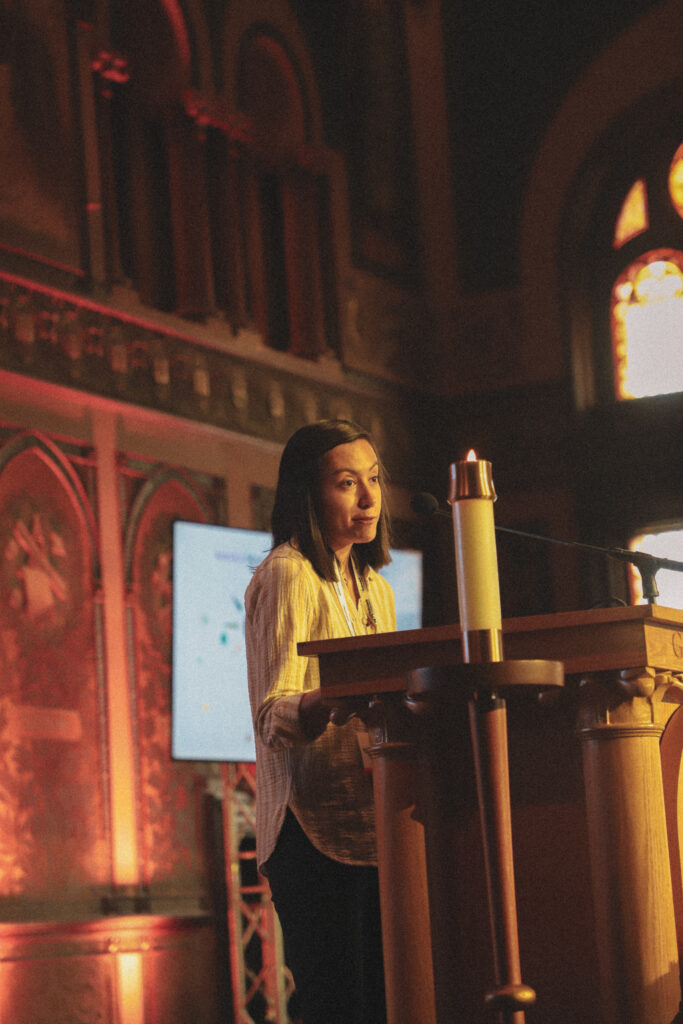
Delivering the final reflection at the closing prayer service of this year’s Outreach conference, again hosted by Georgetown University, Valentina Marquez described how the ministry provides “sources of hope” for its diverse, international community. “You give me hope,” said Marquez, a lay preacher who studied at the University of Notre Dame. “You are all my great cloud of witnesses.”
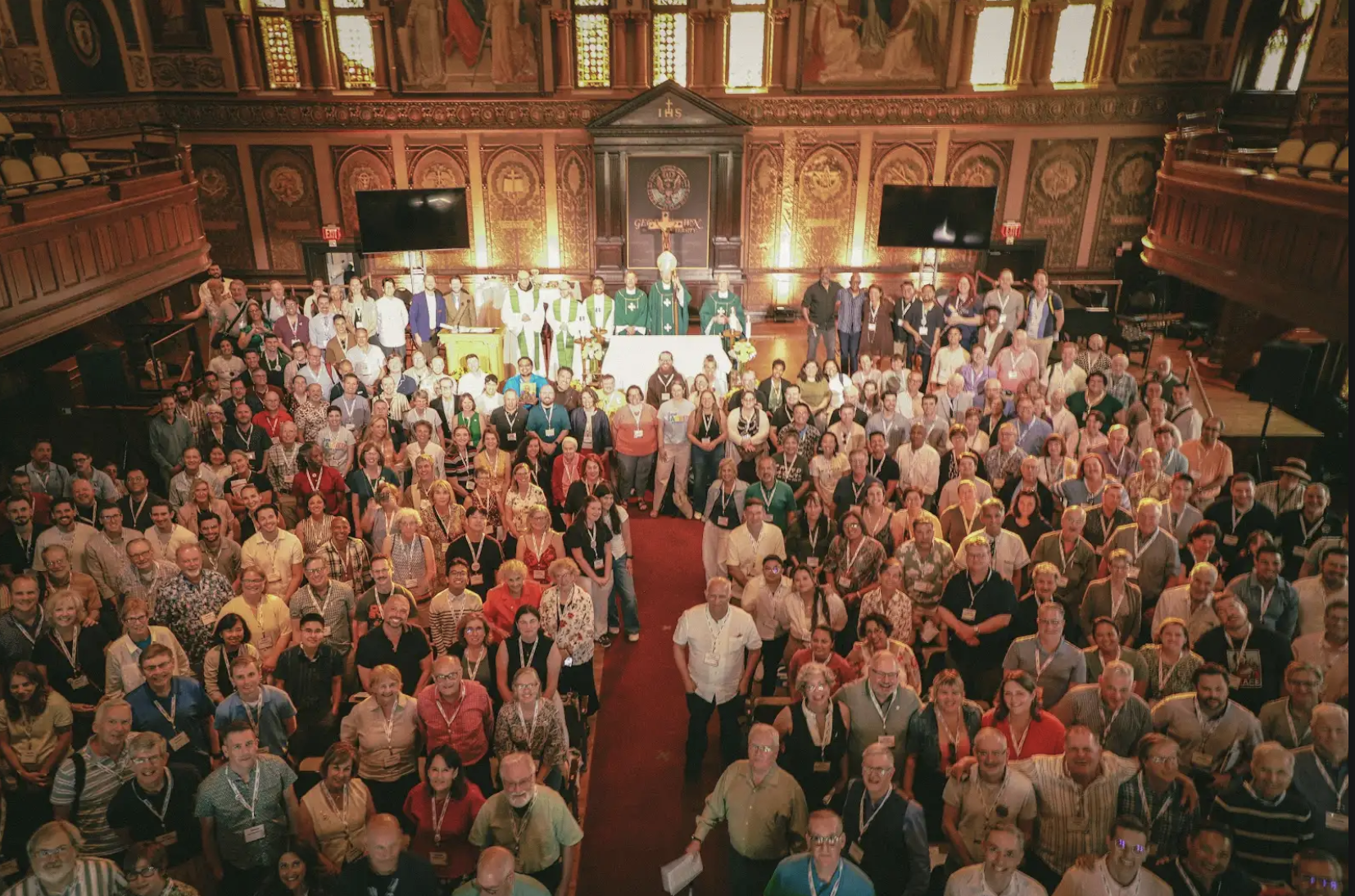
This June, Outreach welcomed more than 450 people from across the United States and numerous far-flung locales—including Italy, Brazil, Slovakia and Lithuania—to its fourth in-person conference since 2022. Distance was no barrier for the LGBTQ faithful and their allies, gathering together for the first time in two years. One participant traveled from Vilnius to Istanbul and then to Los Angeles before making his way to Washington, D.C. And nearly two-thirds of attendees joined the Outreach conference for the first time as the ministry celebrated its largest assembly yet.
“I’m actually a bit astonished at how quickly [the conference] has expanded,” said James Martin, S.J., the founder of Outreach and editor-at-large at America Media. “My sense is that there was a real need for this kind of national and international gathering. LGBTQ Catholics, their families and families, those who minister to them, seemed hungry for it.”
“My sense is that there was a real need for this kind of national and international gathering. LGBTQ Catholics, their families and families, those who minister to them, seemed hungry for it.”
Conor Reidy, a former mission and ministry director who joined Outreach as its top executive this January, said he was “stunned by the feeling of community” present at the gathering. Reidy described his twin goals to foster a network of LGBTQ Catholic peers and to build community with the parents of LGBTQ children.
“We intentionally tried to build the 2026 conference to include more time for networking through shared prayer, social hours, meal times, and specialty events for specific groups, like young adults and parents,” he explained. “These events were received exceedingly well, and we think that speaks to what so many sought in attending the conference: opportunities to build community, stand with one another in solidarity, worship together and see Christ in each other.”
In his homily at an evening Mass for conference attendees on June 20, Cardinal Robert W. McElroy, the archbishop of Washington, reflected on the mercy of God for all people and provided concrete reasons for hope among LGBTQ Catholics today. Citing recent comments from Pope Leo that Christian unity “should not revolve around sexual matters” and a mentioning a Vatican report, issued in May, that encouraged the church to engage with the “lived experience” of individual persons, the cardinal focused on a pastoral approach that encounters the faithful where they are.
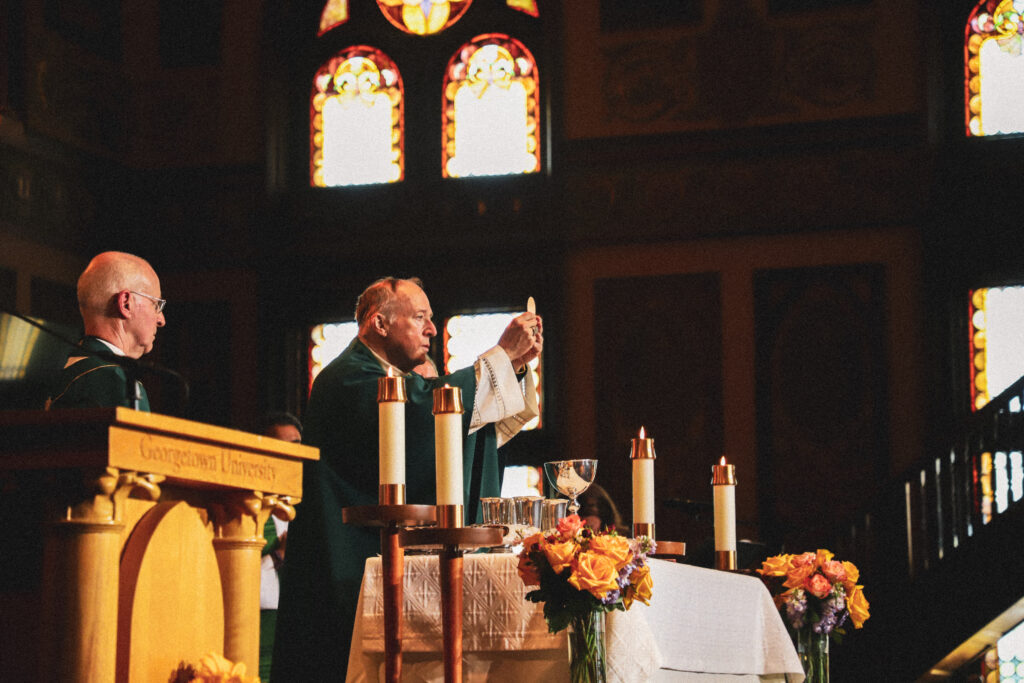
“Pastoral practice is not the understanding of how to apply an already formed and often reified set of principles to concrete situations,” said McElroy, who became the second cardinal (after former Washington archbishop Wilton D. Gregory) to address an Outreach gathering. “It proceeds from the conviction that the concrete situations in which people find themselves are constitutive dimensions of how doctrine should be formed in the light of the kerygma.”
The presence of Cardinal McElroy at an LGBTQ Catholic conference and his explicit welcome to members of that community represents a sea change for the Archdiocese of Washington over the past several decades. In 1989, Cardinal James Hickey asked the Roman Curia to pressure the religious superiors of Sister Jeannine Gramick, the co-founder of New Ways Ministry, to stop her “harmful” and scandalous ministry to LGBTQ Catholics in the archdiocese. Five years earlier, the cardinal had ordered Gramick and Robert Nugent, S.D.S., to cease their work with LGBTQ Catholics—a directive they largely ignored. In 1987, Hickey barred Dignity from celebrating Mass for LGBTQ Catholics at Georgetown.
At the on-campus Mass this past Saturday, as Cardinal McElroy acknowledged a church “which has so frequently wounded the LGBT community through judgmentalism and exclusion,” Sister Gramick sat in the second row.
“[Pastoral practice] proceeds from the conviction that the concrete situations in which people find themselves are constitutive dimensions of how doctrine should be formed in the light of the kerygma.”
“Too often, both in magisterial statements and on the popular level, sexual sins have been condemned with an ardor that effectively places them in the eyes of many believers as the core moral obligation of Christians,” said McElroy. “This is utterly false to the Gospel of Jesus Christ.”
Jack Consolie, the assistant director of Outreach, explained the theme of the conference, “Walking Side-by-Side.” Drawing inspiration from a “big tent” vision of the church, Pope Leo’s call towards “unity within diversity” and the biblical story of the disciples on the road to Emmaus, the theme reveals how LGBTQ Catholics must journey together. Consolie also noted that Outreach seeks to extend its work beyond its articles or website into the public square to create a more welcoming church. “As an LGBTQ Catholic, this year’s gathering was a major inspiration of hope and peace, as it provides a glimpse of what full inclusion in the Catholic Church could look like,” he said. “I really felt that Jesus was made known to us this weekend as he made himself known to the disciples.”
As in past years, conference panels centered on discussions of Scripture, theology, prayer, chastity, parish ministry and the lived experiences of transgender Catholics and LGBTQ Catholic women. “One of the most innovative things we did this year was to have three consecutive panels for how to introduce LGBTQ ministry in a parish setting,” said Father Martin. “That is one of the questions we get asked the most.”
At a standing-room only panel on queer theology, Ish Ruiz, a professor at a Christian seminary in Berkeley, Calif., urged LGBTQ Catholics to take up space in their church and highlighted the importance of LGBTQ people in Catholic scholarship. “Queer theology imagines a world where we are free to be in love,” he said.
A similarly well-attended panel on the Bible, featuring Boston College professor Jaime L. Waters and public theologian Brandan Robertson, also encouraged LGBTQ Catholics to embrace Scripture and reclaim God’s Word as inclusive. Robertson suggested that LGBTQ people read Scripture from their personal experience, providing attendees “the implicit permission to see yourselves in the Bible.” Donna Beech, the Catholic mother of a transgender daughter, offered an example of Christian hope as she described the journey towards understanding her child. Responding to a question about navigating pushback to transgender ministry, Beech cited Outreach as a source of strength and reason to believe.
“Outreach has enabled me to hold onto my Catholicism, for sure,” she said.
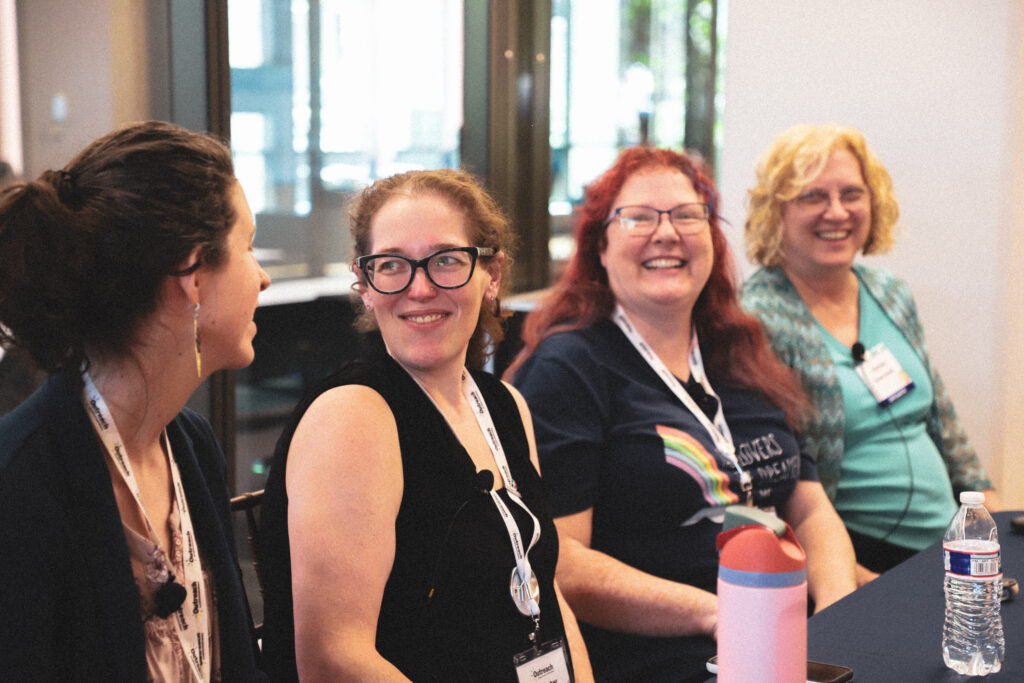
A panel on LGBTQ women, which featured married couple Kirsti Reeve and Terry Gonda, abounded with stories of persistence in the faith despite challenges or rejections from others. Reeve, who said she was raised by agnostic parents and rebelled at age 11 by becoming a fundamentalist evangelical, encountered a “crisis of faith” in her 20s before finding a parish community and eventually converting to Catholicism. Her wife, Terry, said that she feels the support of Christ in her marriage has helped her navigate tension and find “grace under fire.” And Meli Barber, the president of DignityUSA, described how a life of faith remains essential. “Living out being Catholic has always been really important to me,” said Barber.
That panel also included my favorite line of the conference: “Kirsti and Terry met through the Indigo Girls mailing list in 1994.”
“Outreach,” [Fr. Keenan] explained, “is focused primarily on recognizing the other, understanding that we are all vulnerable and therefore related to one another.”
James F. Keenan, S.J., a noted moral theologian and professor at Boston College, introduced “vulnerability as a key word for Catholic ethicists” during his keynote Sunday morning. His address expanded on an appreciation of Outreach he penned in 2023.
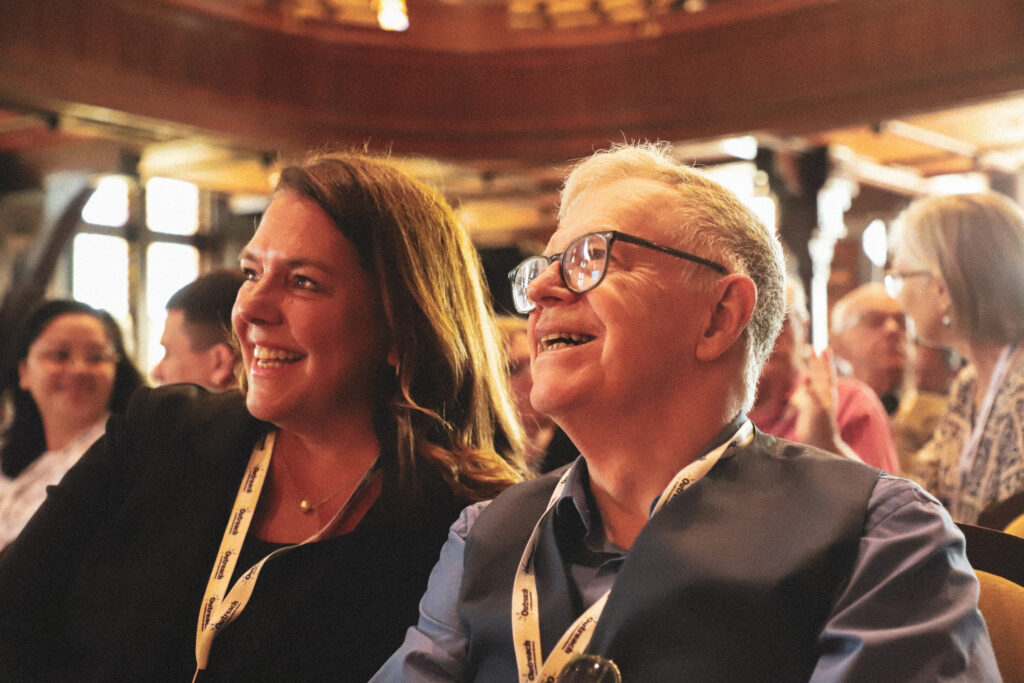
“The beginning of the moral life is first being vulnerably disposed to the other,” said Father Keenan, who described vulnerability as “less about being wounded and more about being responsive” to others’ needs. Outreach, he explained, is focused primarily on recognizing the other, understanding that we are all vulnerable and therefore related to one another. Such recognition provides a moral model not just for LGBTQ Catholics but for all people.
In her keynote, centered on the universal call to service and generosity, Kerry Robinson, the president and C.E.O. of Catholic Charities, lauded Outreach as an example of “moral heroism” that sets a positive example for the church at large. Robinson, too, challenged attendees to be people of hope. “I find the Outreach community, and your participation in this weekend, deeply inspiring,” she said. “Thank you for being a reason for my hope, and the hope of so many.”