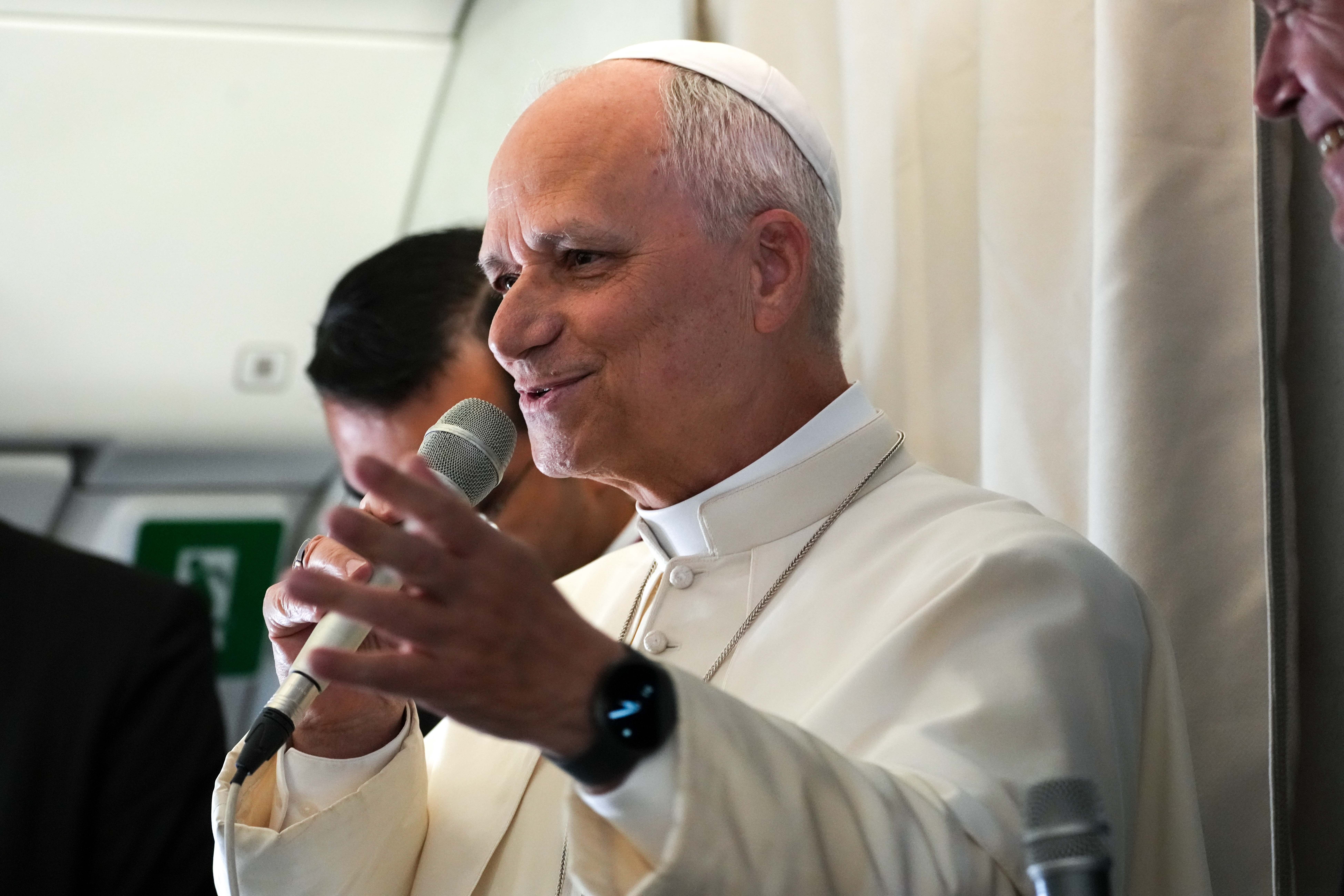
Aboard a flight en route to Rome from Equatorial Guinea, where Pope Leo XIV concluded his historic 11-day journey around Africa on April 23, the pontiff addressed the blessing of same-sex couples with an appeal to Christian unity and a clear illustration of his pastoral priorities.
Responding to a question about Cardinal Reinhard Marx, the archbishop of Munich and Freising, who has allowed his priests to “formalize” same-sex blessings, Leo said that “the unity or division of the church should not revolve around sexual matters.” He also noted that questions of sexual morality are not the sole nor paramount ethical concerns for the church.
“We tend to think that when the church is talking about morality, that the only issue of morality is sexual,” said the pope during the in-flight press conference. “And in reality, I believe there are much greater, more important issues, such as justice, equality, freedom of men and women, freedom of religion, that would all take priority before that particular issue.”
Some commentators have lasered-focused on the pope’s statements about Cardinal Marx, noting that the Holy See “has made it clear that we do not agree with the formalized blessing of same-sex couples.” The key term here is “formalized.” The pope then clarified that the church is specifically opposed to acts that go steps beyond what Francis established during his papacy. Leo’s remarks do not serve to distance himself from pastoral ministry to LGBTQ people nor from “Fiducia supplicans,” the Francis-era Vatican declaration that, for the first time, allowed priests to bless “same-sex couples” under certain conditions. Rather, the pope expresses a desire to preserve “Fiducia” without wandering, ministerially speaking, from its provisions. The Vatican opposes pastoral innovations that go further than the text of “Fiducia,” not the text itself.
Pope Leo acknowledges the dignity of LGBTQ people by refusing to reduce them to an ethical case study or a moral problem to be addressed.
Leo’s remarks are in line with a vision of the church that seeks not to exclude or ostracize its LGBTQ members, but aims to unify all believers regardless of their relationship status or sexual orientation. Rather than resorting to a blanket statement on the moral situation of same-sex couples, Leo identifies LGBTQ people as part of the same church as everyone else, and seeks to dissuade Catholics from placing improper stress on magisterial teaching regarding sex. The priority, for the pope, is the dignity of persons, not theological arguments over sexual concerns. In this sense, he acknowledges the dignity of LGBTQ people by refusing to reduce them to an ethical case study or a moral problem to be addressed.
Leo’s comments, while brief and measured, reveal his moral focus and highlight his pastoral continuity with Pope Francis, who made similar remarks at the start of his pontificate. Speaking in 2013 with Antonio Spadaro, S.J., then the editor in chief of La Civiltà Cattolica, the Jesuit pope noted that not all doctrinal teachings are equal, and he urged Catholics to avoid undue emphasis on a handful of hot-button moral issues.
“We cannot insist only on issues related to abortion, gay marriage and the use of contraceptive methods,” said Francis. “The church’s pastoral ministry cannot be obsessed with the transmission of a disjointed multitude of doctrines to be imposed insistently.”
Rather than resorting to a blanket statement on the moral situation of same-sex couples, Leo identifies LGBTQ people as part of the same church as everyone else
Pope Francis’s remarks were met with controversy from some Catholics who aimed to stress the primacy of those moral topics. Francis’ comments “sent shock waves” through the church and quickly altered its “tone” without changing its doctrine, The New York Times reported. Like Francis, Pope Leo has resisted making incessant proclamations on “culture war” talking points or sexual topics bound to elicit division. In an article in America in 2023 Cardinal Robert W. McElroy, then bishop of San Diego before his appointment to Washington, D.C., elaborated on Francis’ earlier comments, about avoiding an “obsession” with sexual morality. The cardinal explained that all sexual sins were not necessarily considered mortal offenses until the 17th century. “Does the tradition that all sexual sins are objectively mortal make sense within the universe of Catholic moral teaching?” the cardinal asked. His answer was no.
Akin to his predecessor, who made appeals to nonviolence, inclusivity and mercy the focal points of his papacy, Leo (and Cardinal McElroy, for that matter) does not mean that matters of sexual morality are unimportant, but that they have less importance than foundational issues of human dignity and justice, especially in a world convulsed by war.
Over the past several weeks, the pope has devoted much energy to condemning an international capitulation to war and cautioning Catholics to prevent “the spiral of violence,” presenting a moral vision more aligned with the late Brazilian archbishop Dom Hélder Câmara than the bellicose Christian nationalism of Secretary of Defense Pete Hegseth. In uncommonly direct terms, Leo has said that God “rejects” prayers for war and that Christ’s sacrifice on the cross ultimately defeats “the imperialist occupation of the world.” On April 16, the pope’s official X account posted: “Woe to those who manipulate religion and the very name of God for their own military, economic, and political gain, dragging that which is sacred into darkness and filth.”
Catholics could expect further appeals to a “big tent” vision for the church, a model where Catholics are joined by their common identity in Christ.
It is also notable that Leo was asked to comment on same-sex blessings as he returned from Africa, where homosexuality is criminalized in many countries, some of which impose the death penalty for same-sex relations. In 2023, Pope Francis called for the worldwide decriminalization of homosexuality, labeling such laws as unjust, but many African nations continue to impose harsh sentences on LGBTQ people. Following the release in December 2023 of “Fiducia,” bishops belonging to the Symposium of Episcopal Conferences of Africa and Madagascar (SECAM) stated they would not bless “homosexual couples,” citing the risk of scandal. “We, the African bishops,” reads a statement issued in January 2024 by SECAM, “do not consider it appropriate for Africa to bless homosexual unions or same-sex couples, because, in our context, this would cause confusion and would be in direct contradiction to the cultural ethos of African communities.” In his recent remarks, Pope Leo did not address the opposition of many African prelates to LGBTQ civil rights.
What does all this mean for the future of LGBTQ Catholics and, specifically, same-sex couples in the global church? That is yet unclear, as Leo has infrequently addressed these questions directly and publicly. But if his stated focus on church unity and his obvious references to Francis can serve as a guide, Catholics could expect further appeals to a “big tent” vision for the church, a model where Catholics are joined by their common identity in Christ instead of divided by differences in their relationships or opinions on sexual morality.