The Outreach Guide to the Bible and Homosexuality
Encountering God in the Bible is one of the most fulfilling parts of the Christian life. Learning how God loved and led the people of Israel in the Old Testament helps us to understand “salvation history.”
Meeting Jesus in the Gospels, and experiencing his love, mercy and compassion, is often at the heart of a person’s faith. And reading the Letters of St. Paul, and others in the early church, encourages, consoles and inspires.
The Bible is the treasured friend of billions of believers.
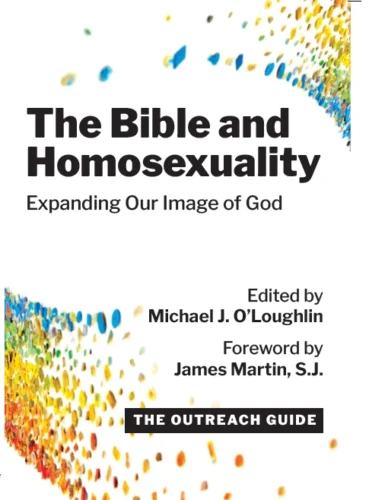
Now Available as a Book!
But for many LGBTQ Christians, the Bible can feel like the enemy. In the Book of Leviticus homosexuality is called an “abomination” (18:22; 20:13). And although Jesus never explicitly condemns homosexuality, though he could have (he is hard on divorce, for example), St. Paul does (1 Cor 6:9-10). The few biblical verses that address homosexuality are used against LGBTQ people over and over: in the political sphere; by religious leaders; on social media; in one-on-one encounters; and, perhaps worst of all, in homilies and sermons in the very churches where LGBTQ people seek to encounter a loving God.
By the same token, the Bible proscribes many laws, moral codes and ethical guidelines that modern-day Christians ignore, don’t follow or have rejected completely. For example, even though they honor the Old Testament, Christians don’t stone people who work on the Sabbath (Ex. 35:2). We don’t sell people into slavery (Ex. 21:7). And if someone curses God, we don’t execute them (Lev. 24:10-16). In the New Testament, St. Paul told slaves to be obedient to their masters (Eph. 6:25-29). He also said that women should be silent in churches (1 Cor 14:34). A now-famous online response to the verses against homosexuality points out even more biblical practices that any thoughtful person would reject today. Besides, Catholics are neither literalists nor fundamentalists.
So one response to what are often called “clobber verses” (because people use them to “clobber” LGBTQ people) is to see them in their historical context and remember that even devout Christians shouldn’t do everything that Old Testament commands. Likewise for the Epistles in the New Testament.
The questions, though, remain: How can we best understand what the Bible says on homosexuality? What did these passages mean then and what do they mean today?
And for LGBTQ Christians, perhaps the most important question: How can we square these verses with Jesus, who reached out to those on the margins? How can LGBTQ people, their friends, families and allies, read these Bible verses?
Outreach has assembled some of the world’s most renowned biblical scholars, as well as LGBTQ advocates, to answer these questions.
We hope that these articles will help LGBTQ people, their families and their friends understand the individual passages from the Bible on homosexuality, more able to respond when these verses are used against them and, most of all, feel more at home with the Bible, where God desires to encounter and embrace all of us, including LGBTQ people.
Walter Brueggemann
Old Testament Scholar
Amy-Jill Levine
Jewish New Testament Scholar
John R. Donahue, S.J.
Jesuit New Testament Scholar
Yunuen Trujillo, Esq.
Catholic LGBTQ Advocate
Harold W. Attridge
New Testament Historian
Brandan Robertson
Scholar and Author
Grant Hartley
Theology student
Thomas D. Stegman, S.J.
Pauline Theology Scholar
James Martin, S.J.
Jesuit Priest and Author
Jaime L. Waters
Old Testament Scholar
Richard J. Clifford, S.J.
Old Testament Scholar
Elizabeth A. Johnson, C.S.J
Catholic Systematic Theologian
Walter Brueggemann
Professor Brueggemann reminds us that we need to read these texts within their specific context, something that is often overlooked. Also, he says, “The reason the Bible seems to speak ‘in one voice” concerning matters that pertain to LGBTQ persons is that the loud voices most often cite only one set of texts, to the determined disregard of the texts that offer a counter-position.” For good measure, Brueggemann also considers some of the individual verses most often used against LGBTQ people.
In a follow-up article, “The Book of Amos shows how God’s “emancipatory embrace” includes LGBTQ people,” Professor Brueggemann adds, “Our several orthodoxies of nationalism, racism, sexism and gender exclusion all have imagined a God who could be safely kept in our preferred boundaries.”
Amy-Jill Levine
Amy-Jill Levine, a Jewish New Testament scholar and the author of the landmark book The Misunderstood Jew, which looks at Jesus’s Jewish background, and co-editor of The Jewish Annotated New Testament, takes aim at the specific verses that address homosexuality in “How to Read the Bible’s ‘Clobber Passages’ on Homosexuality.” She carefully examines each of them, one by one, with special attention to the meaning of the words and phrases in the original Hebrew (in the Old Testament) and Greek (in the New Testament).
Professor Levine concludes by saying, “Because we do not live in the early Iron Age or in the first-century Roman empire, we must judge whether what was appropriate then is appropriate now.”
John R. Donahue, S.J.
John R. Donahue, S.J., the former president of the Catholic Biblical Association, and the author of numerous scholarly books and commentaries, including the influential book The Gospel in Parable, tells us that “The Gospels invite us to find Jesus in LGBTQ people today.”
Father Donahue invites us to see how the Gospels reveal how Jesus specifically reached out to those on the margins of society and what this means for LGBTQ people today. “We turn to the life and teachings of Jesus,” says this Jesuit scholar, “as a fundamental resource in capturing the liberating power of the Gospel and unmasking the destructive force of selective interpretation.”
Yunuen Trujillo, Esq.
Yunuen Trujillo, Esq., an immigration lawyer and community organizer, is a religious formation coordinator at the Catholic Ministry with Lesbian and Gay Persons in the Archdiocese of Los Angeles. She is the author of LGBTQ Catholics: A Guide to Inclusive Ministry.
In her article, Trujillo provides three tips for LGBTQ Catholics when interpreting Scripture. “Listen to God’s voice in your heart and follow your conscience,” she suggests. “This is also known as the ‘primacy of conscience.’ It’s cliché, I know, but I don’t believe there’s anything more important than this.”
Harold W. Attridge
Harold W. Attridge, a New Testament scholar and the first Catholic dean of the Yale Divinity School, brings his own practiced eye to the “clobber passages” as he looks at the letters of St. Paul (one of his specialties) and the other New Testament letters and argues that “New Testament passages on homosexuality must be read in their context.”
As Amy-Jill Levine does, Professor Attridge looks carefully at each of the verses on homosexuality in the New Testament (which come only in the Epistles, not from Jesus in the Gospels) and asks what each one meant (which is often unclear or ill-defined) when they were written. For the Christian, he concludes, “The general framework for thinking about sexual morality should not be determined by generalized condemnations of undefined behavior.”
Brandan Robertson
Brandan Robertson, an openly gay Christian scholar currently pursuing his Ph.D. in theology at Drew University, and author of the book The Gospel of Inclusion, takes his own aim at the “clobber verses” from his vantage point as an LGBTQ person in his article “The Bible does not condemn LGBTQ people.” He notes how these verses, so often used as weapons, are, as Levine and Attridge point out, misused and misunderstood.
Robertson says, “In fact, the Bible is clear in its condemnation in all six of the so-called clobber verses. It’s clearly condemning idolatry, sexual exploitation and abuse.”
Grant Hartley
Grant Hartley, a theology student and co-host of the “Life on Side B” podcast, which discusses the intersections between faith, sexuality and gender, is a freelance writer whose work has appeared in America.
In his essay on the story of Sodom and Gomorrah, found in Genesis 19, Hartley cites Exodus and the Book of Ezekiel to reveal how “the guilt of your sister Sodom” was not homosexuality, but rather inhospitality. “With this full context in mind, the meaning of the destruction of Sodom and Gomorrah is, after all, summed up by the prophet Ezekiel: they ‘had pride, excess of food and prosperous ease, but did not aid the poor and needy,’” writes Hartley.
Thomas D. Stegman, S.J.
Thomas D. Stegman, S.J., a former dean and professor of New Testament at the Boston College School of Theology and Ministry, was the author of several books, including Texts Less Traveled: Exploring Hebrews, the Catholic Epistles, and Revelation. In his commentary on St. Paul’s Epistle to the Romans, “Reading Saint Paul on homosexuality, using the two “hands” of exegesis,” he unpacked Paul’s condemnation of same-sex relations as “unnatural.”
“In the present passage, [Romans 1:24-32], same-sex relations are not the main issue—failure to recognize and honor God is,” wrote Father Stegman.
James Martin, S.J.
James Martin, S.J., a Jesuit priest, author of Jesus: A Pilgrimage and editor of Outreach, looks at a Bible passage that he has found especially helpful in his ministry with LGBTQ people: the story of Jesus’s encounter with Zacchaeus, the diminutive tax collector in Jericho.
“If you read it carefully,” says Father Martin, “this passage from Luke’s Gospel, a masterpiece of storytelling, has a great deal to say about all those who find themselves marginalized.”
Jaime L. Waters
Jaime L. Waters is associate professor of Old Testament at the Boston College School of Theology and Ministry. She is also the author of What Does the Bible Say About Animals? and Threshing Floors in Ancient Israel: Their Ritual and Symbolic Significance. Her helpful article “LGBTQ persons bring fresh perspective to biblical interpretation” invites believers to consider four steps when reading the Bible, especially when encountering difficult passages.
Professor Waters suggests the following:
- Read as you are and from where you are.
- Lean into what resonates with you.
- Pray with Scripture, even if you critique it.
- Study with liberation in mind, but recognize that not all texts are liberative.
Using these four steps, she invites us to consider a famous “clobber passage,” the story of Sodom and Gomorrah (Gen. 19:1-38), and also offers more affirming Old Testament stories for LGBTQ people. “Praying with these types of texts,” she writes, “rather than clobber texts, can be life-giving and encouraging, affirming dynamic and intimate same-sex relationships and helping LGBTQ readers encounter God in Scripture.”
Richard J. Clifford, S.J.
Richard J. Clifford, S.J., is one of the world’s leading experts on the Old Testament. Father Clifford taught biblical studies to generations of graduate students at Weston Jesuit School of Theology in Cambridge, Mass., from 1970 to 2008, and at Boston College School of Theology and Ministry (where he was its founding dean) from 2008 to 2023. He served as general editor of the Catholic Biblical Quarterly and past president of the Catholic Biblical Association. And he is the author and editor of numerous books, including The Wisdom Literature: Interpreting Biblical Texts Series.
Father Clifford looks at one particular verse, “Male and female he created them,” from the Book of Genesis, which is often used to comment on contemporary questions of gender. But Father Clifford notes in his article, “Using ‘Male and female he created them’ to adjudicate gender controversies is “thoroughly misguided” this is a case of not of reading the biblical text but of reading into it.
In a second article, “Genesis reminds us of everyone’s inalienable dignity,” Father Clifford reflects on need, “especially those in the LGBTQ community sidelined by misunderstanding,” to understand the Book of Genesis’s call to “embrace the dignity and responsibility granted them by the Creator.”
Finally, Father Clifford looks at one of the most commonly asked questions about the Bible, not only by LGBTQ people, but by all believers: “Is the story of Sodom and Gomorrah about homosexuality?” His answer is clear: No. “The sexual assault on the two angelic servants is certainly not a warning against homosexuality, and all attempts to interpret the narrative in that direction seriously misread the story.”
Elizabeth A. Johnson, C.S.J
Elizabeth A. Johnson, C.S.J, is a Distinguished Professor Emerita of Theology at Fordham University, a past president of the Catholic Theological Society of America and the author of several books, including She Who Is: The Mystery of God in Feminist Theological Discourse.
In her essay, “Interpret: As with the Bible, so too with church teaching on homosexuality,” Johnson references the work of Cardinal Avery Dulles, S.J., to help “distinguish the good grain of reveal truth from the chaff of time-conditioned formulas.”
“The church’s capacity to grasp the Gospel can grow, and good theological interpretation can help make it happen,” she writes.