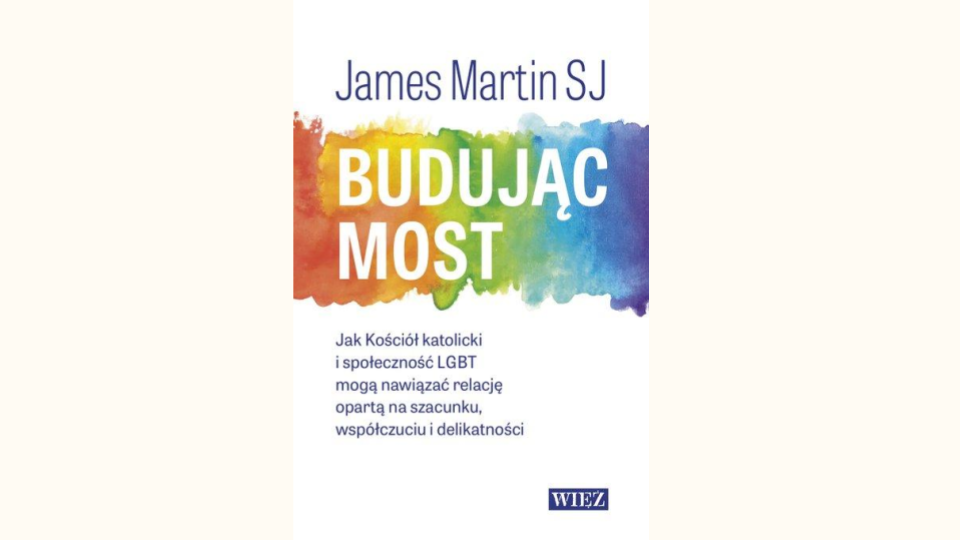
This is the introduction to the Polish-language edition of “Building a Bridge,” recently published by Wiez in Poland.
Aby przeczytać ten artykuł po angielsku, kliknij tutaj.
First, let me express my gratitude to the editors at Wiez for publishing this book in Polish. For many years, it has been a desire of mine that this book, first published in 2017, would be accessible for Polish Catholics, Polish church leaders and, more broadly, Polish-speaking people. For me, the Polish church, with its beautiful history and many saints—including some of my favorites, like St. Stanislaus Kostka, St. Faustina Kowalska and St. John Paul II–has long been a source of inspiration. And so, I am grateful to share this book in return, as a small measure of gratitude to the people who have inspired me.
Let me begin by saying that while this book was written in English, and mainly for an English-speaking audience, the ideas, I hope, are relevant to every Catholic and to every Christian. The theme of the book is simple: Our church is invited to treat LGBTQ people with the “respect, compassion and sensitivity” that the Catechism of the Catholic Church asks (No. 2358), and, more basically, with the love, welcome and inclusion that Jesus always showed in his encounters with people who were “on the peripheries,” as Pope Francis often said.
Jesus was always reaching out to those on the margins, bringing those on the “outside” in, and asking those on the “inside” to go out.
Over the past few years, I’ve been privileged to come to know Catholics from Poland who have shared with me stories about the difficulties often faced by LGBTQ people there. They have also helped me to understand how difficult it can often be for dialogue to occur around this contentious issue in the church. So this book, as we say in English, is intended to bring to this discussion not heat, but light.
In Poland, as readers are well aware, the LGBTQ community is sometimes seen mainly as a “political” community. But this book is not about politics—nor am I a political person. This book does not seek to encourage a person to vote one way or another, to support one political candidate over another or to join any kind of lobbying group or political organization. I’m also aware that sometimes LGBTQ groups in Poland have publicly criticized the church and, as a result, some church leaders believe that the LGBTQ community is somehow opposed to Catholicism. Finally, I’m aware that many LGBTQ people believe that the church is opposed to them, sometimes even opposed to their presence in the church. Given all these difficulties, Catholics sometimes believe that dialogue, communion and encounter are impossible.
But this is not what the Gospels tell us. Jesus was always reaching out to those on the margins, bringing those on the “outside” in, and asking those on the “inside” to go out. With Jesus, as has often been said, there is never an “us” and a “them,” but only an “us.” Thus, one goal of this book is to “bridge” that sad division and create an “us.” And as the Gospels say often, “Nothing is impossible with God” (Lk 1:37).
The onus is first on the church to reach out, to take the first steps, because it is the LGBTQ people who first felt that marginalization.
As you’ll see in the book, the “bridge” is the catechism’s simple goals of “respect, compassion and sensitivity.” This means that the institutional church is invited to see the LGBTQ community as a group of people who have often suffered the severest of persecutions—harassment, beatings, violence and even murder. And, as in the parable of the Good Samaritan in Luke’s Gospel (10:25-37), we are called to stand beside the beaten man lying by the side of the road.
As I see it, the church is invited to see baptized Catholics who are LGBTQ—in other words, LGBTQ Catholics–as full members of the church, as much as anyone else is. The church is also invited to begin to understand how hard it has been for these members to feel like they belong to the church. In turn, this affects their families and friends. So while the number of LGBTQ people in the church may be small, the number of people affected by the church’s welcome or lack of welcome is quite large indeed
At the same time, and as I say in the book, LGBTQ Catholics are called to treat the church and its leaders with equal respect. Church leaders, first as human beings and then as those anointed by God for leadership, deserve our respect. (Church spaces—that is, physical churches—deserve that respect as well.) But, the onus is first on the church to reach out, to bridge the gap, to take the first steps, because it is the LGBTQ people who first felt that marginalization.
At the heart of this desire for unity, for dialogue, for communion, is not an idea but a person: Jesus Christ, who always desires union—“That they may be one,” as he says in John’s Gospel (17:21). This is why the most important part of the book is the meditations at the end, which invite readers to ponder how Jesus reached out to those who felt excluded.
Dear brothers and sisters in Poland, I pray that this brief book may help to increase unity, heal divisions and encourage us to listen to one another as not only brothers and sisters, but as brothers and sisters in Christ.