Jesus, who do you blame?
That’s the question the disciples ask at the beginning of today’s Gospel passage. I imagine this was a familiar question to some of them. They see someone with a physical disability—in this case, the man born blind—and may have fallen into a well-worn debate. “Who sinned, the man or his parents?” Disciples on either side of the debate lean in close to hear their rabbi’s response. Maybe he’ll settle this once and for all.
And on both sides, the logic is quite clear. Well, certainly the man himself must have sinned and incurred God’s punishment in the form of blindness, some may have thought. On the other hand, this man was blind from birth. Therefore, it must have been his parents who sinned. Ah, but perhaps God knew this man would sin in life, so God preemptively struck the man with blindness. We shouldn’t stereotype Jewish thought here (not everyone took this line of thought) but, according to the Gospels, at least some had that question on their minds.
It’s a logic that we ourselves might recognize as religious or even compassionate. Maybe we have exercised this same reflex whenever we encounter suffering, disparity, or anything that makes us uncomfortable? How do we explain this? What went wrong here? Who is at fault?
Jesus refuses to let the man’s life and experience be reduced to a neatly packaged theory or warning about sinning against God.
Jesus, unsurprisingly, rejects that way of thinking and offers a different logic. The disciples see this man and his blindness as a situation that needs a clear moral explanation. Someone at some point failed. How can we avoid that same failure? Yet, Jesus refuses to let the man’s life and experience be reduced to a neatly packaged theory or warning about sinning against God.
Rather, he shifts the focus entirely. “This happened,” Jesus explains to all of us, “so that the works of God might be made visible through him.” Jesus is not interested in assigning blame for this man’s condition. Jesus instead declares that God is with the man, making God’s self known through his life.
For so long, people have had their lives interpreted for them by (sometimes well-meaning) others. LGBTQ people especially have been the locus for debate about sin, blame and moral explanations. Our bodies, identities and experiences are treated as problems to be solved rather than mysteries to be cherished. What went wrong here? Why are you like this? Who failed you?
Jesus stands firmly against that narrative. Notice what Jesus does next. He refuses to engage in the debate. He does not consult the religious authorities.
What begins as a discussion about rightness and wrongness becomes an intimately incarnational encounter.
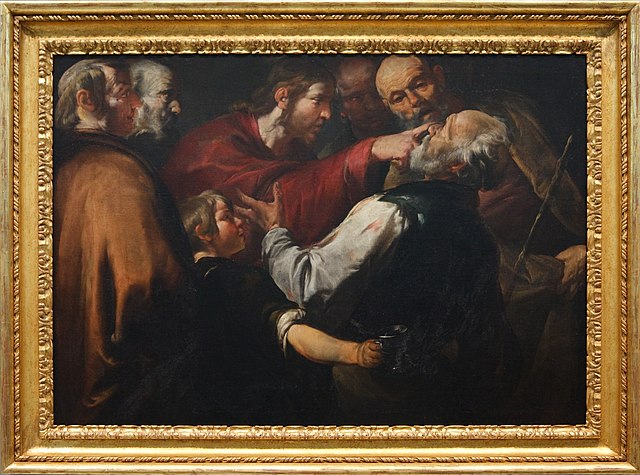
He kneels in the dirt, spits into the ground, makes clay with his saliva and smears the clay onto the man’s eyes. Then, he sends the man on a journey of healing.
What begins as a discussion about rightness and wrongness becomes an intimately incarnational encounter. God’s work is not revealed in this moment through precise explanations, but through hands and clay and eyes and water. Jesus touches the man at the place where he is most sensitive and reminds his disciples about the humanity present right in front of them.
This Lent, let us all guard ourselves against the temptation to theorize rather than encounter, to argue instead of accompany. As the world grapples with violence, terror, injustice and pain, let us not forget the reality of human lives behind the never ending search for who to blame. And, for those of us who have felt the sting of rejection, blame, embarrassment and shame, let us invite Christ to touch the places we have learned to explain away.
Jesus stoops down low into the messiness of our experiences and invites us into healing, renewal and faith. May he continue to open our eyes to discover the God who has been present all along, asking not for our thoughtful explanations, but for our trust in him.