My favorite spot in the whole world is probably Castle Island in South Boston, which offers a view of all of the bustle of Boston in the great amalgamation from a serene beach. A visitor can simultaneously see old timers from Southie tanning on a chair on the sidewalk, young twenty-somethings that have flooded into the neighborhood and gentrified it within the last 10 years, Black and Latino Bostonian families frolicking in the surf and on the sand and lately, Muslim immigrants and refugees that arrived to Boston from war-torn places such as Iraq and Syria.
Whenever I need to clear my head (or when I want a hot dog from Sullivan’s), I battle Boston traffic and make my way into the city from my cushy suburban outpost to visit the beach and pray. It’s one of the places in my life where I see the interconnectedness of the sacred that drew me to Catholicism—and which keeps there despite the hurt the church has sometimes caused for the LGBTQ community.
For me, the seashore is the spot where the heavens, the earth and the sea all meet. On a partly cloudy day, I imagine that the rays of the sun’s light are physical manifestations of God’s fingers reaching out from behind the cloud to cradle creation in his hands. I can’t help but to fall deep in prayer when I am at the beach, whether I am walking along the seashore, listening to the waves crash onto the rocks, sunbathing on a sandy beach, or swimming in the frigid waters of the North Atlantic.
If I end up going for a run or a walk, I will listen to a playlist of my favorite Catholic hymns that I have curated over my years in music ministry. Often I will end up sitting on Head Island at the end of the causeway which juts out into the middle of Boston Harbor, and I inevitably end up reciting the rosary.
I can wholeheartedly say that the interconnectedness and the relationships that are present in the church play an outsized role in my faith.
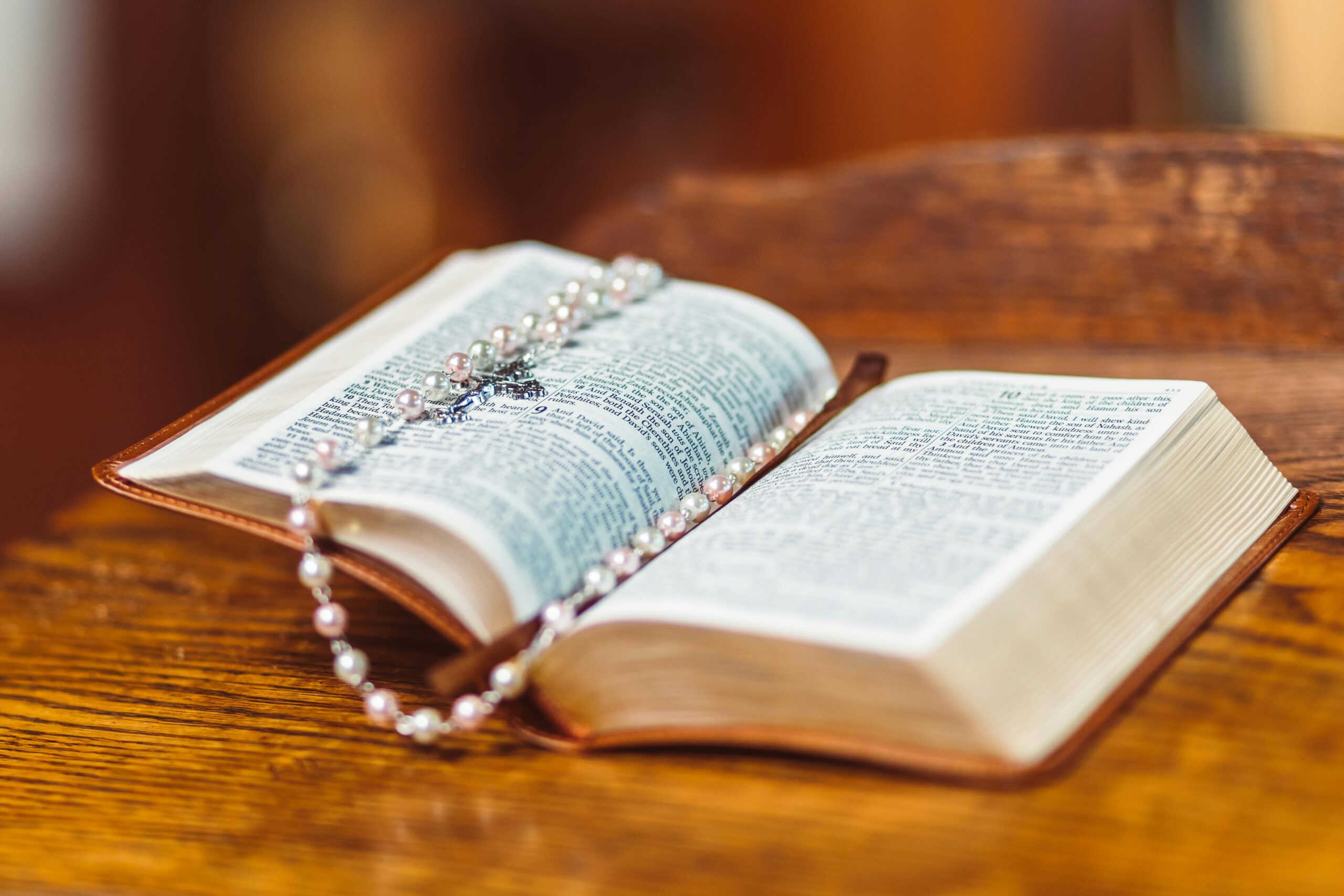
Lately I have been using a set of pink rosary beads that I inherited from my grandmother when she passed. As I recite the prayers, I can’t help but think of the number of times she held that same set of beads in her hands and prayed, exactly like I am at that time, whether she was experiencing sorrow or despair or joy.
I was extremely close to my grandmother, Catherine, and in many ways, she brought me up in the Catholic faith. She lived with my family growing up and each week, she took me to Mass. Her most prized possessions were objects of faith: a lithograph of a painting of the Sacred Heart, her collection of rosary beads from all around Europe. We’d often talk about what it would be like to visit St. Peter’s Basilica or St. Mary Major, even though she never made it to Italy. She taught me about forgiveness, like the time I knocked over her mug of freshly brewed tea. She even agreed to be my Confirmation sponsor when I went through R.C.I.A. (now O.C.I.A.) as a freshman in college. I would have considered her an “Old School Boston Irish Catholic.”
My grandmother faithfully went to Mass every week and every Holy Day. She had a specific pew she sat in every week at the 4 p.m. Mass on Saturday evening at St. Anne’s Church. That routine was the bedrock of her faith. I find that much of my faith life has also settled around a cyclical routine, nurtured by my involvement in music ministry or my involvement in my parish’s social justice ministry. If I find myself at St. Anne’s Church for daily Mass or for Eucharistic adoration, I almost always gravitate to that same pew where my grandmother sat. While I sit in that spot, I can sense the ever-present connection that I have with her, even though it has been over a decade since she passed.
I’ve often thought that it has been easier for me to “come out” as transgender in my Catholic circles than it has been for me to “come out” as Catholic in LGBTQ settings. Because of a long history of homophobia, that has often been attributed to the magisterium, many of my LGBTQ friends and acquaintances describe themselves as “ex-Catholic,” or “spiritual but not religious.” My friends will frequently cite religious trauma, often at the hands of family or loved ones—and sometimes at the hands of clergy—as reasons for leaving the Church.
It’s this notion of interconnectedness that holds a grip over me and keeps me Catholic.
They will mention the church’s complicity in the sex abuse scandal. Some will even mention the Catechism of the Catholic Church states that homosexual tendencies are objectively disordered (no. 2358). They will often pose the question to me: “How can you remain Catholic when the church can be so homophobic?”
It’s a question I’ve thought extensively about. I came home to the Catholic Church only after I came out, and I never truly had a concrete answer to the question of why I am Catholic other than to say it just feels right.
Though I’m not going to go so far as to claim that I have a simple answer to the question of why I am Catholic, I can wholeheartedly say that the interconnectedness and the relationships that are present in the church play an outsized role in my faith. In each of the examples I have cited, the connection between different elements provides a source of comfort and mystery to me. The connection of heaven, earth and sea at the beach; the connection of various groups of people enjoying the same piece of creation; and saying the rosary using a set of beads from a deceased loved one are but three small examples of how nothing exists in a vacuum. We are all parts of the same creation.
One of the most interesting books I’ve had the opportunity to read recently is All Shall Be Well, which is a modern language translation of the Showings of St. Julian of Norwich by Ellyn Sanna. It is a collection of revelations, or “showings,” that Julian experienced in 1373 while serving as the Anchoress of an English Catholic parish. One of the most striking visions that Julian experienced was when God showed her an orb the size of a small hazelnut that she held in her hand. Julian asked God what the orb was, to which God replied, “It is all that is made.” For Julian, this drove home the concept of interconnectedness. She understood that the hazelnut has three distinct properties. First, God made it. Second, God loves it. And third, God protects it.
It’s this notion of interconnectedness that holds a grip over me and keeps me Catholic. We focus on social justice and human dignity because in the eyes of God, we are all fearfully and wonderfully made. We honor the communion of saints where we can connect with our departed loved ones, because in the eyes of God, we are all totally worthy of love.