Per leggere in italiano, clicca qui.
Walking together in Rome
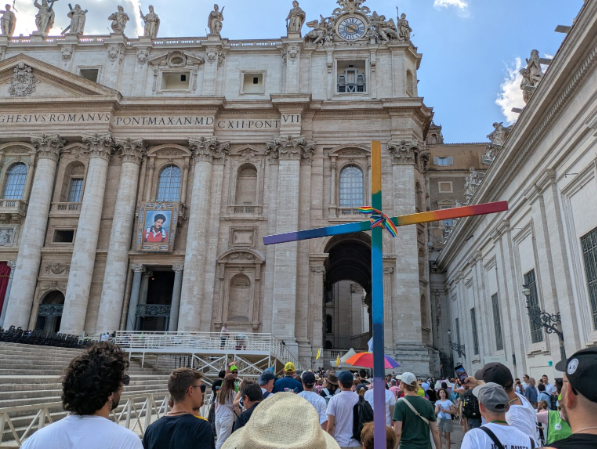
For those few days it was tangible, the welcoming spirit of the church. It was September 2025 and people who had often felt at the margins of the church found themselves walking within it, beside priests, religious sisters and other believers. They had come to Rome for the pilgrimage organized by La Tenda di Gionata and other associations, including Outreach, often referred to informally as the LGBTQ pilgrimage.
It was a powerful time, a pilgrimage for LGBTQ individuals who were publicly recognized within the wider Jubilee context, welcomed in church spaces and marked by the presence of numerous priests, religious sisters and other believers. That mattered. The novelty was not simply that LGBTQ persons and their families had come to Rome, but that they could come as their full selves, invisible no longer.
But after the Jubilee pilgrimage in Rome, many people were left with the same question: What now?
I was coordinating the foreign-language groups and in the months before the pilgrimage I had spent long hours helping people understand what this experience would look like. I had heard questions, doubts, worries and hopes. By the time we arrived in Rome, the 1,400 pilgrims were not just a number, but familiar faces. In Rome these pilgrims were met by priests, sisters and believers who stood there in person, with their own histories, faith and names.
When a river flows underground, people begin to think it is gone. In the same way, when the pilgrimage ended, a question emerged: Had that spirit of renewal disappeared too? How might that path continue?
That thought has stayed with me, and a new initiative has begun to take shape. But to explain why that question mattered so much, I need to go further back.
A Path Forms
My own path into this work goes back to the late 1990s. I was living in Palermo, Sicily, at the time. I was part of a secular organization, and we were offering a space of listening for LGBTQ persons, especially those most exposed to rejection, street vulnerability and social exclusion. This brought some risks. In that context, accompanying people away from desperation and exploitation could mean crossing interests tied to prostitution, territorial control and criminal economies. Desperation, after all, can become a business. Yet I would paint Palermo unfairly if I left it there. True to its deep cultural heritage, many people there showed a profound and immediate capacity for welcome that required no words, one I have rarely encountered elsewhere. I was working in a secular organization, but it was the church that offered us space.
At the time, few would have predicted that a church would be the place where a door opened. Yet that is what happened. I came to see that there is no formula—welcome begins when someone is willing to open a door.
I would carry that lesson with me through other places and other seasons of life.
Years later, while living in Poland, I began to grasp the scale of the question. I remember one Warsaw Pride Day celebration in particular. On one side were LGBTQ people, visible in face and presence, a colorful crowd moving through the streets. Across from us stood a crowd of counter-protesters—dressed in gray, heads shaven, shouting in unison, arms raised in the Nazi salute. Between us, lines of riot police formed a protective wall that stretched the length of the march. On one side, color and visibility; on the other, monochrome hatred.
When I returned to Italy, I found my faith, and I started getting involved with various groups. I connected with extraordinary people in the church who had devoted years of their lives to building paths of welcome and accompaniment. That path eventually brought me into the Jubilee pilgrimage working group.
That experience confirmed something I had sensed for years: Much more is happening in the church than people can see from the outside. Priests, sisters, lay people, parents and LGBTQ persons themselves are doing the patient work of listening, welcoming, discerning and accompanying—connecting faith, prayer and real encounter, not faceless ideas.
Yes, after the pilgrimage, many people felt that a path had opened and asked: What now? Because when a river is flowing underground, people begin to think the river is gone.
The answer could not be silence.
I wanted some of the voices that had helped make the pilgrimage meaningful to reach persons both in Italy and abroad.
Called by Name
I thought one way to continue the path might be prayer: real prayer, shared prayer. That is the heart of a new series of meetings we call Called by Name. They are free online gatherings, in Italian and English, with prayer, testimony, reflection and space for dialogue.
What I did not want was another N.G.O. webinar, with a committee matching themes and speakers to a preferred narrative or political logic. I think there are people who need spaces for prayer and dialogue that begin from lived faith and encounter. That is why the organizers are individuals, not representatives of groups. This is deliberate– there is no committee or council behind it. The true host of each gathering is the priest or religious sister who extends the invitation. That speaker chooses the theme. That speaker decides what to present about. This difference matters.
The first meeting, on May 8 at 9:00 p.m. CET, will be led by Sr. Enrica Solmi of the Franciscan Sisters of the Immaculate of Palagano, near Modena, Italy.
When I first spoke with Sr. Enrica, I asked her for one key word for the meeting. She answered “disarmament”. She then began to speak, with calm and great conviction, about the way disarmament can open hearts and paths of fraternity. She wants to begin from St. Francis and St. Clare and speak about a transformation that does not begin with destruction but with conversion, humility and the disarming of the heart.
Francis was radical, but not schismatic. Clare’s fidelity was gentle but never weak. They sought change, not rupture for its own sake. They wanted the church to become more faithful, not to tear it apart. In a moment of hardening divisions, to begin here says a great deal.
Sr. Enrica herself is an extraordinarily gentle person, but there is nothing weak in what she is proposing.
Other evenings will follow. Fr. Andrea Conocchia, known for his closeness to people living in situations of distress and exclusion, will join us, though he is still discerning the theme he will bring.
Fr. Andrea Bigalli will begin from the Gospel scene of Jesus healing the leper, and from the question of what is really being healed there: not only the wound of the excluded person, but the eyes of those who no longer see a person, only a label.
Fr. Marco Torre will speak about moving from a bureaucratic image of the church toward the image of a family where people are known and called by name.
These are only a few of the voices that will join us in the coming months. More will come from different parts of the world. I cannot say how many, or for how many months. I can say for sure that each meeting will be worth attending, because each will be unique. There is no large planned narrative, only prayer, faith and the joy of being who we are, loved in faith. But I think that one invitation at a time, one prayer at a time, like stones placed side by side, a path will appear.
I am happy that so many people in La Tenda di Gionata, GNRC, Drachma, Outreach, believe in the initiative. I hope many people will join us. Prayer shines brighter together.