It was September, 1997. I’d journeyed to France with two friends for the one-hundredth anniversary of the death of St. Thérèse, my favorite saint. We were visiting sites associated with her, culminating in an enormous celebration on her feast day in her hometown of Lisieux, at the basilica built in her honor.
But as we embarked on our pilgrimage, I felt a nagging anxiety. Would I be able to participate in a celebration led by scores of priests and bishops without my head exploding? How had I come to such a moment, where this proposition made me so uneasy?
I didn’t grow up religious; but as a teenager, I had a life-altering experience of the God of love. Looking to explore my love for God and neighbor, I joined the Catholic Church in 1982, at the age of 17. I was in the closet then, terrified of my queerness, and felt relief at the idea that following Jesus in my mind meant I could hide and ignore my sexuality. But a few years later I came out, and befriended people who had learned how to integrate their queerness with their faith. They challenged me to recognize that love and truthfulness cannot be separated. If I was going to love authentically, I had to do so with the heart God had given me—a queer heart.
Faith amid the AIDS crisis
This was during the early years of the AIDS crisis, and those friends were all absorbed in caring for people who were ill. If anyone needed love, it was certainly people with AIDS—the sufferings and cruelties they endured were unspeakable. I felt called there. By 1997, I’d spent a decade caring for people with AIDS. In particular, I helped a man named Albert; preparing his meals, doing his shopping, cleaning his apartment and his cats’ litter box, and accompanying him to his doctor’s appointments.
He was so weak our two-block journeys took half an hour—he’d walk just 10 yards and become so exhausted he’d need to stop, resting his head on my shoulder while people shot us hateful stares. I also organized medical care for another man, named Melvin, counseling him as he faced his terrors and arranging a death-bed reunion with his long-estranged son. I kept vigil by hospital beds, planned funerals. And I’d been working with unhoused teens—many of them queer—offering food and counseling, medical care and providing the nation’s first housing program for homeless HIV+ teens. Daily I faced the horror of kids in my care growing sick and dying.
Those were terrible years—when the LGBTQ community was besieged with death and terror. Those were also years of shocking cruelties against our community on the part of church officials. A time of “intrinsically disordered” slurs, of church leaders hell-bent on fighting against our human rights, a time of constant rejection in Catholic spaces. For me, it was a time of profound disillusion.
What cut closest to the bone was the opposition of most of the hierarchy to safer sex measures. It was soul-crushing. H.I.V. infection was a death sentence then. Our queer community was being annihilated. I’d ask myself: Who are these men who would sooner see us dead than wearing condoms? How could they possibly respond so rigidly, so callously, so recklessly? By 1990, I’d gotten to the point where I was unable to attend Mass without becoming overwhelmed by anger, sorrow and disgust. I remember R.E.M.’s song “Losing My Religion” was all over the airwaves then—a soundtrack to my own sense of spiritual loss and estrangement.
But for all that, I still loved God and continued looking to the saints for help and inspiration—especially St. Thérèse. Over the course of my life, I experienced a series of remarkable moments of her helping me find the courage to be honest about my queerness. And I was particularly grateful for her miraculous act of kindness to an H.I.V.+ friend during a medical ordeal. So, despite my anger and heartbreak, there was no way I would miss her centenary celebration.
Beside Thérèse, a place in the church
On our second day in France, we came to Alençon, the town where Thérèse was born. When we arrived at its large gothic Cathedral, we were overwhelmed to see an enormous photo of Thérèse had been draped across the church. Her image was at least 100 times larger than life!
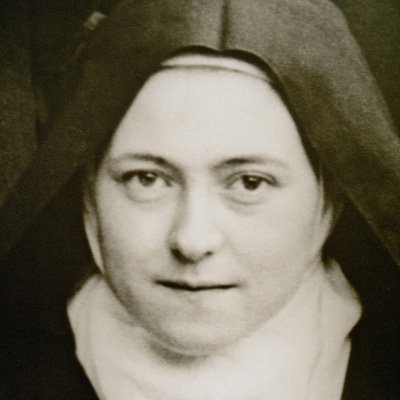
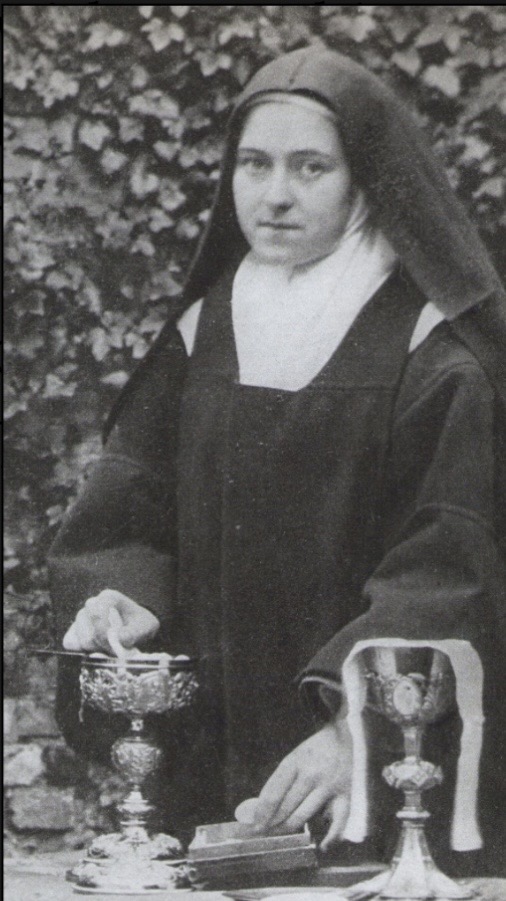
It was these photographs of Saint Thérèse that birthed to my devotion.. After joining the church, I opened her autobiography, Story of a Soul, several times. but I could never get past the first few pages. Her writing just seemed so sappy and juvenile. Then, in 1984, I spent six months trying out a monastic vocation in a small Benedictine monastery. Their library had a French book, Le Vrai Visage de Saint Thérèse, containing every photograph taken during her short life.
Her images fascinated me—I’d never before seen photos that so palpably radiated goodness, peace, love and holiness. I spent days meditating on her face and finally read through her memoir. I discovered someone utterly dedicated to loving God, utterly dedicated to loving others and participating in Christ’s saving love for humankind. From then on, I considered Thérèse a cherished guide, spiritual sister and soul friend.
As we continued visiting Theresian sites—a shrine in Paris, where Thérèse prayed in thanksgiving for being delivered from a severe childhood illness, and the Cathedral in Bayeux, where Thérèse asked her bishop for permission to enter the convent at the very young age of 14—we were met again with these gargantuan photos of Thérèse draped across the facades.
Each time I saw those enormous images of Thérèse, I was reminded to prayerfully repeat the final words she wrote in Story of a Soul: “I go to God with confidence and love.” And as I did so, my anxiety lessened.
When we arrived in Lisieux, we discovered Theresian pandemonium. Her images were everywhere—hundreds of them all over the town. I felt like I was being borne aloft on a sea of love made up of waves of her image.
On the morning of her feast day, we made our way to the Basilica of Sainte-Thérèse. However, such huge throngs of devotees had already arrived that we were unable to enter the massive church but had to join thousands on the great lawn outside, watching huge video screens where the liturgy inside was broadcast.
Those screens showed a small casket before the altar. I realized with great excitement that it contained Thérèse’s relics. When the Mass ended, I saw that the reliquary was being carried down the central aisle towards the front doors. Immediately, I felt an intense surge of devotion and told my friends that I had to be beside Thérèse when she came through the doors. I felt irresistibly drawn to her. With much effort, I squirmed through the throngs, finally arriving at the steps just outside the front door. Once there, I saw, with consternation, that I was among scores of priests, each one hoisting aloft a tall flagpole topped with colorful streamers flapping exuberantly in the wind.
Before I even had time to process my ecclesial discomfort, a priest nodded his head toward me imperatively and said, in French: “You are a big, strong man. Please, take my pole!” I saw that he was struggling with the weight of it. He handed it to me, and a moment later, when Thérèse’s relics emerged through the doors, I stood beside her, joyously waving the banner, a lone layman doing so among dozens of priests.
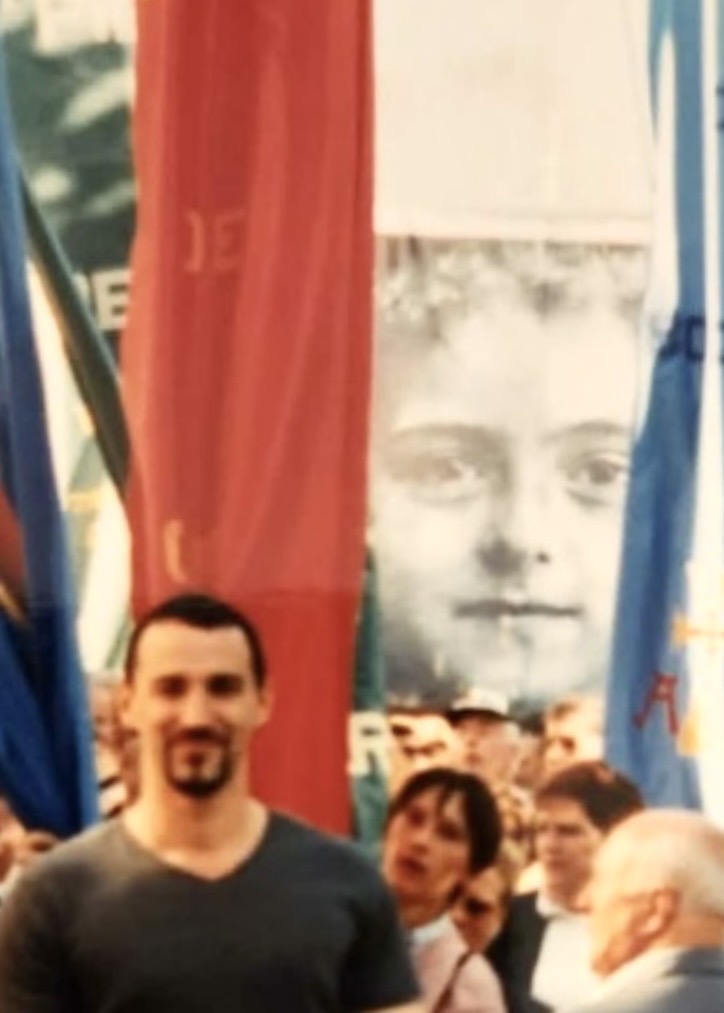
It was a moment of extraordinary grace. It felt as if Thérèse was telling me, with almost unbelievable clarity, that my anger and heartbreak didn’t disqualify or exclude me. That I too had a place in the heart of the church, right by her side.
Love at the heart of the church
I’ve continued all my life to meditate over that moment, pondering what belonging can mean in a church that maintains my way of loving is “disordered” and “depraved.” Many of those mediations have focused on how Thérèse responded to her own experiences of exclusion in the Church.
Writing of her adolescent pilgrimage to the holy sites of Italy, Thérèse recounts frustration at being repeatedly forbidden access due to her gender: “I still cannot understand why women are so easily excommunicated in Italy, for every minute someone was saying ‘Don’t enter here! Don’t enter there, you will be excommunicated!’”
Thérèse deployed humor to convey her exasperation. But there was nothing funny about her deepest experience of being excluded due to her gender. For Thérèse felt, in the core of her being, a call to be ordained a priest. “I feel in me the vocation of a priest.” she wrote. “With what love, O Jesus, I would carry you in my hands…and give you to souls!”
Her heartbreak at being denied ordination was profound, so much so that when she was slowly and painfully dying of tuberculosis at the young age of 24, she interpreted it as a gift from God to spare her further anguish. She confided to her sister, Mother Agnes: “You see, God is going to take me at an age when I would not have had the time to become a priest…. So that I would not be disappointed, God let me be sick.” How devastating—Thérèse preferred sickness and death to living with the pain of being denied ordination.
In an extraordinary passage in her autobiography, Thérèse wrestled with the stark reality of her unachievable desires, describing them as a “veritable martyrdom.” Then, meditating on the mystical body of Christ, she had a profound realization: “I understood that the church had a heart and this heart was burning with love…that love comprised all vocations, that love was everything…. My vocation, at last I have found it…my vocation is love!”
How striking, that grappling with her exclusion led Thérèse to a realization of love as the church’s very heart—recognizing it as the core of all vocations. As if she uncovered love as the penultimate sacrament given freely to everyone directly by God, not subject to human structures of exclusion, domination or bigotry. She has a vision of a God at once afire with love for us and burning with desire for our love. Our capacity to love is God’s holy spark within us. It is our most precious gift, our divine birthright as God’s children. We might be excluded from roles, from structures, but nobody can take from us our capacity to love.
It is in the light of Thérèse’s realization that I now re-evaluate my and my friends’ fraught experience of church during those grim years of the AIDS pandemic.
I think of Gary Donatelli, my lover then, and with me in Lisieux on that joyous day. I think of his dedicated work at Bailey House, New York City’s first residence for homeless people with AIDS, consoling and comforting hundreds during their final days. I think of us lying in bed at night, under a statue of Jesus manifesting his Sacred Heart, as he whispered of each day’s ordeals.
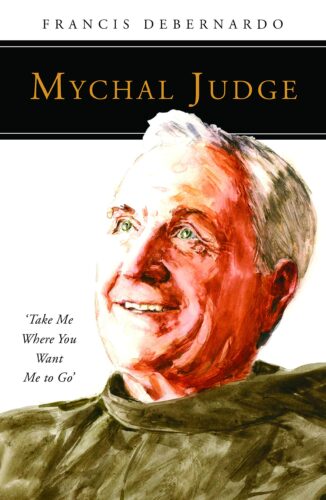
I think of the Dignity Masses at St. Francis Xavier, where we had the great honor of receiving Communion from Daniel Berrigan, S.J., Mychal Judge, O.F.M. and Father Bernárd Lynch, each of whom had dedicated years ministering to people with AIDS. I think of the beautiful AIDS healing Masses that Gary and I would attend at Our Lady of Guadelupe, of the spirit of devotion and love that Bill McNichols, S.J., engendered there amid so much trauma.
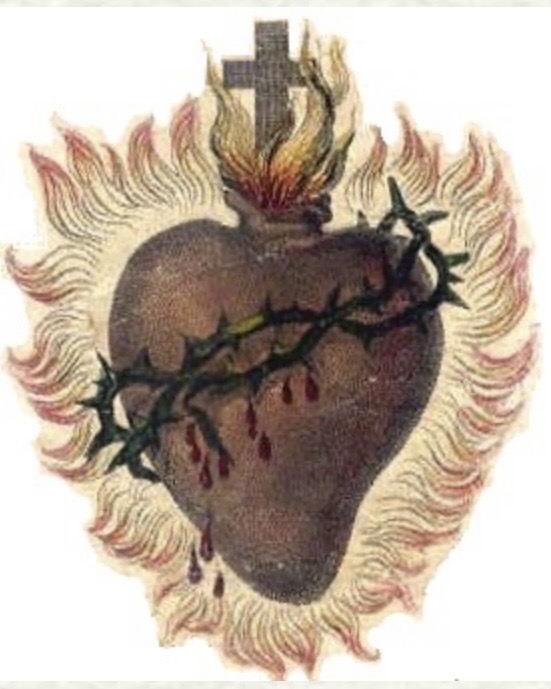
I think of going up to receive Communion from that holy priest, who also spent years ministering to people with AIDS, and seeing him flanked by rucharistic ministers who happened to be our close friends: Peggy Scherer, who worked alongside Gary at Bailey House, and Ernesto De La Vega, who assisted people with AIDS at the Brooklyn AIDS Task Force. And I am overwhelmed by all the love they brought forth. It was as if their hearts were beating in unison with Christ’s own Sacred Heart. They showed me an image of queer holiness in the heart of the church.
As gruesome as those times were, I now realize how blessed I was to be among people graced to respond to the AIDS crisis with compassionate love. What was important was the love we brought to those in desperate need. For I learned from Thérèse that love brings us to the place where we belong.
O my beloved St. Thérèse, on this, your feast day, I pray in thanksgiving for your loving welcome during a time of estrangement. May our capacity for love be put to abundant use. And through your intercession, may the day come when none of us are excluded for being who God made us to be.