
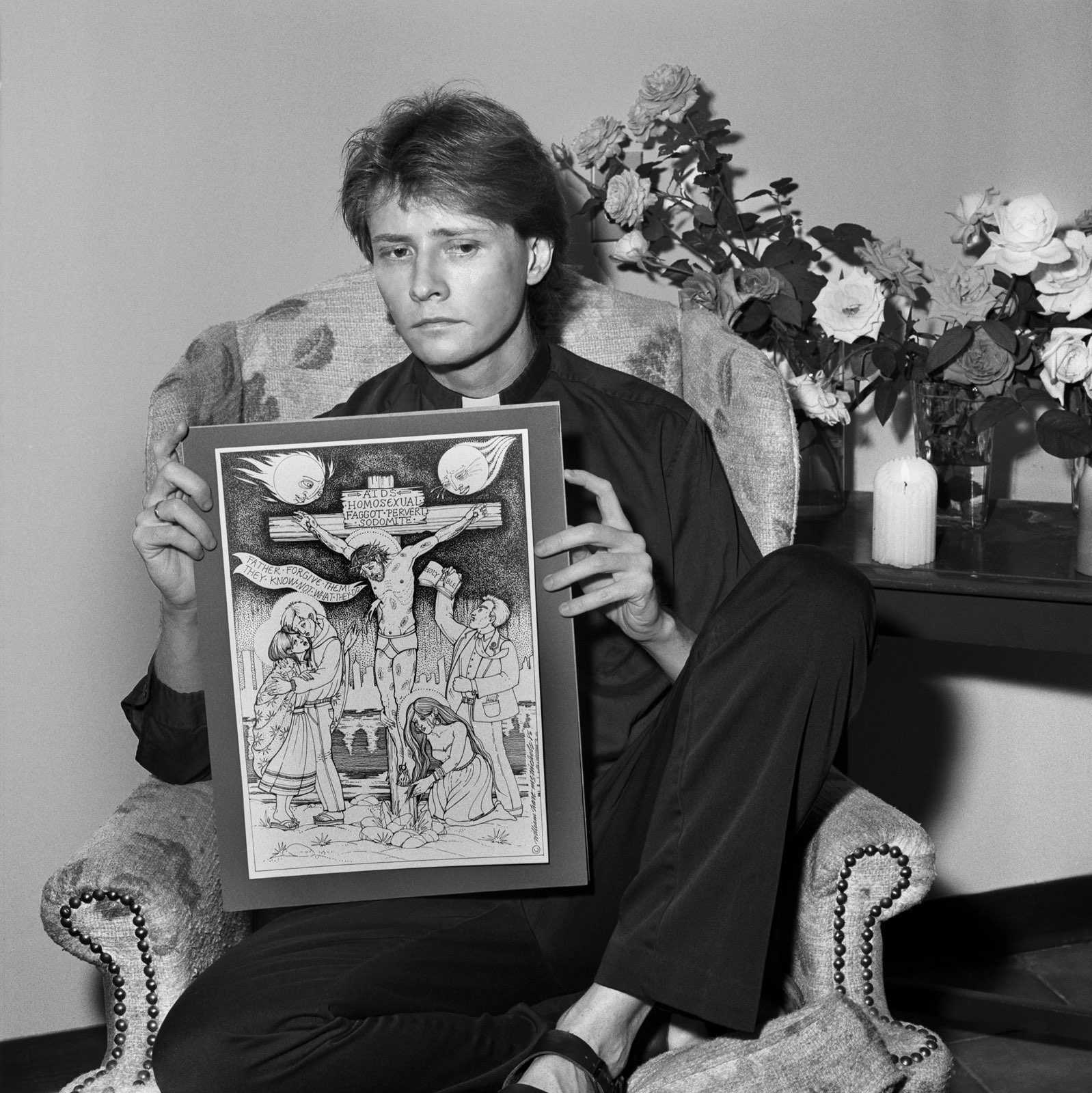
The following is the text of a homily delivered by Michael A. Zampelli, S.J., a member of the Outreach Jesuit Board of Advisors, at the Outreach mini-pilgrimage in the Mary Chapel at the Church of St. Francis Xavier on September 26, 2026. The text has been edited for style.
I am deeply honored to pray with you this morning on your pilgrimage to New York City, a beating heart of American LGBTQ people and the American church.
We are celebrating this liturgy within the context of what St. Ignatius calls in the Spiritual Exercises “the third week,” that time during which we meditate on the passion of Christ, seeking to connect with his deep humanity as we pray for the graces of confusion, genuine grief, and deep compassion.
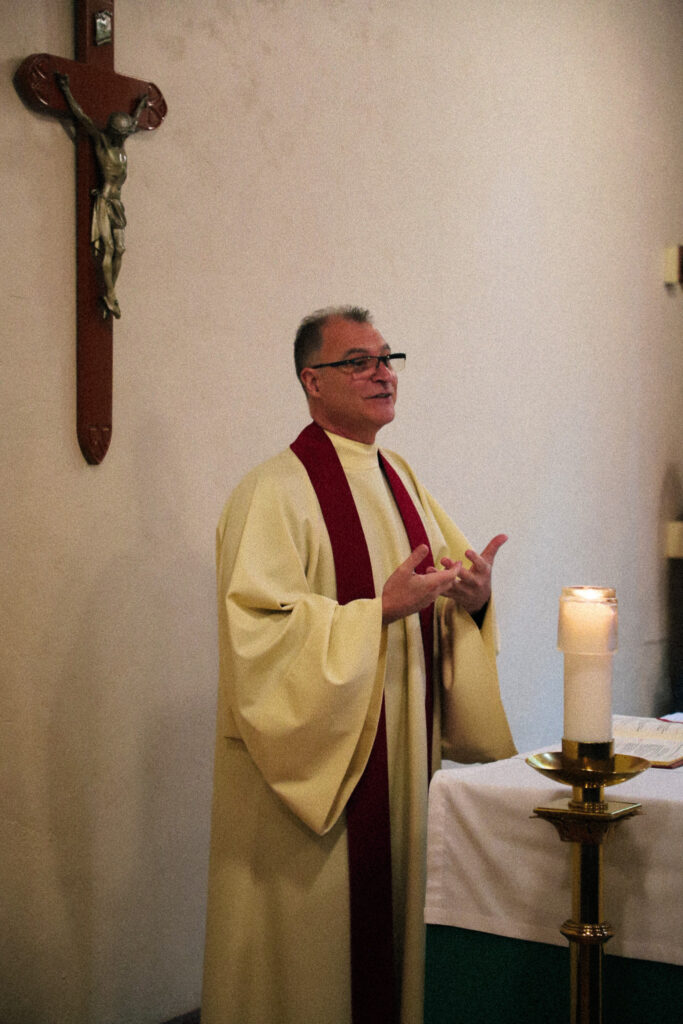
Confusion because we cannot quite fathom how we human beings (capable of so much creativity) could treat other human beings in such callously cruel ways.
Grief because we feel in our bodies some measure of the pain Christ suffers for our health and our salvation.
Compassion because, though we can’t make anything “better” in this situation, we can share his suffering by staying with him.
Perhaps we might just take a minute right now to think about Christ on the cross and pray for those graces: confusion, grief, and compassion.
When I first saw that image, I was a Jesuit regent teaching high school in the DC area. And it haunted me.
Your morning began by recalling the AIDS crisis and the Catholic Church. The parallels between the suffering of bodies with AIDS and the suffering of the body of Christ are clear and compelling. In fact, as I was preparing this brief homily, I could not stop thinking about an image—that to this day—moves me deeply: “AIDS Crucifixion,” a 1986 drawing by Father William Hart McNichols who in those years had been working with AIDS patients here in New York City.
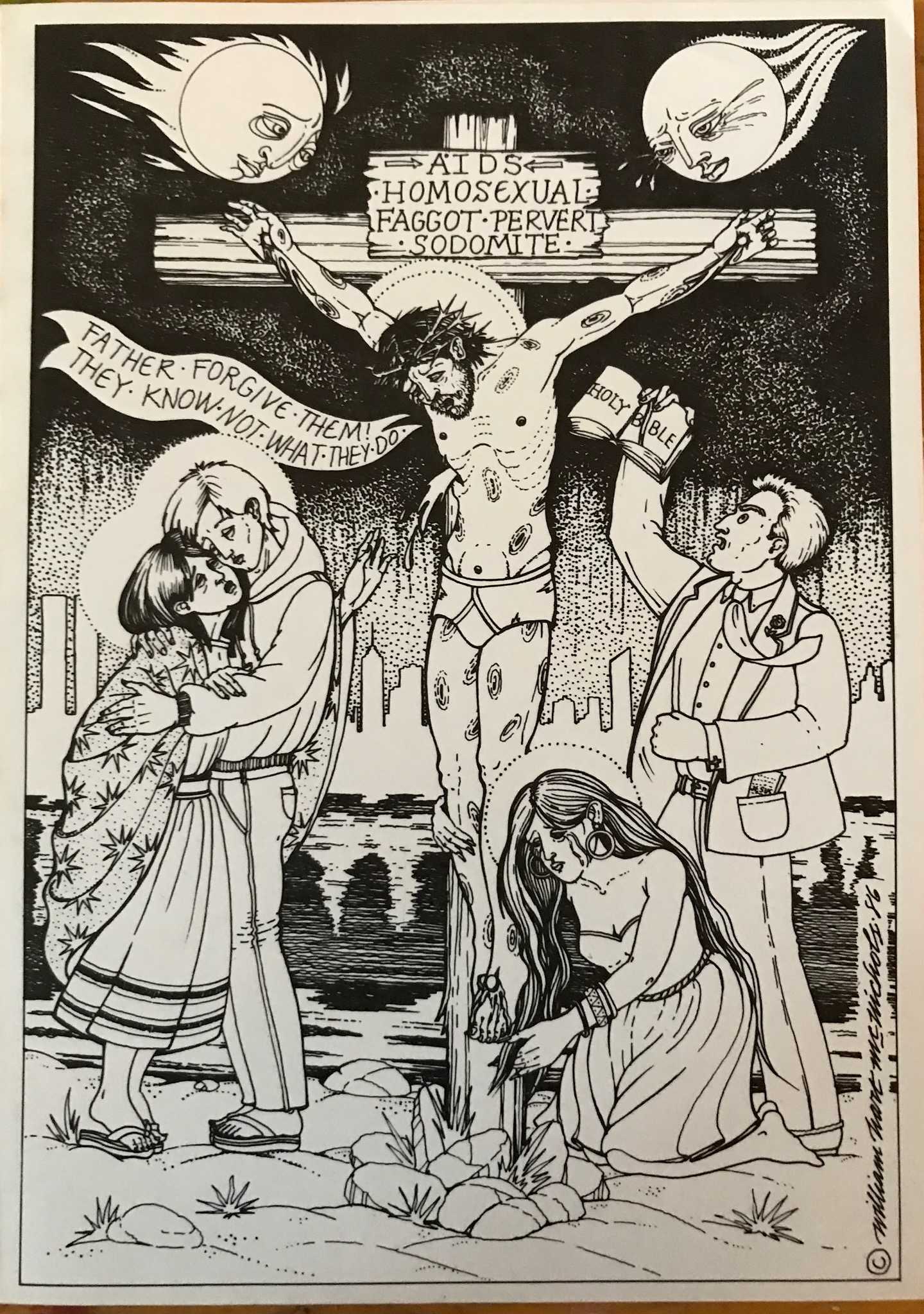
I’m not sure if you have ever seen this black and white drawing of the crucifixion where, against the backdrop of the New York City skyline, Christ hangs on the cross. Covered with Kaposi’s sarcoma lesions, that aggressive skin cancer which became one of the most visible and stigmatizing markers of AIDS—both outing the person’s HIV status and pointing to an impending death—the AIDS Christ is emaciated, as were so many of our friends.
And above his head hangs a sign that reads: “AIDS, Homosexual, Faggot, Pervert, Sodomite.”
Beside him is an angry-looking man in a suit waving a copy of the Holy Bible. Beneath him is a Magdalene figure and next to her are a Mary and John, all trying to stay present in their grief to the person of sorrows, all dressed as 1980s city dwellers on the margins.
When I first saw that image, I was a Jesuit regent teaching high school in the DC area. And it haunted me. Somehow, because of it, I knew that my life as a religious preparing to be a Catholic priest was going to have to change.
Fast forward to 1990 in the San Francisco Bay Area where I had gone to study theology at the Jesuit School of Theology at Berkeley. At that time, the McNichols image surfaced for me again and, in spite of my very real fears, compelled me to find my way to that cross. Thanks to one of my closest Jesuit friends, I became aware of an intensive AIDS ministry training program sponsored by the Episcopal Chaplaincy at San Francisco General Hospital.
While the Catholic Chaplaincy in the hospital was taken up, for the most part, with sacramental ministry, the Episcopal Chaplaincy employed a clinical-pastoral education model to train an international group of interns in accompanying those living with HIV/AIDS. In addition to visiting patients in the by-then famous Unit 5A, we spent time with patients in the day clinic. The visiting was complemented by a rigorous schedule of meetings that immersed us in the realities of HIV/AIDS—physical, social, medical, emotional, spiritual, economic.
Sojourn’s ministry was grounded in “invitational presence.” The chaplains’ sole duty was to be present to the patients, inviting them, simply by virtue of our physical presence, to share themselves in whatever way they most needed.
We were never to “do” things “for” the patients.
At the time, I remember being stymied by the approach. “What could be the problem,” I thought, “with getting the patient some water or helping him organize for his return home?”
I soon discovered, however, that even the most insignificant task served as a way for me—as a chaplain—to distance myself from the uncomfortable and disturbing realities sitting before me, to turn my gaze away from the cross.
Getting a glass of water became a way for me to slip out from under the penetrating stare of a person who, because he was experiencing his third opportunistic infection, sensed that his death was closer than he ever thought it would be.
Shuffling through the papers left by the social worker made me feel better because I did not have to engage the vexing question of why the church’s presence to this person became understanding and benevolent only when his life seemed to be slipping away.
“Invitational presence” helped me cultivate the discipline of “being” in complex situations without trying to resolve them with easy answers or activities that highlighted my competencies, my usefulness.
“Invitational presence” invited me simply to be present, of course to my patients and the caregivers, but also to myself and so recognize my own persistent tendency to “run for cover.”
How is it that your time with the cross today might invite you to change?
“Invitational presence,” attending to those crucified before my very eyes—not just physically but emotionally and socially and spiritually—attending to those crucified before my eyes helped me to understand the kind of priest God was calling me to be:
A priest that did not use God as a Novocain but one that witnessed to the ways God was revealing Godself in the crucified, calling us to a deeper humanity by standing in solidarity with those most in need, those most misunderstood, those most “despised and rejected.”
At this point in your pilgrimage, you have been invited to be present to the cross upon which our Lord and so many of the Lord’s beloved are crucified.
The cross is HIV/AIDS, homophobia, transphobia (and all the other phobias that do nothing except tear us apart).
The cross is greed, the lust for power, and the desire to dominate.
The cross is the willful forgetting of what God calls us to—solidarity and mutual love.
How is it that your time with the cross today might deepen your relationship with the crucified Christ and those crucified along with him?
“The cross is not the end but the beginning of a story.”
How is it that your time with the cross today might invite you to change for the sake of those who, in this day and age, need you—perhaps not to “fix anything” but simply to assure them that they are not alone?
How is it that your time with the cross today might signal in you and in the world the approach of new life?
Remember that today’s gospel reading ends not with the death of the Lord but with the empty tomb, reminding us that the cross is not the end but the beginning of a story in which we tell others what we have seen, heard, felt, touched, and experienced. As you may know, I teach theatre and I cannot resist ending this homily with some lines from one of my favorite plays of the last century: Tony Kushner’s Angels in America.
Angels was a breakthrough piece in the history of gay theatre because it was the first play written in which the protagonist with AIDS did not die.
In the epilogue of the play, Prior Walter (the protagonist), surrounded by his community of support, steps toward the audience and ends the play with words that might inspire us to share the good news of this pilgrimage, of our faith, and of our rich and diverse human experience:
We are not going away. We won’t die secret deaths anymore. The world only spins forward. We will be citizens. The time has come. Bye now. You are fabulous creatures, each and every one. And I bless you: More Life. The Great Work Begins.