Norėdami skaityti originalų straipsnį lietuvių kalba, spustelėkite čia.
When I first heard in 2024 that a Pride march would take place in Vilnius, Lithuania’s capital, my initial instinct was to respond with protest. At the time, I could hardly imagine another way for a Christian to be there. I thought only in terms of disagreement: If our convictions mattered, surely we had to make them publicly visible through protest.
Then I had a conversation with a Catholic acquaintance whom I knew through various prayer events and who was also thinking about how Christians might respond to Pride. His ideas were unconventional and quite different from what eventually I came up with. At one point, he suggested blessing Pride participants with holy water.
To my surprise, this idea unexpectedly changed the direction of my thinking.
Instead of using holy water as a gesture of opposition, I began to wonder whether water itself could become an invitation. What if, rather than protesting the people walking past us, we offered them something freely—a bottle of drinking water that had been blessed, together with a simple invitation to explore faith?
That felt different. We could still be visibly Christian and faithful to what we believed, but our presence would begin with a gift rather than a confrontation. Instead arguing over ideology, we could meet people face to face and offer a small invitation to encounter Christ. That felt like a more purposeful way to be there. And that eventually became our first experiment.
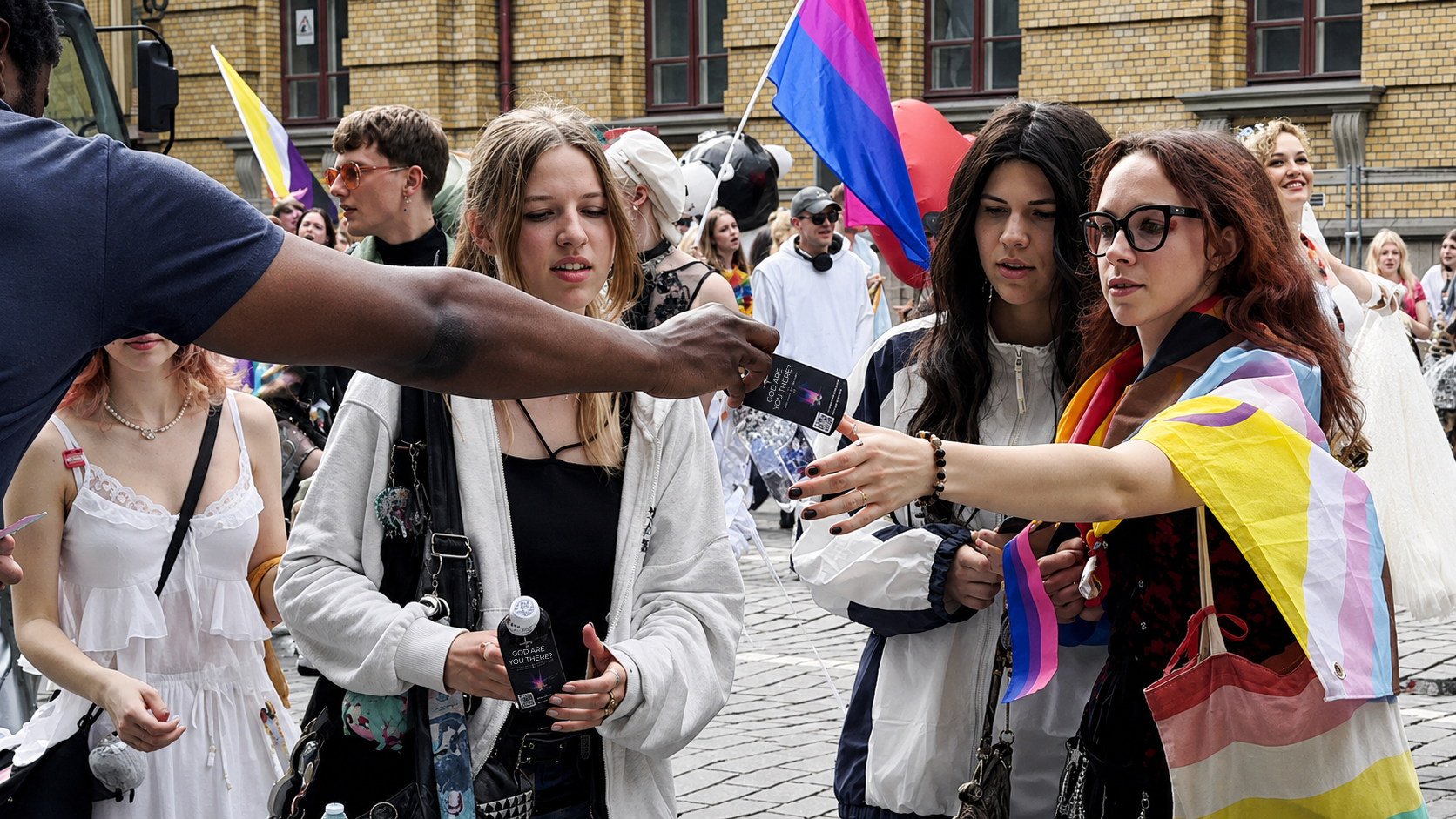
We brought 500 bottles of drinking water that had been blessed before the event, together with small invitations to explore faith.
I began asking God to help me look at everyone we met with the eyes of Jesus and Mary.
I did not know how people would react. I expected suspicion and perhaps confrontation. Instead, to my surprise, some people stopped at our stand, smiled at us, accepted my invitation to take photographs together, shook my hand and even embraced me. People thanked us for the water, and one person shook my hand and thanked me for what we were doing.
That experience unsettled some of my assumptions. The people walking past me no longer seemed primarily like representatives of a social debate. They were people carrying stories, relationships, wounds, hopes and questions that I could not see from a distance.
I began asking God to help me look at everyone we met with the eyes of Jesus and Mary.
None of this made the theological tensions surrounding these questions disappear. But it made me realize that those tensions cannot be the only starting point for a truly Christian encounter. Before we can say much that is meaningful, we have to be willing to see the person in front of us and to listen.
Out of those first experiences grew “Light In The Dark,” a Catholic evangelization initiative in Lithuania.
One of our central hopes is to offer people who may feel distant from the church a positive encounter with Christians. Many Pride participants seemed surprised to meet Christians who were not there to protest against them. We were there with water, conversation, prayer and an invitation.
We hoped our presence would communicate something simple: You are loved. You are never forgotten. God is always seeking you.
For me, this means believing that Christ seeks to call people to himself at all times, even when we feel far from the church. Someone does not first have to become a different person before our church is called to welcome them, listen to them and pray for them.
In Lithuania, encounters between LGBTQ people and the Catholic church are not always easy. Some Catholics worry that welcome will be interpreted as abandoning church teaching. At the same time, some LGBTQ people have experienced Christians as distant, hostile or simply uninterested in their lives.
“Light In The Dark“ tries to enter that difficult space without pretending those tensions do not exist. Our hope is to create a respectful bridge toward prayer, faith, Christian community and, over time, a deeper relationship with Christ.
For us, that bridge has to extend beyond the day of a Pride Parade.
Before each initiative, I invite Catholics to volunteer, including local LGBTQ Catholics, and I also reach out to clergy, religious communities and other believers for prayer and support. As part of our initiative, we also invite people to attend Catholic Mass, so before the 2026 event we contacted local churches in Vilnius and asked them to offer a warm welcome to anyone who might come because of our invitation.
Our hope is to create a respectful bridge toward prayer, faith, Christian community and, over time, a deeper relationship with Christ.
For me, that is part of what building a bridge means. It is one thing to tell someone that the doors of the church are open; it is another for them to walk through those doors and actually experience welcome.
By 2026, our outreach had grown considerably. During and around the Pride event in Vilnius, our small team distributed 2,000 bottles of drinking water that had been blessed, each with a label carrying a QR code leading to our website.
Most of our encounters lasted only a few seconds. Pride participants were moving quickly, and often there was just enough time to offer a bottle, exchange a smile or briefly explain who we were. Some stopped to talk, read our signs or scan the QR code. Others simply continued walking.
Because those encounters are so brief, we wanted the invitation to continue after people walked away.
Through LightInTheDark.space and our social media accounts, people can continue exploring faith privately and at their own pace. They can find Catholic Masses in Vilnius in Lithuanian and English, locate Masses and Christian communities elsewhere in the world and discover resources for Scripture, prayer and Christian meditation. We also point people toward digital tools that make it possible to begin exploring Christianity immediately, even from a phone.
People can also submit prayer intentions through the website.
During the 2026 event, we also invited people to write prayer intentions in person. Some stopped long enough to do so, and a few of those prayers have stayed with me.
One person wrote:
“I pray to be happy and to find my path to God.”
Another prayed for financial stability, good relationships with family and “a close, real, trustworthy and empathetic friend.”
Those prayers revealed something that can easily disappear beneath public debates. They were about happiness, belonging, friendship, security, meaning and God—longings that are deeply familiar to all of us.
The project has also developed an international character. Our volunteers have included people of different ages, nationalities and cultural backgrounds. William, one of our volunteers, is from Uganda.
At an event attended by people from many countries, I felt that the diversity of our own team made our presence more approachable and our conversations more natural. It also offered a small reminder to local Catholics that the church itself is larger than any one nationality, culture or social circle.
William later told us that when he heard Christians would be present at Pride, he wanted to take part.
“We prayed together,” he said. “I believe that after this day, more people will become interested in what is happening in the church.”
Another volunteer, named Kęstutis, explained his decision more simply:
“God inspired me to come and do something good.”
Afterward, he said he was leaving with renewed hope and a desire to share that hope with others.
Their words reminded me that this outreach is not only about the people we meet. It also forms those of us who take part in it.
That has become another important goal of “Light In The Dark”: helping Catholics in Lithuania think more deeply about how we meet people on the margins of the church.
Through social media, Catholic media, clergy and religious communities, I have invited believers to volunteer, pray and support our efforts. In the first years, alongside generous support, some Catholics also reacted critically when I announced that we would be present at Pride with this mission.
Those reactions led to conversations of their own.
I tried to explain that our purpose was not to erase difficult theological questions or pretend tension did not exist. Rather, our goal is to see the person before us as someone loved and sought by God—to meet people, pray for them and leave room for Christ to work in ways we cannot control.
Over time, I noticed something change.
In 2026, although I communicated about the initiative more actively than ever before, the criticism that had appeared in previous years was largely absent.
What we hope to bring into that darkness is a reminder that every person is seen and loved by God.
I cannot know exactly why. But I hope those earlier conversations helped some Catholics see that pastoral sensitivity and fidelity to faith do not have to be opposites.
For us, the “dark” in “Light In The Dark” is the fear, isolation, shame, misunderstanding and distance that can keep people apart—and that can exist anywhere, even within the church. What we hope to bring into that darkness is a reminder that every person is seen and loved by God.
This initiative remains small. Each year, only a handful of volunteers have been able to participate, and bringing everything together is not easy.
We do not know what happens after every bottle is handed out or every QR code is scanned. Most of the time, we may never know.
What we can do is make a first encounter possible and leave a path open for whatever may come next: a prayer, a Mass, a conversation, a return to Scripture, a Christian community or simply a new curiosity about Christ.
I have come to believe that sometimes the most important thing we can do is make it a little easier for someone to encounter Christ—the one who made them and loves them.