
Jesus meeting the Samaritan woman at the well is one of the most powerful encounters in all the Gospels. For one, he speaks with a woman he does not know in a hospitable way even though they are from different backgrounds. And over the request for water, Jesus offers her living water and entry into a divine life.
When this story from John was the assigned as the Gospel on the Third Sunday of Lent this year, I used it as a template to explain how Catholics can encounter people whose experiences or life styles may be different from our own. As Catholics, and as humans, we have a tendency to become insular and run with those most like us. Yet this Gospel invites us to go outside our circle of friends and begin new relationships. That’s the beauty of being church and building community, which is how our parish ministry to the LGBTQ community began over a decade ago.
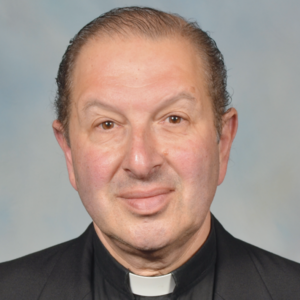
Currently, I am in my 22nd year as pastor of Our Lady of Grace Church in Hoboken, N.J., which is celebrating its 175th anniversary. During my seminary years, there was much ferment in the church and overtures to revisit the harsh language the Catholic Church used toward those who identified as “homosexuals.” As society became more tolerant, this attitude of tolerance and acceptance was creeping inside Catholic churches.
This Gospel invites us to go outside our circle of friends and begin new relationships.
Hoboken is a very diverse community, and among its population of 60,000—mostly young adults—there is a large number of LGBTQ Catholics. There had been no outreach, so we invited people to talk about how we could become gay friendly. Fortunately, a parishioner, Gary Stavella, stepped forward to co-moderate a support group that would meet regularly and invite any LGBTQ Catholics to attend. Eventually, Cardinal Joseph W. Tobin appointed him to serve as a member of the Archdiocesan Pastoral Council and serve on the U.S. Continental Synod.
The attendance at the support group began small and mostly attracted older Catholics who had been alienated. Some of the sharing was heartbreaking as people began to cry, sharing their rejection by members of the Catholic Church. One former parishioner said she never thought she would be back at the parish where she felt berated for her sexual orientation. She began to cry as she expressed how welcomed she felt in this space. One couple traveled a distance to share their concerns about their eldest child’s desire to transition. They were worried if he could eventually receive the sacrament of confirmation. They knew enough to enter into counseling with their son so they could support his desires.
One time we invited representatives of our active young adult group to talk about how they viewed the conversations surrounding LGBTQ members of the church. Not surprisingly, they were more tolerant and accepting than some aspects of the institutional church. In fact, they believed that the church’s teaching needed a makeover as a matter of justice.
In my own preaching, I try to incorporate LGBTQ imagery and language in a homily when it is appropriate.
After two years, we decided to offer what would become an annual Pride Mass, coinciding with the national annual Gay Pride Sunday. Our use of the word Pride was meant to indicate pride in the lives of our LGBTQ brothers and sisters as children of God. It did not go over well with some reactionary groups, and I continue to receive thousands of negative e-mails annually around the time we begin publicizing the Mass. In the past, protestors gathered across the street from the church at every Pride Mass, but we have not stopped. It occurs at a regularly scheduled Sunday morning Mass except for the designation.
Our attendees come from all across the metropolitan area of Hoboken as well as from Pennsylvania and southern New England. One of the highlights was a joint homily I shared with Christina Zuba, a trans woman from southern New Jersey who is a practicing Catholic and had a private audience with Pope Francis in 2024. What is most affirming—besides the visitors and local LGBTQ Catholics coming to the Mass—is the number of families from the parish with small children who attend. They deliberately bring their children to the Mass because they want them to grow up with the knowledge of how inclusive the church should be.
One drawback is that some LGBTQ Catholics want to worship in a predominantly gay congregation, which we do not offer. Nonetheless, they are always welcome to worship when they can. In my own preaching, I try to incorporate LGBTQ imagery and language in a homily when it is appropriate. Sometimes, this means including members of the LGBTQ community alongside other couples or individuals in homiletic imagery. At other times, I mention a national or local matter surrounding the LGBTQ community in a homily and offer a Christian perspective.
Our vocation, as people of faith, is to allow a person to find his or her relationship with God and invite them on that journey on their terms.
An especially important part of my ministry happens before the Pride Mass begins. I walk up and down the church, welcoming everyone, making a particular note to welcome any new faces. I do not think it is appropriate to ask any questions relating to sexuality. On occasion, someone might offer that they are LGBTQ, and I simply thank them for coming. I also am willing to speak with anyone who is trying to navigate a return to active participation in church.
I sense that in the back of some minds people may wonder if our hospitality is a Trojan horse of sorts, luring people in and then giving the old “fire and brimstone” messaging. This is not our philosophy with our parish nor in our LGBTQ ministry. A handshake, a smile and a warm welcome can go a long way toward healing.
It is precisely this reality that makes Jesus’ encounter with the Samaritan woman so powerful. It is a story of two people exploring what they share in common. Our vocation, as people of faith, is to allow a person to find his or her relationship with God and invite them on that journey on their terms. As Christians, we are to guide all people to learn from their conscience, face the reality of being human and find the “living water.”
From our parish LGBTQ ministry and my two decades of ministry, I know that the LGBTQ Catholic experience is wide and diverse. No two stories are ever the same. However, I believe it is my mission and the mission of this parish to support their journey of faith, and assure them that no one will deny their relationship in the church and with God. Grace strives to bring others to that level of faith, continuously drawing from the “living water” of God’s love and mercy in Jesus.