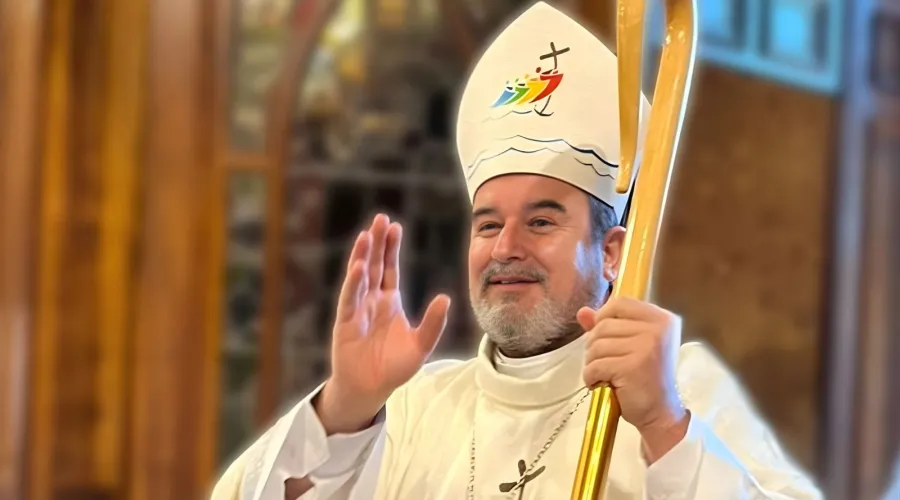
The following is adapted from a talk delivered by Bishop Arnaldo Carvalheiro Neto of Jundiaí, Brazil, during the Third Northern and Northeastern Regional Meeting of Brazil’s National Network of LGBT+ Catholic Groups. Bishop Neto serves as the bishop accompanying the network’s activities. The meeting, held June 4–6, 2026 in Fortaleza, Ceará, explored the theme “Tenderness and Dignity: Pastoral Ministry as an Expression of God’s Mercy.” This text has been edited and condensed for length.
No one is excluded
The joy of the Gospel is not the joy of someone who has never suffered; it is the joy of someone who has discovered that no wound inflicted on them is greater than the love of God. It is not superficial euphoria, a denial of pain or naïve optimism. Christian joy is paschal. It passes through the cross, but it is not held prisoner by it. It looks at wounds, but does not reduce the person to the wounds that were caused. It acknowledges the story, but affirms that God can still make hope be born again.
Inclusion and healing are not the concern of one particular group. They are a Gospel question addressed to the entire Christian community: What face of God do our communities reveal? A God who closes doors or a God who goes out to meet us? A religion that weighs on the shoulders or a faith that lifts up those left by the wayside? An institution concerned only with protecting itself or a home where grace circulates and life can flourish? The answer matters greatly for LGBT+ Catholics, many of whom have already learned it the hard way.
We are not here to represent a problem, to justify our own existence or to ask permission to be loved by God. We are people of faith, people in search, people who carry concrete stories, concrete bodies, concrete affections, concrete wounds and concrete hopes. The space we need in the church is not a courtroom. It is an encounter.
Pope Francis, at the beginning of Evangelii Gaudium, writes that the joy of the Gospel fills the hearts and lives of all who encounter Jesus. He adds that those who let themselves be saved by Christ are set free “from sin, sorrow, inner emptiness and loneliness.”
We are people of faith, people in search, people who carry concrete stories, concrete bodies, concrete affections, concrete wounds and concrete hopes.
That enumeration matters a great deal. The Gospel does not touch only guilt; it also touches sadness, emptiness and isolation. Many spiritual wounds never show on the surface but corrode from within: the sense of not belonging, of living under constant suspicion, of needing to hide parts of one’s own life in order to be accepted, of being unable to pray with the whole truth of one’s heart.
Evangelii Gaudium contains a decisive line: “No one is excluded from the joy brought by the Lord.” That line needs to be heard slowly, almost like a prayer. No one is excluded. It does not say no one is excluded except those with a complicated story. It does not say no one is excluded except those still trying to understand their own life. It does not say no one is excluded except those who feel far from what their community expects of them. It says simply: no one is excluded. God’s love allows no exception.
That line is not a license for a faith without conversion; on the contrary, it is the doorway to true conversion. Only someone who knows they are loved can change at a deep level. Only someone unafraid of being restored by God can hand over their wounded places to God. Only someone who senses that God approaches not as an accuser, but as a merciful Father—as Christ, who looks, touches, calls by name and gives back a future—can open their life to grace.
Francis goes on to say that God never tires of forgiving, that it is we who tire of asking for mercy and that no one can take away the dignity conferred by that infinite love. Here is an essential word for people wounded by religious rejection: Dignity is not a concession granted by the community; it is a gift from God.
The Christian community can recognize that dignity with evangelical maturity or fail to recognize it, but it does not create it. Before any debate, before any label, before any social boundary, the human person exists before God as a beloved creature.
Here is an essential word for people wounded by religious rejection: Dignity is not a concession granted by the community; it is a gift from God.
The joy of the Gospel is born when that truth stops being merely an idea and becomes an experience. Many of us have heard since childhood that God loves us. But it is one thing to hear, in general terms, that God loves humanity; it is another to be able to say with peace: God loves me, here, in this story, in this body, in this searching biography. The Gospel begins to heal when a person stops imagining themselves as merely tolerated by God and starts to recognize themselves as desired, seen and loved.
Not a tollhouse, but the house of the Father
A joy that includes is not only an inner disposition; it calls for a certain shape of church. Francis spoke of a church “going forth”: a community that takes the initiative, goes out to meet people, seeks out those who have drifted away and stands at the crossroads to invite in the excluded.
The Christian community should not wait for wounded people to prove first that they deserve to be approached. Love is never a matter of merit. It is grace. A church that goes forth knows that God took the initiative. If God loved us first, the community can also learn to love first.
Pope Francis used very concrete verbs: to take the first step, to get involved, to walk alongside, to bear fruit and to celebrate. These verbs can guide Catholic outreach and evangelization with LGBT+ people.
Taking the first step means making the first move, not staying on the defensive or waiting for someone who has been hurt to come back on their own. Getting involved means listening to real stories, not speaking about LGBT+ people only as an abstract category. Walking alongside means accompanying people with patience, respecting their processes, consciences, family histories, histories of faith and moments of crisis and reconciliation. Bearing fruit means believing that each person’s life can generate gifts for the community. Celebrating means recognizing every small step as a sign of grace.
Getting involved means listening to real stories, not speaking about LGBT+ people only as an abstract category.
Perhaps the most beautiful image comes from paragraphs 46 to 49 of Evangelii Gaudium. Francis affirms that a church which goes forth is a church with open doors, called to be “the house of the Father, with doors always wide open.” He says the church is not a tollhouse, but “the house of the Father, where there is a place for everyone, with all their problems.”
The word “tollhouse” is remarkably expressive. A tollhouse controls, inspects, suspects, blocks, authorizes or denies passage. The Father’s house welcomes, feeds, listens, teaches, heals and calls people to life.
Many people have known communities that functioned like spiritual tollhouses: They were classified before being heard, evaluated before being able to pray and reduced to a moral topic before being called by name. A church with the heart of the Father’s house does not abandon discernment, but it trades fear for mercy, distance for encounter and control over grace for facilitating access to God. In the Father’s house, every child holds a key. And the key is the sincerity of the heart.
No one can face life in isolation
In Fratelli Tutti, Francis writes: “No one can face life in isolation.” We need a community that supports us and helps us look ahead. That line carries great pastoral weight. Exclusion makes people sick because it isolates. Healing begins the moment someone can say: I do not have to walk alone. My faith does not have to be lived in secrecy. My prayer does not have to hide my story. My community does not have to be a place of fear.
Fraternity heals because it breaks solitude. For many LGBT+ people, solitude is not simply the absence of company; it is the experience of being unable to be whole anywhere. It is the sense of having no home. In some settings, a person can feel that they may be LGBT+, but not Catholic.
Inclusion is not a sociological trend. Inclusion is an expression of the logic of the Incarnation.
The pastoral challenge for a group of LGBT+ Catholics is to bear witness that a person does not need to fragment themselves in order to find God. Each person is called to an honest, responsible, prayerful and communal integration.
Inclusion is not a sociological trend. Inclusion is an expression of the logic of the Incarnation. God did not save us from a distance. In Jesus, God drew near, took on human flesh, touched lepers, sat at table, looked into people’s eyes, listened to cries, wept at the death of a friend and allowed himself to be touched by those who were not considered socially “pure.” In Jesus, love is always close.
A healed community becomes a healing community
The Gospel includes because God draws near; the Gospel heals because God loves the whole person. Christian inclusion is not mere tolerance. To tolerate can mean simply to put up with something at a distance. To include, in the evangelical sense, is to recognize dignity, open space for belonging, listen, accompany, discern and allow each person’s gifts to build up the community.
Christian healing is not the erasure of history. To heal is not to pretend a wound never existed. To heal is to let the wound stop controlling the entire narrative of a life. To heal is to be able to remember without being destroyed. To heal is to be able to pray without fear. To heal is to be able to serve without resentment. To heal is to be able to belong without erasing oneself. To heal is to be able to say: My story carries marks, but it also carries grace.
In this sense, LGBT+ Catholic groups can be prophetic signs for the whole church. They remind us that faith is not the property of those who have never known conflict, but the path of those who let themselves be found by Christ. They remind the church that it needs to listen to its peripheries not as a threat, but as a place where the Spirit can speak. There is no cure for something that never was, is not and never will be an illness!
None of this works without listening: There is no true welcome without hearing real stories. Language matters just as much. Words can heal or wound, so pastoral language must remain faithful to the Gospel and attentive to dignity.
People are not helped by slogans; they need a path, time, prayer, friendship, formation and discernment. An LGBT+ Catholic group does not exist only to discuss identity, though that can matter. It exists to help people encounter Christ with the whole truth of their lives. This means staying in communion with the church: praying for it and with it, contributing to it and also asking it to continue converting to the style of Jesus.
LGBT+ Catholic groups can be prophetic signs for the whole church. They remind us that faith is not the property of those who have never known conflict, but the path of those who let themselves be found by Christ.
Those who have been comforted can comfort others. Those who have been welcomed can welcome others. Those who have experienced mercy can become a sign of it. A healed community becomes a healing community.
The joy of the Gospel fills the hearts and whole lives of those who encounter Jesus. That joy is not the privilege of a few. Pope Francis affirms that no one is excluded from the joy brought by the Lord. So if anyone arrived carrying the question, “Is there a place for me?” the Gospel’s answer begins like this: There is a place for you in the heart of God. The church’s mission is to make that truth visible, concrete and inhabitable.
Healing may not happen all at once. Some wounds may need time, psychological support, spiritual direction, family reconciliation, silence, tears and new experiences of community. But the Gospel allows us to keep walking. Christian joy can begin small, like a beam of light in the middle of the night. It can be born the moment someone realizes: I am not alone. God has not given up on me. My life can still flourish.
May our groups be spaces of prayer, listening, formation, creativity, boldness, friendship, discernment and mission. May every person be able to hear, once again, the call of Christ: “Come, follow me.” Not as someone erasing their story, but as someone handing it over to a greater love. Not as someone presenting themselves as perfect, but as someone who knows they are loved. Not as someone living in fear, but as someone who has found the joy that no one can take away.
This article has been translated from the Portuguese by Ricardo da Silva, S.J.