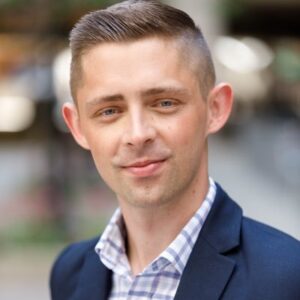

This summer, I’ve had the privilege of traveling to over 30 cities across North America, speaking about my new book Queer & Christian: Reclaiming the Bible, Our Faith, and Our Place at the Table. I have to admit that when I began this tour, back in May 2025, I was a bit nervous—nervous about the state of our country, nervous about the state of the Christian church broadly and wondering how people might respond to the vision I cast in the book of a truly queer Christian faith. As I come toward the end of this year’s tour, I’ve spent a good amount of time reflecting on what I’ve experienced, and I have found that through it all, I am profoundly inspired and hopeful about our collective future as LGBTQ Christians.
What I have seen in communities from Hattiesburg, Mississippi, to San Francisco, California, are communities of Christ-followers coming together across lines of difference that at various points in history would have divided us—sexuality, gender, politics, ethnicity and denominations—and choosing to build faith-rooted coalitions in order to create a more just and inclusive church and world. In my mind, this is exactly what I mean when I write in my book that we need a queer revolution in the church. Let me explain.
Queerness is not merely an umbrella descriptor…but is a fundamental posture that we adopt as we engage in our world.
The author bell hooks writes of queerness: “Queer not as being about who you’re having sex with (that can be a dimension of it); but queer as being about the self that is at odds with everything around it and that has to invent and create and find a place to speak and to thrive and to live.”
This is the framing of queerness that has been utilized since the earliest days of the LGBTQ rights movement in America. Queerness is not merely an umbrella descriptor for the broad LGBTQ community and all of our unique identities, but is a fundamental posture that we adopt as we engage in our world. It recognizes the uniqueness and diversity of every individual person and works to create spaces where all of us, in all of our diversity, can “speak and thrive and live.”
In this sense, queerness is necessarily a communal effort—one cannot be queer on their own—because it requires us to situate ourselves in the midst of difference. It requires us to recognize that our own experiences and perspectives of our faith and world are valid, but they are not the only perspectives and experiences. Thus, we must create a church and society where a plurality of people can flourish. At its core, queerness is a push against conformity—any effort to force us to adopt identities, perspectives or beliefs as a requirement to belong or experience equality. It is a posture of curiosity, willing to ask “why?” when the powers that be demand that we show up in the world a certain way. From a Christian perspective, it is an openness to the Spirit of God, whom Jesus describes as “like the wind” (John 3:8), affirming that if our God cannot be confined or contained by our words or institutions, then neither can the people who are made in the image and likeness of that God—and that’s all of us.
Queerness is necessarily a communal effort—one cannot be queer on their own—because it requires us to situate ourselves in the midst of difference.
Queerness isn’t rebellion for the sake of rebellion, but an affirmation that reality is always more complex than it seems, and that in order for humans to truly flourish, each of us needs space and permission to become the authentic people our Creator intended us to be. Yet for many queer people in the world today, such spaces are being eliminated at an alarming rate. In the church and society at large, we are seeing power brokers demand that we eliminate diversity and difference in favor of conforming to their arbitrary desires for how the church and world should look. From a theological lens, the push for conformity is also a push to try to limit God, to box God in and to control what the Spirit can and cannot do. But the witness of Scripture is very clear—such plans to limit God always fail.
And indeed, the efforts in our world are failing, though it may take time for us to recognize this. To try to limit God or the people God has made in God’s own image is like trying to put a cap on a bottle filled with vinegar and baking soda—the pressure will build and eventually there will be an explosion of liberation and diversity once again, because God and God’s people cannot be confined or constrained. It is our fundamental nature and indeed our deepest calling to express our authentic selves, for in doing so, we bring glory to the One who created us and whose image is magnified in human diversity. Instead of seeking to box people into tight and neat categories, any authentic Spirit-led community or society should be seeking to tear down the walls and boundaries that have been erected in order to see, experience and learn from the broad diversity of God’s creativity.
It’s a posture of…radical openness that asks God to open the eyes of our hearts that we might perceive the ways God is at work.
This is happening. You’ve probably seen it in your own parishes or communities. Even in the church I pastor, I have been amazed at the diverse people who have been showing up in our pews each Sunday—not because of our marketing or efforts to draw folks in, but because people are yearning for communities where they can be themselves, where they can be in proximity to others who are different and where they can be united in the common goal of pursuing God and working to establish God’s kingdom on earth as it is in heaven through subversive acts of love and justice. While the forces of conformity and oppression are raging in our day, what they do not realize is that they are actually being used by God to shake the masses from their slumber and to recognize the kind of society and the kind of church they actually desire to see—not one of rigid boundary lines, but one of open doors where we get to experience the wild winds of the Spirit through our questions, doubts and doing life with those who experience the world differently.
For me, this is what it means to queer the church and the world. It’s a posture of resistance and curiosity, a posture of radical openness that asks God to open the eyes of our hearts that we might perceive the ways God is at work through unexpected people and in unexpected places. It’s a commitment to “tearing down the dividing walls” (Ephesians 2:14) and recognizing that the only way to create the world Jesus calls us to work for is through “inventing and creating,” through resisting the stagnation of our faith, and embarking each day on the journey to discover new ways of seeing and being in the world. This is what the powers in our society are raging against in this moment, but this is indeed what God is provoking in communities in every corner of this nation and indeed in each one of our hearts. A queer revolution is underway, and I am more confident now than ever that God’s inclusive love will indeed win in the end.