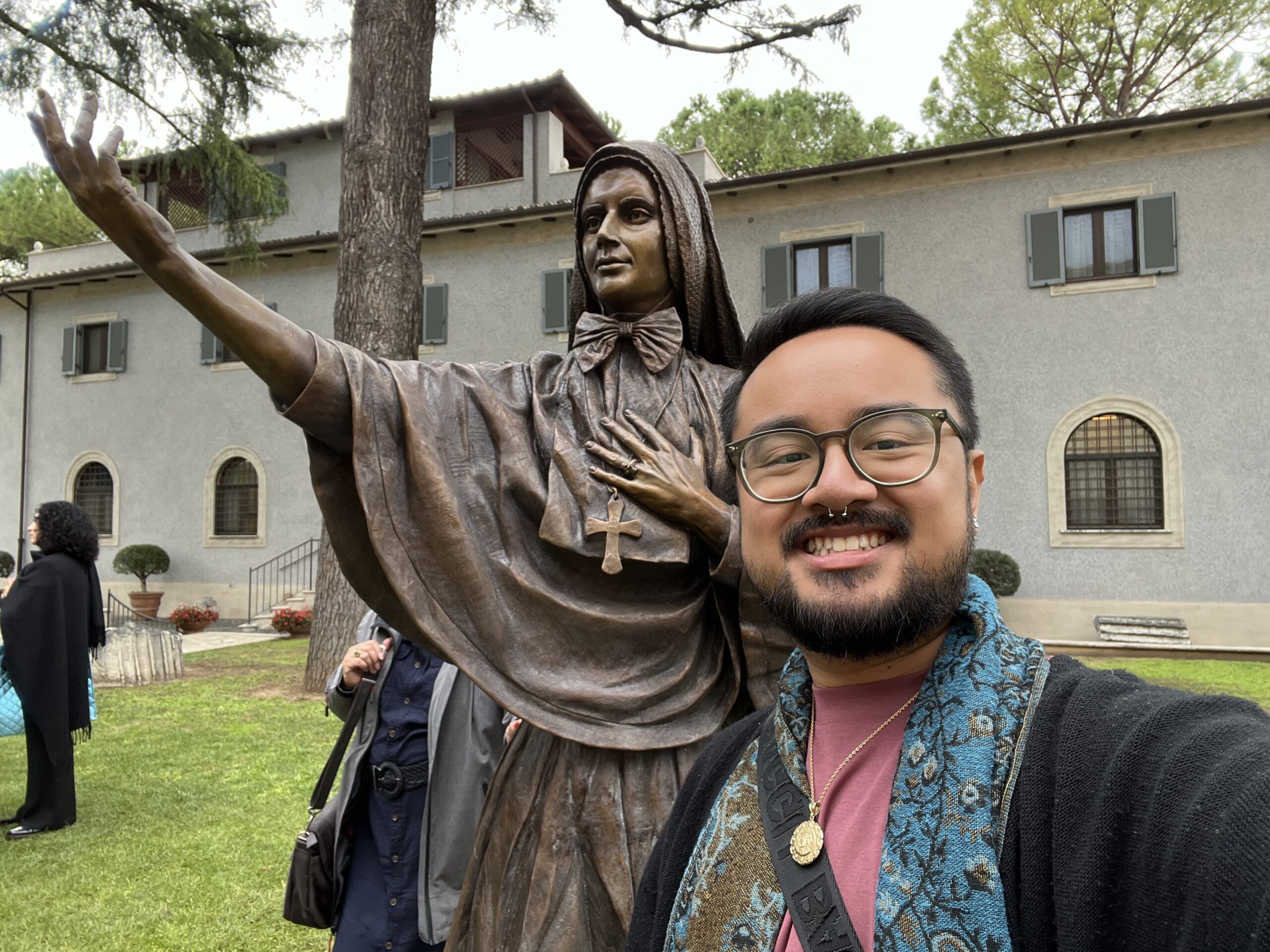
In my neighborhood of Lakeview in Chicago, the past and present coexist in beautiful harmony. Beautiful Gilded Age mansions stand alongside modern high rise apartments; and their inhabitants reflect the past, present and future of this diverse city. A few blocks away from my apartment is the site of the old Columbus Hospital, opened in 1905 by none other than America’s first citizen-saint, St. Frances Xavier Cabrini, affectionately known as Mother Cabrini.
It’s true; a saint once lived here and walked the streets of this neighborhood that are now dotted with hip cafes, grocery stores, boutique shops and vibey bars. The once sprawling hospital campus, which stood along Lake Michigan, was demolished in the early 2000s. Today only a shrine to its founder remains, enveloped by a luxury condominium that was literally built up and around it, securing the future of this sacred place for generations to come.
With the 80th anniversary of this saint’s canonization today, I want to give the patron of immigrants another honorific: a patron of the LGBTQ community. It was through my own encounter with Mother Cabrini that I found a path back to my Catholic faith through the example of her own life, my encounters with her spiritual daughters, and the welcoming community at her shrine.
With the 80th anniversary of this saint’s canonization today, I want to give the patron of immigrants another honorific: a patron of the LGBTQ community.
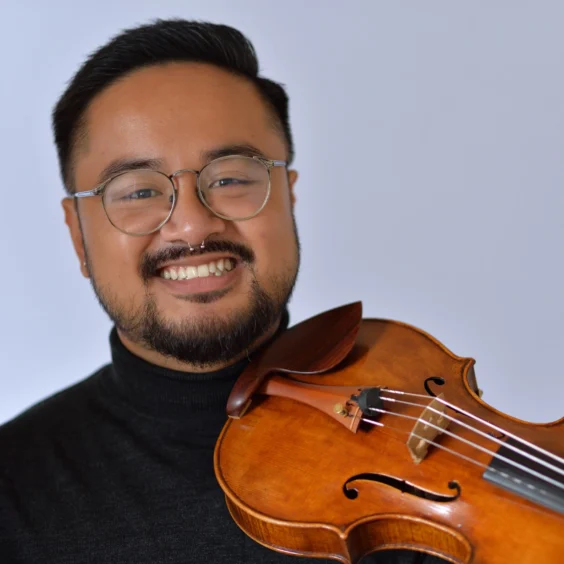
Despite living in this neighborhood for over nine years, I did not set foot inside the National Shrine of St. Frances Xavier Cabrini until 2023, when I was hired as a violinist to play for her feast day Mass. It was at this location that Mother Cabrini died on Dec. 22, 1917. After Mass, I lingered around and explored the shrine’s small museum.
The expression “67 institutions in 67 years,” is a phrase passed among the Cabrinian family that reflects the 67 orphanages, hospitals, convents and schools she established by the time she died at the age of 67. Testifying to this fact is an enlarged black and white map on the wall of the museum that shows all of Mother Cabrini’s international travels, shown with dotted lines, and her establishments, symbolized by stars on the map. Who was this globe-trotting nun? I eagerly read through biographies and resources about her life, especially related to her time in Chicago, to try and piece together a more complete portrait of this woman. It was also around this time that I made the decision to re-engage with the faith of my childhood after several lukewarm and strained years with it after coming out of the closet.
Mother Cabrini’s life story deserves its own article, but for now let’s cover the basics. Mother Cabrini, born Francesca Cabrini, was born on July 15, 1850, in Sant’Angelo, Italy, to a modest and pious farming family. Influenced by her older sister, Rosa, the young Francesca desired to become an educator. From an early age, she also felt a call to religious life, inspired by the stories recounted in the Annals of the Propagation of the Faith, a publication similar to America magazine in that it shared articles about Catholic culture and news, but most notably, tales of Catholic missionaries in far off countries. It was these stories that instilled a desire in a young Francesca to traverse the globe to bring the Gospel to far off lands.
It was through Sr. Laura’s ministry of encounter that I felt Mother Cabrini’s sense of unconditional welcome.
After being rejected by multiple local religious orders because of her poor health, she eventually received permission from her local bishop to found her own order: the Missionary Sisters of the Sacred Heart of Jesus. Soon afterward, her congregation opened a house in Rome, firmly planting them in the heart of the Catholic world. Wanting to seek papal permission to open a mission in China, she met with Pope Leo XIII, who instead directed her to go to the United States to assist with the plight of the Italian immigrants there: “Not to the east, but to the west,” Pope Leo XIII said.
From my initial research, I was able to gather that Mother Cabrini was someone who
- Had complete and total trust in God,
- Relied on community and help from those around her,
- Was dedicated to the undeniable truth of the innate dignity of every person.
All of these traits, while inspiring, still paint only a two-dimensional image of Mother Cabrini, but I wanted to see if I could get closer to the real person. Who better to ask than the spiritual daughters of Mother Cabrini who still carry on her mission today: the Missionary Sisters.

I soon befriended Sr. Laura Baldini, M.S.C., one of a small group of Missionary Sisters who remain in Chicago and tend to the shrine. It was through her that I learned much about Mother Cabrini and her charism that could not be read in any book or article. It was through Sr. Laura’s ministry of encounter that I felt Mother Cabrini’s sense of unconditional welcome, and we soon had a standing appointment for a chat every Friday at the shrine.
I had just come back from the 2024 Outreach Conference, and I was feeling inspired and full of the Holy Spirit. As I approached Sr. Laura’s office, I realized that in order to explain where I had just been, I had to disclose my sexual orientation. At that point, I was in my late 20s and never batted an eye whenever I mentioned my LGBTQ identity to anybody. But coming out to a nun is a rather different story. I remember being a bit apprehensive as I approached Sr. Laura’s office. We began with some small talk before I pulled out the conference program to show her. “It’s a gathering for LGBTQ Catholics, allies and clergy,” I explained. Sr. Laura looked on with her usual kind eagerness while I told her about my experience.
Without missing a beat, Sr. Laura said, “I’m so glad you were able to go, Brent! Jesus didn’t put labels on people, and Mother Cabrini certainly didn’t either. She loved diversity!” Sr. Laura remains one of my dearest friends and has welcomed me and other LGBTQ people to the shrine, including the two groups AGLO Chicago (Archdiocesan Gay and Lesbian Outreach) and Dignity USA. The shrine has even hosted two AGLO Chicago retreats during Pride Month, where we meditated on the Sacred Heart of Jesus, the perfect synthesis of LGBTQ and Catholic identity.
Something that particularly inspired me about Mother Cabrini’s spirituality was the constant emphasis that God’s love is not far away from us, but rather dwells deeply within all of us.
Another Missionary Sister who brought Mother Cabrini’s story to life was Sr. Thérèse Hope Merandi, M.S.C. In November 2024 I was fortunate enough to accompany a group of pilgrims from Chicago to Italy, to trace the steps of Mother Cabrini from her hometown in Sant’Angelo all the way to Rome. It was there that I met Sr. Thérèse, who accompanied us every step of the way.
As we traveled across Italy, Sr. Thérèse shared her insights into Mother Cabrini’s story, tying in every site we visited back to Mother Cabrini’s spirituality. The climax of the pilgrimage was the unveiling of a new statue of Mother Cabrini, a gift to the late Pope Francis from the Archdiocese of Chicago, which was to be installed on the grounds of the Basilica of St. Paul Outside the Walls. The ceremony was presided over by Cardinal James Harvey, a fellow American, who remarked on the appropriateness of Mother Cabrini being present at this site for “it was at the margins, ‘outside the walls,’ that Jesus also went to be with those who felt hopeless, abandoned, or alone.”
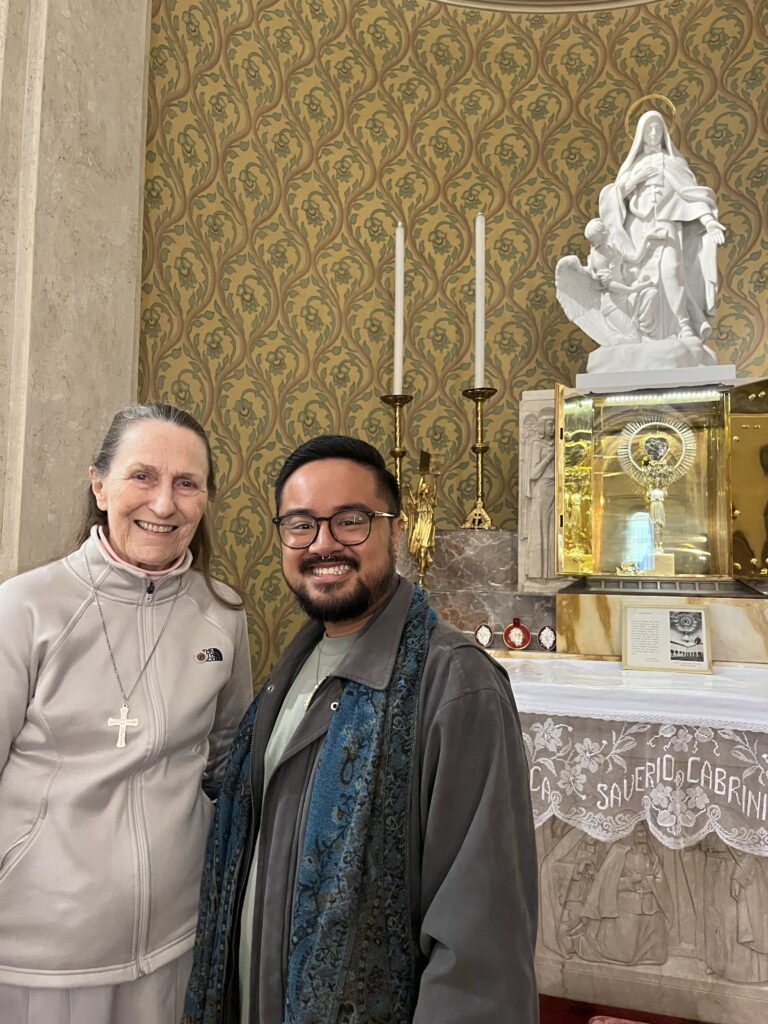
Recently, Sr. Thérèse visited Chicago to give a retreat on “Cabrinian” spirituality. She spoke of Mother Cabrini’s story and related it to what would eventually become the spirituality of the Missionary Sisters: “Sacred Heart spirituality.” Mother Cabrini, having lived through much trauma and suffering in her own life, developed a spirituality that was grounded in reality and in the present. Rather than trying to escape suffering to an other-wordly spirituality, she grew and loved through it. From this emerged her sense of hope and determination that allowed her to minister tirelessly to those around her.
Something that particularly inspired me about Mother Cabrini’s spirituality was the constant emphasis that God’s love is not far away from us, but rather dwells deeply within all of us. It is something that is not merited by us, but freely and abundantly given. “It is a love that gives life,” and as Sr. Thérèse said, it is a love that “desires us to be unified, inclusive, and welcoming.” Another pillar of Sacred Heart spirituality is the importance of encounter, which Mother Cabrini considered as the compliment to contemplation: “The Spirit of God in us recognizes the Spirit of God in others,” says Sr. Thérèse.
[Mother Cabrini] is a model of what an inclusive and welcoming church can look like…
Mother Cabrini’s story is more timely than ever, especially at this very divided time in the United States. We have watched with horror as our neighbors are unjustly kidnapped and abused by ICE, all against the backdrop of ignorant rhetoric from our government leaders. However, even amid all this darkness, the light of Mother Cabrini’s story shines through. In 2025, the United States Conference of Catholic Bishops released The Cabrini Pledge, a pledge that reaffirmed the Church’s stance on the innate dignity of those on the margins, especially those who are members of the immigrant community.
I believe that the Lord sends us the right people at the right time to help us on our journey and it was truly more than a casual connection that brought me and Mother Cabrini together. Her story reminds me that the church is a place for everybody, especially LGBTQ people, despite what some in the church might say about it. Her spiritual daughters, the Missionary Sisters, continue to carry that charism today: Sr. Laura showed me Mother Cabrini’s true sense of welcome, affirmation and accompaniment while Sr. Thérèse taught me a deeper understanding of the profound love of God and his desire for an inclusive and welcoming church.
Lastly, the community at Mother Cabrini’s shrine, who have shown me nothing but charity and welcome, reflect the fruit of Mother Cabrini’s ministry and spirituality. It is through these three touch points—her story, her spiritual daughters, and the community at her shrine—that she reaches out across history to reassure me and other LGBTQ people that there is room for us at the table. She is a model of what an inclusive and welcoming church can look like and that is why I want to mark her 80th canonization anniversary by giving her the additional title as a patron of the LGBTQ community. It was through her that I, like so many other people, found my own path back to the Sacred Heart of Jesus—and I hope she can do the same for you.