
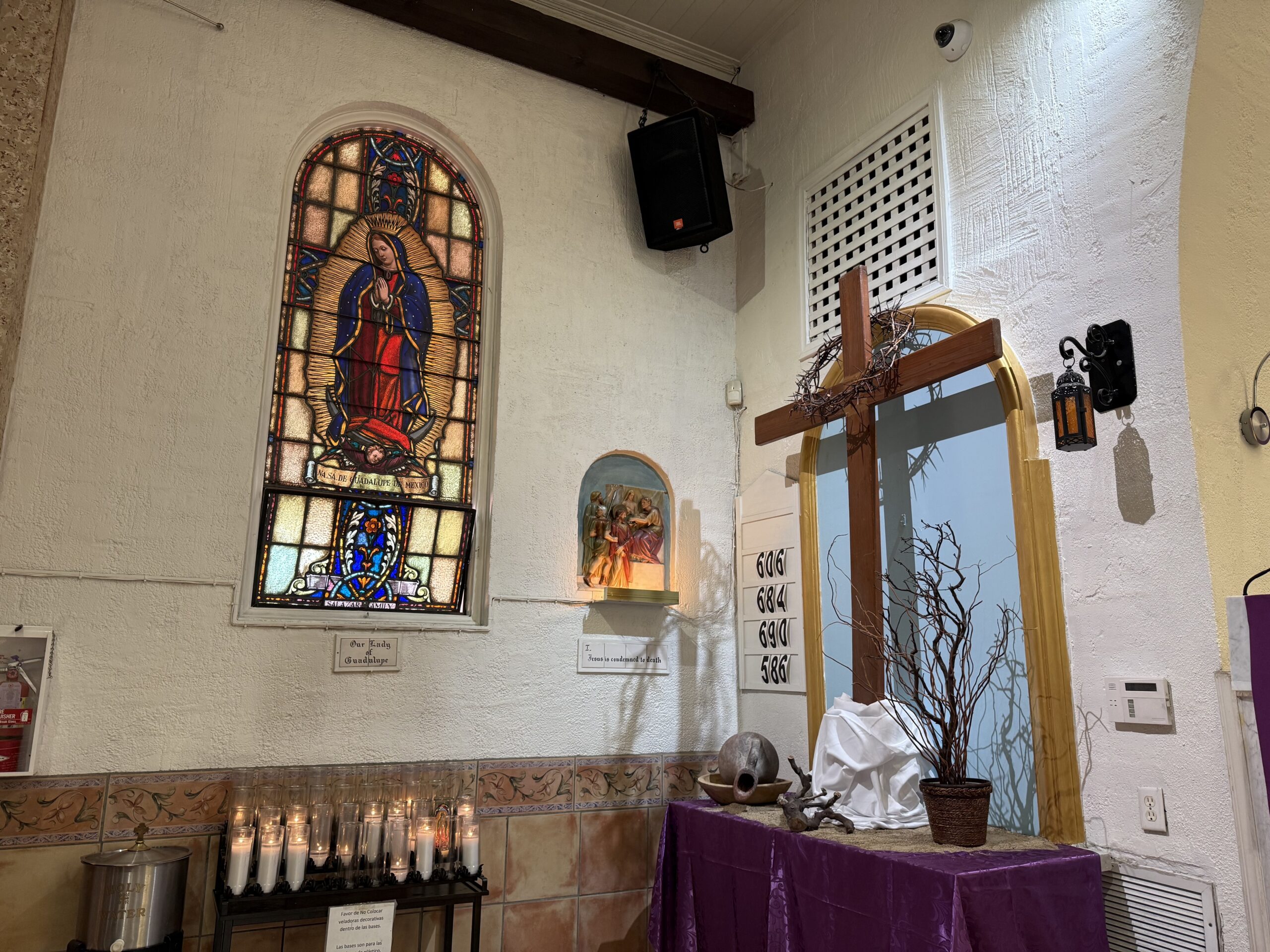
With the season of Lent well underway, you might be wondering how you can mark this holy time of the year in your own life. Traditionally, there are three pillars of Lent: prayer, fasting and almsgiving. As Fr. John McGivern, pastor of Our Lady of Mount Carmel in Chicago, says, “These practices are not spiritual achievements; they are acts of restoration. They place God back at the center. They reorder what sin has disordered.”
Our rich faith provides a myriad of ways you can dive into the spirituality of this season and as LGBTQ Catholics, it can feel intimidating to make these devotions your own. I’m reminded of something Fr. Steve Krupa, SJ, coordinator of Seminars in Ignatian Formation, said to me during a retreat for LGBTQ Catholics: “It’s good for us [LGBTQ Catholics] to have these sacred practices and symbols—the “smells and bells”—and to claim them because they’re yours too!”
The following are some of my favorite devotions that can be especially enriching during Lent, but they can be prayed all year long. May they help deepen your relationship with our Lord as we await the joy of Easter!
It’s good for LGBTQ Catholics to have these sacred practices and symbols—the “smells and bells”—and to claim them because they’re yours too.
The Rosary
The Rosary is probably one of the most iconic and popular Catholic devotions and its use isn’t limited to the season of Lent. The mysteries of the Rosary take us through the various scenes and stories of Jesus’s life, but during this season, the Sorrowful Mysteries become our primary focus. There are many commentaries and adaptations of the mysteries of the Rosary, but one that I find especially moving is The Rosary for LGBTQ People: Reflections on the 20 Mysteries of the Holy Rosary by Fr. Don Greene, MSSD. In this set of reflections, Fr. Greene takes us through each of the mysteries while drawing parallels to the queer experience. In his preface, Fr. Greene says, “The Rosary for LGBTQ People is designed to add prayerful time to the LGBTQ person’s—or allied person’s—day while continuing to affirm God’s love for all of humanity. We are made in the image of our Creator, perfect and pleasing in God’s sight. Because our Creator has made us this way, we pray this rosary, proudly and devoutly, to Our Lady so she might look upon us with her Motherly love and bring us closer to her Son, Jesus.”
The Way of the Cross
As a cradle Catholic, attending the Stations of the Cross during Lent was a common practice. I will take a moment to humbly brag that I was runner-up to play the role of Jesus in my middle school’s annual production of the Stations of the Cross (as consolation, I was awarded the role of Roman Soldier #1). I used to consider this practice very “old school,” citing my own experiences of seeing the more mature members of my childhood parish praying this before Sunday masses during Lent. As I began to more seriously engage with my faith in early adulthood, that mindset changed and I found the practice fruitful and rewarding to my spiritual life.

When I moved to Chicago in 2017, I joined AGLO Chicago, the archdiocese’s LGBTQ outreach ministry based at Our Lady of Mount Carmel in Boystown, the city’s gayborhood. As part of their Lenten offerings, they hosted an LGBTQ-centric adaptation of the Stations of the Cross using John T. Kyler’s book Search Me: A Way of the Cross in Solidarity with the LGBTQ Community. In this beautiful booklet,
Kyler places the LGBTQ experience side by side with Christ’s own experience en route to Calvary. To further deepen the experience, modern queer interpretations of the Stations were projected on a screen for us to meditate on during the time of prayer. After each station, the floor was open for people to comment on how they felt or to share any insights that came to them at that moment. The gathered crowd, made up of elders and young people, shared a variety of stories and memories. It was an opportunity not only to pray together, but to hold space for the heavy emotions that often arise when reflecting on the events of Lent and the LGBTQ experience.
The Stations of the Cross was an opportunity not only to pray together, but to hold space for the heavy emotions that often arise when reflecting on the events of Lent and the LGBTQ experience.
Eucharistic Adoration
As Catholics, the Eucharist is the “source and summit” of our spiritual lives and the true presence of Jesus is a central tenant of our faith. One of my personal Lenten goals is to spend more time in quiet and prayer, which Eucharistic adoration is perfect for. The thing I really enjoy about Eucharistic adoration is that you can make it anything you’d like. You can pray a prescribed prayer such as the Rosary or the Divine Mercy, you can pray lectio divina with the Scriptures, you can journal your prayers or you can simply sit and soak in the Divine Presence.
One of my New Year’s resolutions from a few years ago was to attend weekly adoration at the National Shrine of St. Frances Xavier Cabrini, just a few blocks away from me. It has now become a staple in my spiritual life and I find the experience vital to my spiritual, mental and even physical health (what is more beneficial for the body than moments of rest and repose?). Mother Cabrini, who is one of my patron Saints, would often say that in the presence of the Eucharist, she was immersed in “an ocean of love.”
The Divine Mercy Chaplet
You may be familiar with the famous image of the Divine Mercy: Jesus robed in white standing against a black background with red and white rays emanating from his chest, a hand outstretched in blessing while the other gestures to his heart. My early encounters with the Divine Mercy, made famous by the Polish mystic and Saint, St. Faustina Kowalska, were not always positive ones. I was a senior in high school, freshly out of the closet and attending my first Pride Parade when I saw a protester off to the side with the image. Armed with a megaphone and shouting angry obscenities at parade attendees, I saw the famous Divine Mercy image with a message of eternal damnation printed across the front in a garish font.
Needless to say, I kept my distance from the Divine Mercy, even after I integrated my queerness with my faith. It wasn’t until my 30’s that I decided to pick up St. Faustina’s Diary and read it for myself to try and understand this devotion. You can imagine my surprise when I began reading and found not fire and brimstone, but sweet messages between Jesus and St. Faustina.
At the behest of her spiritual director, St. Faustina recorded her visions and conversations with Jesus in a collection of six notebooks throughout her life. This would later be edited and compiled into her famous Diary. From the start, Jesus charged St. Faustina to be his “secretary of Mercy” with the sole aim of spreading his message of mercy, compassion, and forgiveness to the world. Throughout the Diary, Jesus tells St. Faustina that people do not believe or trust in his mercy, but that they should not be afraid to come to him: “I am love and mercy itself…Let no soul fear to draw near to Me, even though its sins be as scarlet…My mercy is greater than your sins, and those of the entire world.”
“Rejoice all you creatures—she wrote—for you are dearer to God in His infinite mercy than a baby to his mother’s heart.”
Out of these visions and reflections came the image of the Divine Mercy and the Chaplet of the Divine Mercy. Jesus encouraged St. Faustina to compose this chaplet and encourage its use to remind people of God’s boundless love and mercy. This devotion was greatly admired by the late Pope St. John Paul II, who beatified St. Faustina in 1993.
This has since become one of my favorite prayers, but it is especially appropriate for Lent given that this season highlights a return to God, turning away from the things that impede our relationship with him and trusting in his love and mercy. It’s also appropriate because the Feast of the Divine Mercy (“Divine Mercy Sunday”) is always on the second Sunday of Easter. A fellow LGBTQ Catholic friend of mine recently told me that he keeps two books on his nightstand for spiritual reading and nourishment: the Gospels and The Diary of St. Faustina.
Here are a few favorite quotes of mine from the Diary that relate to the LGBTQ experience:
“Everything that exists has come forth from the depths of My Mercy.”
“Rejoice all you creatures—she wrote—for you are dearer to God in His infinite mercy than a baby to his mother’s heart.”
“My love has taken possession of your soul, and I want you to be confirmed in it. Bring your ear close to My heart, forget everything else, and meditate upon My wondrous mercy. My love will give you the strength and courage you need in these matters.”
Daily Lenten Reflections
If your parish is anything like mine, it typically offers little booklets of daily Lenten reflections. These little books are available for the various seasons of the liturgical year and are designed for easy daily use. They typically include the scripture reading for the day, a brief reflection and a prompt to reflect on over the course of the day—all designed to be done in under 10 minutes. I loved using these booklets as I could read them on the train en route to work or with my morning cup of coffee as I start my day.
Lent is a season of return.
Since we do live in the digital age, we also have the option of daily emailed Lenten reflections. For the past few years, I’ve really enjoyed daily emailed reflections from the Jesuit Media Lab. Similar to the little booklets, they often contain reflections on a certain Lenten theme from both clergy and lay people alike and are always accompanied by beautiful art. America Media, the Jesuit ministry of which Outreach is a part, also offers free daily Scripture reflections during the season of Lent. Written by members of America’s staff, these reflections on the Mass readings for the day provide insight to the Scripture passages that combine Biblical commentary and personal experience.
Make Lent Your Own
These are just a few devotions that are spiritually nourishing me this Lenten season, but the important thing is that you make your practice personal to you. As mentioned earlier, this is a season of return. How can you mark your personal prayer time so as to grow closer to God? My last bit of advice would be to avoid overcommitting to severe penances or additional devotions. It shouldn’t feel like a check-list or over laborious.
My prayers are with you all as we accompany one another this Lenten season: As Alan J. Hommerding, the composer wrote: “From ashes to the living font your Church must journey still, through cross and tomb to Easter joy, in Spirit-fire fulfilled.”