
This essay appears in the forthcoming French volume Homos Et Cathos: L’Église à l’épreuve du réel (Gays and Catholics: The Church Put to the Test of Reality), published by Desclée De Brouwer. Read in the original French here.
When we were schoolboys and would get into arguments in the playground of our Catholic boys’ school, the ultimate weapon was to call each other the F-word. We didn’t really know what we were talking about, but we knew it was the worst insult we had up our sleeves before things came to blows. In all honesty, I must admit that for a long time I still laughed at the barracks jokes that touched on the dignity and privacy of people who were, to me, unreal, outside my social circle, whereas they were, of course, part of it and suffered the humiliation in silence. It took my entry into the Dominican Order for me to experience brotherhood with homosexual brothers, just as I was a heterosexual brother. It was when one of them said to me one day, ‘no one chooses to be homosexual,’ that my eyes were finally opened. That was my road to Damascus.
How, then, can we be surprised by the force of the pendulum swing set in motion by the first heroic coming-outs, which in certain places and circles can even lead to a dynamic of identity-based minorities, or even lobbying?
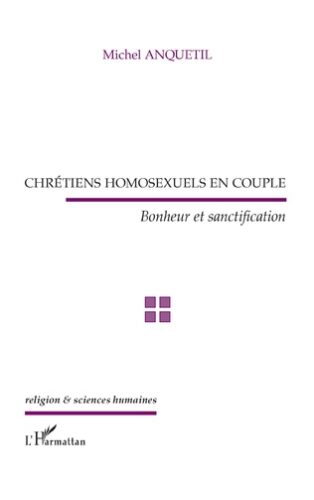
Taboo for centuries due to its ignominy, taboo today because of institutionalized trivialization—how difficult it is to speak of homosexuality! It is the great merit of this book to break this taboo in the most beautiful and soothing of ways. Starting from life experiences and re-examining them in the light of Scripture, theology and morality naturally unites heart and mind and brings peace.
It is the great merit of this book to break this taboo in the most beautiful and soothing of ways.
Yes, how difficult it is to put homosexuality into words. It is not an illness; there are no chemical treatments, and attempts at psychological treatments are sickening. It is not a sin, for sin is committed freely, and no one chooses to be homosexual. Nor is it the result of educational or social conditioning, for within the same family where siblings have received the same upbringing, one child may be homosexual while the others are not.
Social acceptance does not make one homosexual, but it makes it easier to acknowledge it, to share it with others, and to live one’s emotional life as serenely as possible. Homosexuality has no obvious reason, and we must accept this element of ignorance regarding God’s creative work.
Nor is homosexuality part of the norm, and in that sense it is not normal—provided, of course, that the opposite of normal is not abnormal. I like the definition given by James Alison in his contribution: homosexual orientation is a regularly occurring non-pathological minority variant in the human condition. This definition places homosexuality within the order of creation and not within that of disorder or pathology. It also places it within the realm of singularity.
Fundamentally, since time immemorial, homosexuality has suffered from our difficulty in accepting difference. For centuries, and still today in many places, difference in sexual orientation has been intolerable, denied or banished. And today in our Western societies, this difference is just as much denied by a drive toward standardization. In both cases, it is this same refusal to acknowledge difference that raises questions. Yet the question of difference lies at the very heart of homosexuality.
The suffering so finely described in the stories that form the raw material of this book lies, at some point, in the realization of a difference that seems abysmal, both to the person themselves and to their loved ones. This suffering does not stem solely from the fear of family or social rejection; it has its roots in far more intimate depths. The experience of an affectivity that is not only possible but joyful, and the desire to suffer less from one’s difference, naturally lead to a form of normalization; but can this normalization, for all that, deny a difference that comes back to haunt the couple at the moment of their legitimate desire to procreate?
What, in my view, constitutes the extreme pastoral—and ultimately doctrinal—value of “Fiducia Supplicans” is the reminder that God blesses each of his creatures, whatever their state of life.
How painful it is to recognise that, faced with a human reality so complex and potentially so painful, we in the Church struggle so much to find the right words and to reconcile the solidity of Christian anthropology with the truth of existential experiences that must be accompanied and respected for what they are. Pope Francis’s Who am I to judge? caused a sensation, yet he was merely stating the possibility for the Church not only to refrain from setting itself up as judge and guardian of doctrinal truth, but at least to demonstrate a salutary lack of knowledge and non-judgement of individuals.
Several contributors refer to the magisterial text “Fiducia Supplicans” as a significant step forward. Indeed, while the Church’s doctrine on marital morality is carefully reiterated in the preamble, it allows for a major pastoral advance. For my part, I do not believe that the intention of this text was to permit only a “hush-hush” blessing of same-sex couples, as has sometimes been understood. What, in my view, constitutes the extreme pastoral—and ultimately doctrinal—value of this text is the reminder that God blesses each of his creatures, whatever their state of life.
What would be the opposite of blessing for God? Cursing? Or being neutral, without opinion? It would be madness to think so, just as it would be madness to think so of parents toward their children! God’s heart is infinitely greater than we can ever imagine. Through this text, the Church authorizes its ministers to impart this blessing, not merely in their own name but in the name of the Church, and that changes everything.
How good it is that homosexual people, whatever their state of life, should hear this blessing just as you and I do.