A Quiet Pull
I drummed my fingers on my parked car’s steering wheel. When the clock ticked 7:03 p.m., I crossed the street to a small Presbyterian church, planning to slip quietly into the Ash Wednesday service.
I had been here once before for a Christmas Eve service with my then-boyfriend. At the time, we were in a loving relationship, exploring our future together. I was an estranged Catholic; he, a practicing Hindu. We didn’t usually attend church, but that Christmas I felt a nudge and he readily agreed.
The homily preached inclusion. The congregation was diverse in age, race and family structure. During the sermon, Pastor Reggie mentioned his husband. My partner and I felt at ease, moved by the service’s warmth.
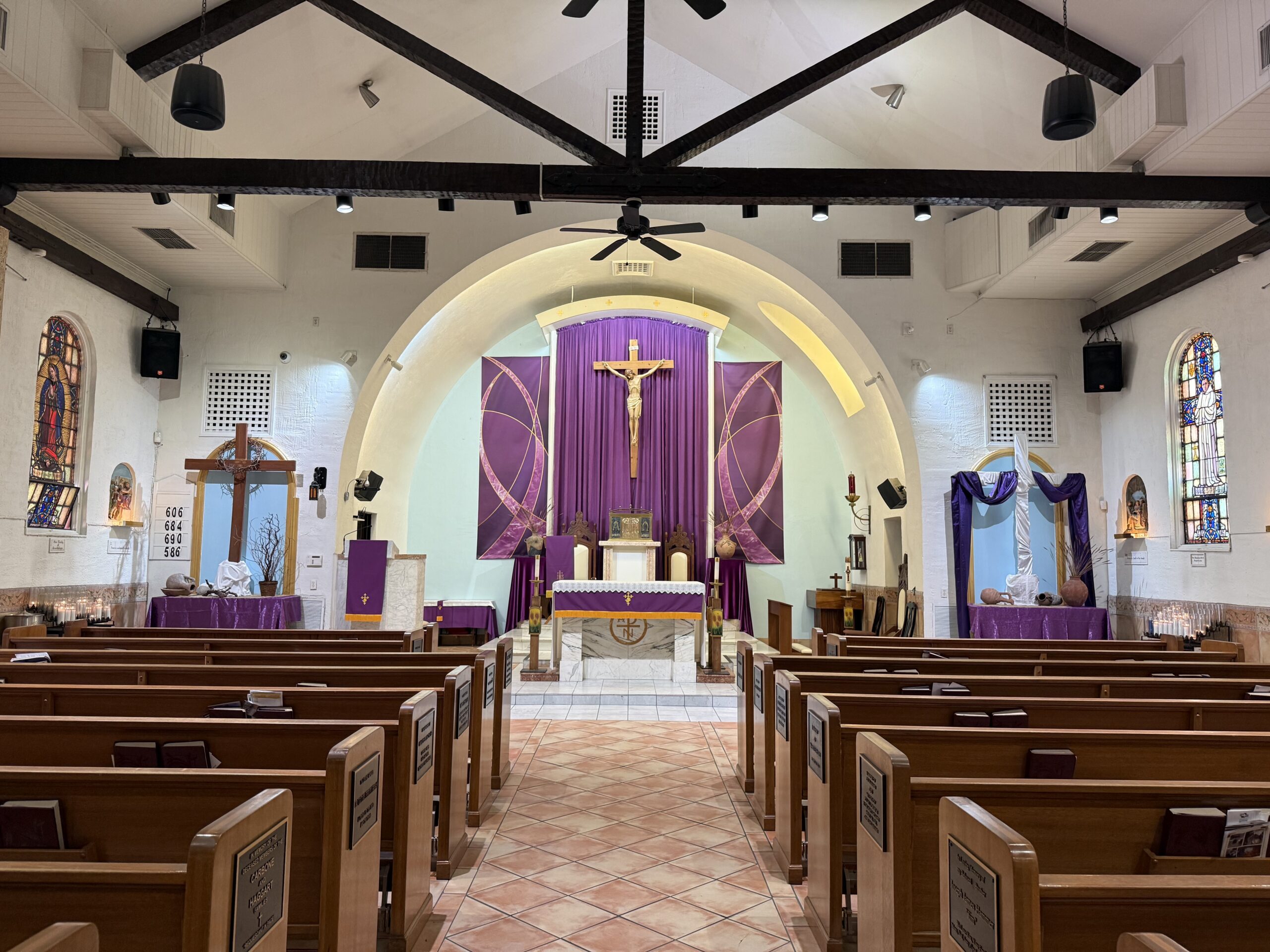
Now, climbing the church’s steps two months later, I stepped into a pitch-dark sanctuary. A prickle of uncertainty ran through me. Had I gotten the time wrong? I heard voices in a dimly lit space off the side of the chapel, a small service underway.
A conflicted, infrequent churchgoer, it had been easier to join a brimming Christmas service. This felt more intimate. I backtracked.I sighed as I sank into the driver’s seat. Still wanting to attend a service, I drove to a nearby Episcopal church. Here I knew what to expect: I stood, knelt, recited prayers and received ashes.
So day by day, I tried to pay attention.
Driving home, I appreciated how the Episcopal service echoed my Catholic upbringing. But I kept thinking about what had drawn me back to the Presbyterian church—the glow of being welcomed as a couple, the quiet integration of other queer congregants into that intimate faith community. That Christmas Eve, I had felt closer to my full self in a church than ever before.
That evening, I found Pastor Reggie’s email online and sent him a note.
Old Wounds
Reggie and I met a week later. Broad-shouldered with a wide smile, he was decades older than me. Away from the pulpit, his powerful presence was softer. We ordered steaming mugs of coffee.
Reggie shared with me about his own journey as a gay man in the church. He was clear-eyed about the past but not stuck there. His hospitality allowed me to open up and share scattered memories, one by one.
“God didn’t make Adam and Steve,” a priest in my childhood parish preached. As a young boy, many years away from coming out, I squirmed uncomfortably as if a spotlight were shining on me. If God didn’t make Steve, I wondered, who did?
Years later at a youth retreat, I gathered courage to talk to a priest about my sexuality, looking for support. His eyes darted across the room, landing everywhere except mine. Without responding to what I shared, he ended the conversation abruptly. I was left in a limbo of shame.
In college, now an openly gay man myself, I was attending Mass when the priest announced during a sermon that the ushers would be passing around petitions to ban same-sex civil marriage. No one seemed to blink an eye as parishioners dutifully added their signatures.
This is what I heard explicitly in the sermons and implicitly in the silence:
God didn’t make you. We can’t talk about this. The way you love has no place here.
As I watched signatures fill up those petitions, something broke inside me. I felt I was at a crossroads: self-rejection or trust in the fullness in which God created me. Making my choice with my feet, I walked out.
And yet, here with Pastor Reggie nearly fifteen years later, I shared that my belief in God had never wavered. My spirit felt alive, albeit bruised. But something was missing.
Reggie listened patiently, holding my gaze. “I think you should pay attention to this longing,” he said softly.
A Blessing Spoken
So day by day, I tried to pay attention.
I remained open during my morning meditations and periodically attended Reggie’s church. I began searching for a spiritual director. I scheduled a three-day retreat at a small Catholic monastery.
Arriving at the monastery weeks later, its silence was a refuge. To my surprise, I found myself joining the community’s daily prayer. On my last evening, sitting in the stillness after vespers, a gentle hand tapped my shoulder. It was one of the enrobed monks, asking if we could meet the next morning before I left.
I didn’t know what to expect, but the invitation seemed innocent enough. That morning, we settled into armchairs, surrounded by plants and religious icons. Eventually, I shared, “I grew up Catholic…” before pausing.
“But you had to leave, didn’t you?” he said, not a question, but a quiet recognition. We held eye contact. There was no judgment. Just understanding.
In the soft morning light, the day after Palm Sunday, I poured out the exile, the longing, the searching—and the nourishing parts of my life, too: my work, my relationship, the hopes we nurtured together.
“Your relationship is a blessing,” he said softly, his loving acceptance filling the room. My whole being turned toward him, like a sunflower reaching toward the sun. I swallowed hard. A blessing.
He continued, acknowledging religion’s limitations and God’s boundless majesty, and encouraging me to stay open to the desires whispering within. As our conversation came to a close, we embraced in a tender hug. I returned to my guest room, his words reverberating in my head: Your relationship is a blessing.
“Your relationship is a blessing,” he said softly, his loving acceptance filling the room.
I already felt the blessing of my boyfriend in my life, so I knew, intuitively, what the monk said was true. I had family and community who affirmed our relationship. I just wasn’t prepared for how much I needed to hear those words in this sacred place.
Desiring Wholeness
A few days after Easter I had my first session with my new spiritual director, Kathleen. A queer Catholic elder, her invitational demeanor was embodied and spacious. Breathlessly, I shared everything on my heart. When I ran out of words, I looked at her expectantly. Taking it all in stride, she offered matter-of-factly, “It sounds like you’re desiring wholeness.”
Wholeness. I let the word sink in. It felt good. It felt right.
Through our conversations I began exploring how I erected walls toward church to protect me from rejection, more a reaction than a conscious choice. I began to recognize, though, that walls are a blunt tool. While they blocked pain, they also blocked participation in something I was hungry for.
Around this time, I found myself deeply moved by the Gospel story of the woman who had bled for twelve years (Lk 8:43-48). Exiled from her community and considered unclean, she wasn’t supposed to be among others. Yet she presses through the crowd, pushing against her religious community’s rigid understanding, reaching for Jesus with furtive hope—daring to believe in the possibility of healing.
In the story, Jesus stops. He sees her. What she tried to do quietly becomes visible. Rather than rebuke, she is met with dignity. As Kathleen and I continued meeting, I found myself drawn to the courage of the woman in this story. I began considering my relationship to the church and realized how I had ceded my place in it to institutional doctrines and earlier experiences that had left me feeling unwelcome. Is this what the church was? Or could I, too, be the church – or at least a part of it?
Coming Home
One early summer evening, I tepidly stepped into the Jesuit parish blocks from my home. For eight years I had walked past it almost daily, never setting foot inside. An “Everyone Belongs” rainbow banner hung nearby but the walls within me had doubted it was true. I was ready to risk that it might be.
This Lent may we learn to listen to our longings—and trust they are leading us home.
The evening Mass hummed with quiet energy. Even so, as I walked down the aisle and into a back pew, every bone in my body tensed. Memories of the dark Ash Wednesday sanctuary rushed back.
But this time, I stayed. I slipped into the ritual of crossing myself and kneeling, and the stillest place inside me settled. The liturgy got underway. I felt like I was easing into a warm, familiar embrace.
As I stepped into line to receive communion, I neared a threshold I hadn’t approached in years. In this place that long felt like exile, the bread in my hand was sustenance—nourishment and belonging.
I understood then how the bleeding woman must have felt. Beheld, not hidden. At the center, not the edge.
My heart swelled within me. Tears brimmed.
Returning to my pew, I wiped my eyes, glancing around. Trusting this parish’s overt welcome of the LGBTQ community allowed my nervous system to calm down enough to finally remember—and viscerally feel—my belonging wasn’t contingent: it was inherent in God.
Deepening into a community of faith over the years—joining ministries, building spiritual friendships with other LGBTQ Catholics and the wider community—began to soften my habit of self-protection. Bringing my full self into participation in the liturgy continues to open me up.
The liturgical calendar spirals, returning us again and again to the mysteries of faith, each time inviting deeper transformation. It often begins with longing: an outstretched hand, a holy conversation, a tentative step into a darkened sanctuary.
This Lent may we learn to listen to our longings—and trust they are leading us home.