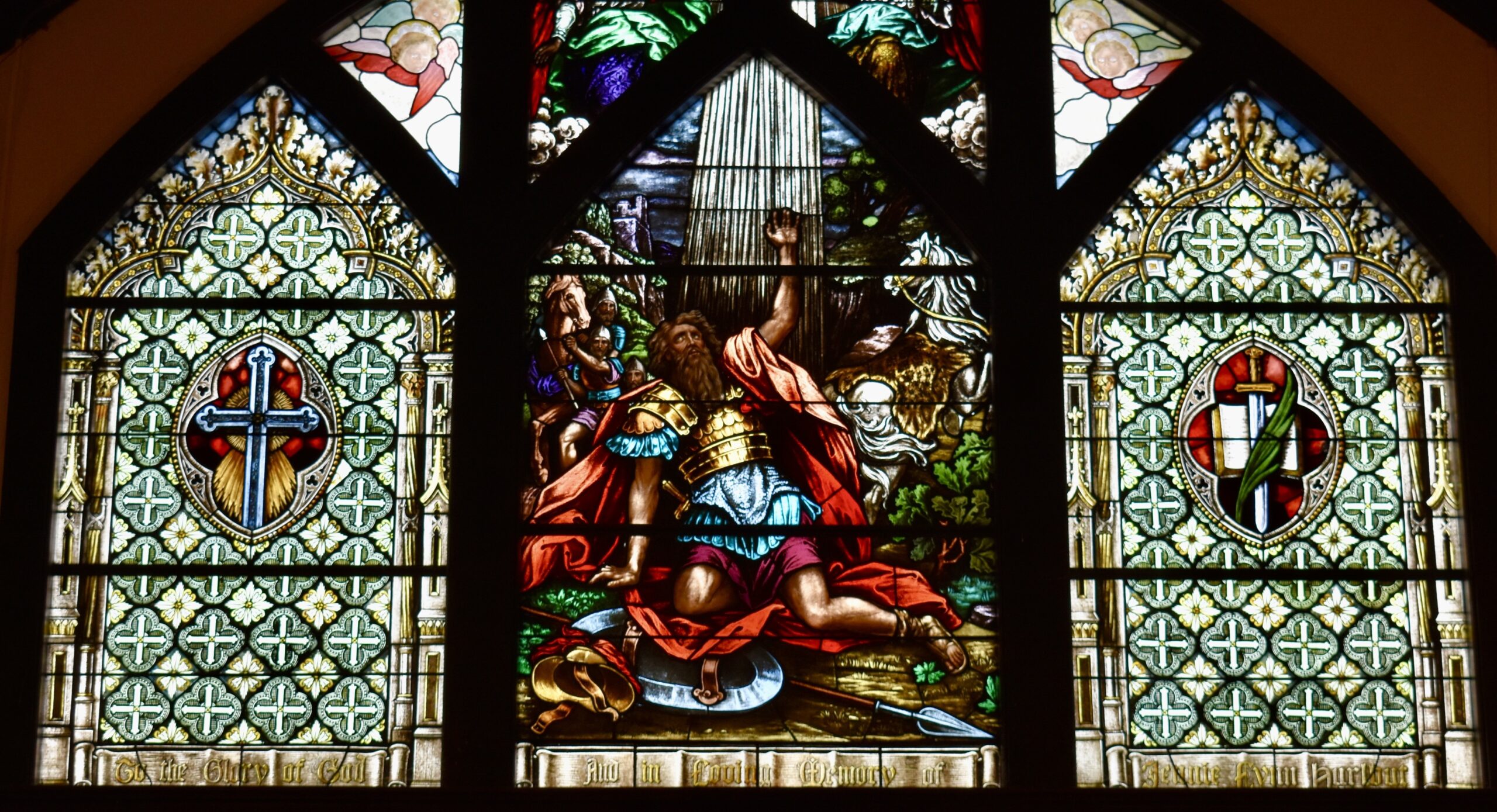
January 25th commemorates the Feast of the Conversion of St. Paul, the moment when Christ met Saul of Tarsas on the road to Damascus, and Paul discovered that he had been persecuting the God whom he loved.
I’m not alone among LGBTQ Catholics in having a complicated relationship with this saint. After all, Paul wrote all the New Testament ‘clobber passages’ that are often used against people like me. But the story of Paul’s conversion also contains elements—an encounter with Christ and the help of compassionate people like Ananias and Barnabas—that parallel my own and maybe other Catholics who have experienced their own conversion.
Even without having the vocabulary for it, I have known since I was about three years old that I am what we now call “transgender.” That early realization aside, I had an otherwise normal childhood. I grew up in the Philippines during the 1990s, during the tumultuous recovery period after the Marcos dictatorship. Lesbian and gay people were definitely present in everyday life, and there were even a few gay celebrities, but questions of LGBTQ rights never came up.
But the story of Paul’s conversion also contains elements that parallel my own and maybe other Catholics who have experienced their own conversion.
I found it easy to postpone the “LGBTQ” question during my youth. My priorities were school, sports and music, and I excelled. I got involved in my parish’s music ministry and fell in love with liturgical music. There, I found a space in Sunday Mass that felt unaffected by my increasing awareness of gender disconnect. Though the contrast between the sex that my body seemed to indicate and my gender identity was so stark even then, I was well-positioned to push aside questions of gender identity that might otherwise have absorbed me in adolescence.
Being known as the reliable “violin kid” also put me in good standing with parish staff, including the priests, who invited me to join them in their ministry to prison inmates and women in crisis centers. All of that made church the place I felt safest in, and it is likely why, when I first came out as an adult, it was to my priest-friend. He immediately assured me of his support, going so far as to offer to talk to my parents about it (an offer I did not take, much to my later regret). While we didn’t directly talk about my being transgender, I still found it so easy at the way-too-young age of 19 to confidently say, “Don’t worry Father, I just won’t date.”
In my mind, I likely thought that so long as I remained “celibate,” I could avoid questions of sexuality and gender identity altogether. While this naïveté was tragic on its own, I made it worse by developing contempt for LGBTQ peers who I thought were too quick to dismiss church teaching on sexuality. These were friends, even my own family, who for the most part didn’t enjoy the same privileges I did: a sterling reputation and easy access to people in authority. I became a zealot for an institution, while looking down on people who lived authentically.
Damascus moments have pushed me to see Christ in those who are marginalized for being LGBTQ.
Damascus moments have pushed me to see Christ in those who are marginalized for being LGBTQ. But I also needed several Ananias and Barnabas figures, people who cared enough to accompany someone who they could have been excused for avoiding.
The first came when, out of concern for my inability to form close relationships, older friends on the college basketball team took me aside to talk. With all the added life experience of at most two extra years, they taught me what they knew about the LGBTQ experience. Instead of condemning me, my friends, like Ananias, helped me see that my attitude and actions reflected not the righteousness of my position, but rather a lack of acceptance and self-understanding. They patiently explained how my attitude only persecuted myself and those around me. While this “intervention” helped me to start living openly as an LGBTQ person, it didn’t fully solve my intermittent tendency to be less than welcoming and inclusive.
The decisive moment would come about 15 years later, during my initial encounters with LGBTQ Catholic ministries. By that point, I had taken a break from dating after the end of a long relationship and was finally taking the time to confront my questions about LGBTQ issues head-on. I had, for instance, realized that my own transgender experience, while closely related, merited its own exploration apart from my sexual orientation. And I still struggled to visualize even a world where the church merely stopped assuming that all LGBTQ people in same-sex relationships are in a state of mortal sin.
The story of Paul’s conversion shows that God often transforms us by working through other people.
Rather aggressively, I asked several LGBTQ Catholics to effectively “give the reason for the hope” (1 Peter 3:15) that seemed to allow them to live authentically. Maybe I wanted them to admit that they too lived in fear of mortal sin. But their non-confrontational responses radiated a quiet confidence in Christ rather than in the law. An older gay Catholic at my new parish even took me out to lunch to talk things over, and his compassion and sensitivity eventually made me turn my questioning on myself. This man became a Barnabas figure—he vouched for me to some veterans of LGBTQ Catholic ministry.
As I meditated on these encounters, I increasingly felt as if Christ was asking me, “Do you not see or care that many of your LGBTQ siblings are having a hard time with all this too?”
I am definitely no St. Paul, who spent his remaining life spreading the Gospel at the ultimate cost of his life. But, as we are often told, his story illustrates that God can and does choose to transform even great sinners. Because of Paul’s writings, I have come to believe that nothing can ever separate me from God. And while I still have many questions, I have decided that my response to Christ’s question to me will be to focus on people rather than rules, on learning to love God and my neighbor as God loves all of us.
The story of Paul’s conversion shows that God often transforms us by working through other people. As I reflect on the details of Paul’s early ministry, it strikes me how difficult and scary Ananias’ and Barnabas’ actions must have been. Ananias chose to obey God’s call to accompany a person he had very good reason to fear. Barnabas built a bridge between Paul and the apostles. My own path to a more authentic life has depended on those who chose compassion over condemnation.
Perhaps, as we hope and pray for the conversion of those who marginalize LGBTQ people, or of other LGBTQ Catholics who appear to oppose their own inclusion, we can also recognize our own calling to be Ananias and Barnabas for one another—to build bridges where many in the church have built moats and to trust that God can transform even the most unlikely among us. St. Paul’s conversion inspires me to dream of the day when the church will fully embrace LGBTQ Catholics, and when we will all be able to say openly and without qualification: “By the grace of God, I am what I am.”