When I asked Outreach’s new assistant director, Jack Consolie, what he’s been hearing from the LGBTQ Catholic community, he had a ready answer: “Lately,” he said, “I’ve heard people asking, ‘Who can I look up to?’ and ‘Who are some role models for me, not only in the Bible and among the saints, but in contemporary life?”
Advent and Christmas offer LGBTQ Catholics many compelling role models. As does our church today. So, let’s start with the Bible.
Role models in the Gospels
When I think about LGBTQ Catholics, I often think about their patience. Now, on the one hand, a few LGBTQ Catholics respond even to very positive steps (Pope Francis’s call for the decriminalization of homosexuality, the recent LGBTQ Catholic pilgrimage during the Jubilee Year, even my own meeting with Pope Leo XIV) with the words, “Not enough” or “Too late.” But, for the most part, LGBTQ Catholics live out the virtue of Christian patience—not a passive waiting, but hopeful expectation for greater welcome, inclusion and participation in their own church.
In that vein, let’s look briefly at some key figures in the Infancy Narratives in Matthew’s and Luke’s Gospels, which we read during the Advent and Christmas seasons. They highlight not only patience, but several other virtues for LGBTQ Catholics.
The first patient couple is Elizabeth and Zechariah (Lk 1:5-25). Quite elderly, Elizabeth has given up on having children. Luke’s Gospel describes her bluntly as “barren.” (The Greek is steira, from which we get the word “sterile.”) One day, as her husband Zechariah is performing his priestly duties in the Temple in Jerusalem, the Angel Gabriel appears to him and reveals that his wife will become pregnant. Not surprisingly, Zechariah questions this: “How can I know this will happen?”
This is something that LGBTQ Catholics often ask: “How can I know this will happen?” Or, put differently: How can I know that the church will become more welcoming, that its leaders will listen to me, that things will get better? Look to Zechariah not only for patience, but honesty.
For his question, Zechariah is struck dumb. (Later on, interestingly, Mary asks the Angel a question and is reassured. New Testament scholars suggest that as a priest, Zechariah should have trusted more. Maybe there is a lesson for all of us believers!) In a few months, Elizabeth delivers her child—John the Baptist. Their trust has been rewarded. Eventually, Elizabeth will share this joy with Mary, her cousin, and will praise Mary for her own trust. “Blessed is she who believed that there would be a fulfillment of what was spoken to her by the Lord.”
LGBTQ Catholics live out the virtue of Christian patience—not a passive waiting, but hopeful expectation for greater inclusion and participation in their own church.
Have you ever considered a person like that worthy of praise—someone whose patient trust in God has been rewarded?
Next let’s turn to Mary and Joseph. Most of us already know that Mary and Joseph can provide models for all of us, and that includes LGBTQ people.
During this time of year, I love meditating on the story of the Annunciation, in which the Angel Gabriel announces to Mary the birth of Jesus (Lk 1:26-38). Notice how Mary’s story, which may initially seem far removed from us, mirrors our own spiritual lives.
To begin with, God takes the initiative, as God does with us, inviting us into a relationship. Next, Mary questions, as we often do. “How can this be?” she says, as a virgin. Isn’t that often the case with us? Don’t we, when faced with something confusing, often question God? But God reassures Mary, reminding her of Elizabeth’s pregnancy. God often does the same with us, inviting us to look back over our lives so we can say, “Yes, you were there with me in the past and will be again.” When Mary says “yes,” God does something wonderful, bringing new life into the world.
But, as my friend Janice Farnham, RJM, once suggested, the most important part of this story may be the final line: “Then the angel departed from her.” After a powerful experience (during a Mass, with a friend or maybe even during an Outreach conference, retreat, prayer service or pilgrimage) we feel certain of God’s love. “I’ll never doubt God’s love for me again!” we say. But then “the angel departs” and we return to daily life. “That’s the time of faith,” said Sister Janice.
What about Joseph? In the face of his fears about Mary, who is found to be pregnant after their betrothal, Joseph must put all his faith in God. Maybe we don’t have a dream like Joseph did, as recorded in Matthew’s Gospel (1:18-25), but LGBTQ Catholics all have dreams for their church, their families and themselves. Can we trust in those dreams, as Joseph did?
Finally, in Luke’s Gospel again, we meet Simeon and Anna, who encounter Mary and Joseph, along with the Infant Jesus, in the Temple (2:25-38). Simeon and Anna are two elderly, devout people who have awaited the coming of the Messiah. For his part, Simeon, described as “righteous and devout,” was waiting for God to “comfort Israel.” Isn’t that what so many LGBTQ believers are awaiting: for God to “comfort” their community?
Likewise, Anna, 84 years old, “worshiped with fasting and prayer night and day.” And when she encounters the Good News of the birth of Jesus, what does she do? She “spoke about Jesus with everyone.”
So, in addition to seeking models of patience, LGBTQ Catholics can look to the Prophetess Anna for what to do in the face of the Good News. Share it!
Role models today
Now I can imagine some LGBTQ Catholics thinking, “That’s beautiful, but what about contemporary role models?” There are many! And depending on where you are in your spiritual journey, one or another, or maybe each of them, can inspire you.
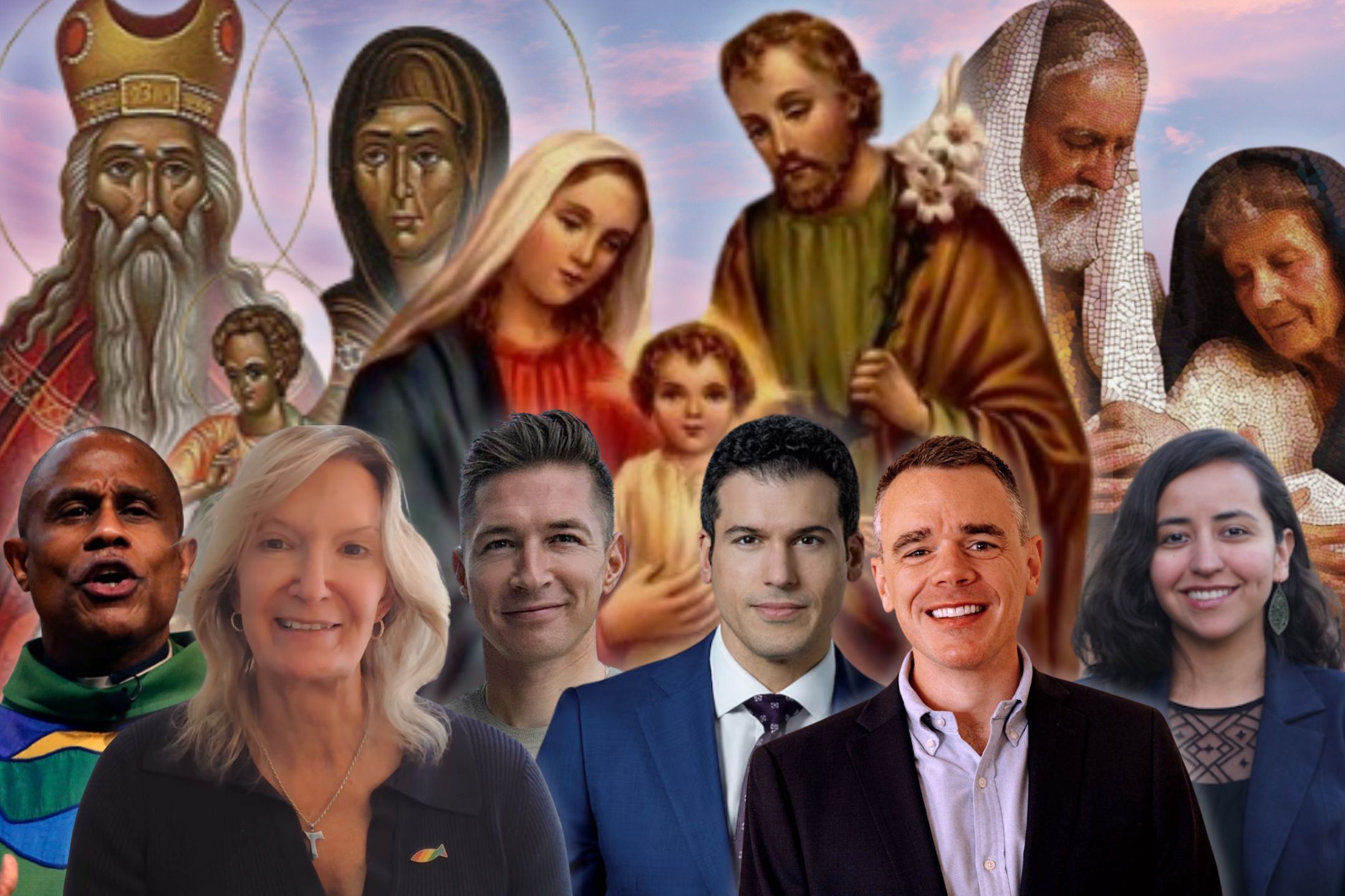
Think of someone like the Rev. Bryan Massingale, a Black and openly gay Catholic priest and theologian who teaches at Fordham University. Fr. Massingale preaches boldly about the sins of racism, homophobia and transphobia in the church and society. How does he do it? Even during tough times, he not only trusts in God, but also believes in his own dreams for a more welcoming church.
One answer to the question “Where do I look for role models?” is: both in the Bible and beside us.
Or think about Christine Zuba, a Catholic transgender woman who recently spoke movingly at our Outreach seminar in Rome during the Jubilee celebration. She is a faithful Catholic and Eucharistic minister who has faced many struggles in her life. But, as we are all called to do, like Anna (Christine is a lot younger than 84!), she shares her experiences of Jesus “with everyone.”
Or how about Michael O’Loughlin, the outgoing Outreach executive director? A married gay man, he has carved out a unique place in the Catholic Church, as a journalist, author and now executive editor of the National Catholic Reporter. Before joining Outreach, his podcast “Plague” helped people understand more deeply the church’s often hidden role in ministering to people during the HIV/AIDS crisis. That podcast was the foundation of his book Hidden Mercy: AIDS, Catholics and Untold Stories of Compassion in the Face of Fear.
Or perhaps you know Yunuen Trujillo, who has spoken at several Outreach conferences and the most recent Ignatian Family Teach-In for Justice in Washington, DC, and runs the “LGBTQ Catholics” Instagram account. Yunuen is not only a member of the LGBTQ Catholic community, but also a faith-based community organizer and an immigration attorney, making a difference in so many lives in so many ways.
Finally, you might look at two men I came to know during the recent papal conclave. James Longman is an openly gay and married Catholic journalist who travels around the globe reporting on places of both conflict and peace, helping millions of people understand our world. Gio Benitez, another ABC reporter, who is also gay and married, recently felt moved to consider “full incorporation” within the Catholic Church. After Gio’s confirmation, he had to face pushback online, which he handled with grace and humor.
Heroes and heroines abound in our tradition, both in the past and today. So, one answer to the question “Where do I look for role models?” is: both in the Bible and beside us.