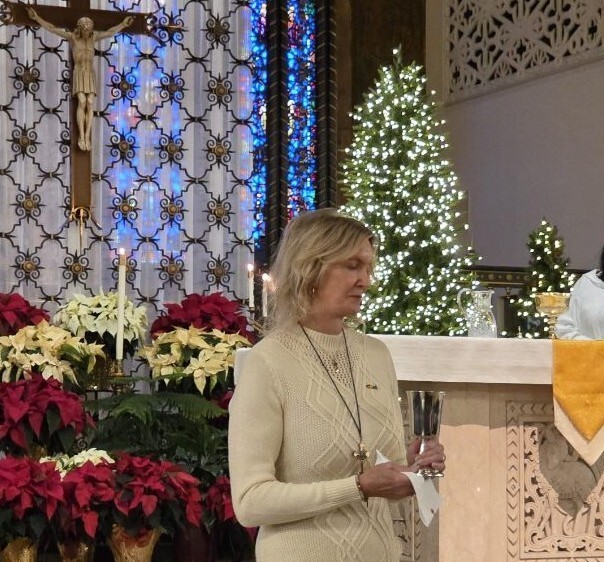
A few days ago, I was on a Zoom call with one of the cohorts of the Fortunate Families Transgender Accompaniment program. One of the participants, the mother of a transgender young adult said, “Christine, you are always so positive!” I responded that since my transition about 11 years ago, I have been a “glass-half-full” person. However, there are times when something from our government or church or a diocese makes it a challenge to stay positive.
This is one of those times. The past month, for example, was not a good one. For a transgender person it is a very worrisome and scary time.
Over the last few years, we’ve witnessed a calculated effort by politicians, influencers, and religious leaders in the US and worldwide to roll back LGBTQ progress and especially transgender rights. Roughly 2.8 million Americans (less than 1% of the US population) identify as transgender according to the UCLA Williams Institute, School of Law.
Today in the US, millions of Americans will shortly lose their health care. At the same time, thousands of migrants (and even some US citizens) are being kidnapped on our streets, dragged from their homes, separated from families and deported to God knows where. And what else is our government focusing on? On the less than 1%.
Almost daily, transgender people are being demonized through untruths, fear tactics and intimidation. We’ve seen bathroom bans, barriers to sports and other events, healthcare limits, trans people removed from the military, passport restrictions, just to name a few of actions taken by the federal, state and local governments. Are we really that much of a threat to society?
In December, the federal government stepped up its targeting of transgender persons and their families. Sarah McBride, a member of Congress from Delaware and the first transgender person elected to the House of Representatives, denounced what she called the Republican Party’s “obsession” with transgender people. Just consider what has happened of late:
The U.S. House of Representatives passed a bill that would enact a nationwide felony ban on gender-affirming healthcare for transgender youth, imposing prison sentences of up to ten years on providers (God willing, this will not make it through the Senate).
The Florida state legislature has proposed making it illegal for state, county, and local employers to discipline or fire employees who harass or bully their transgender coworkers. Bullying and harassment of transgender persons would, therefore, be legal.
The Department of Health and Human Services, under Secretary Robert F. Kennedy Jr., proposed a rule barring any hospital that accepts Medicare or Medicaid funding, from providing any gender-affirming care for transgender youth, or risk losing all such funding (Medicare and Medicaid funding typically account for about 45% of hospital revenues). Access to gender-affirming healthcare for trans youth would be eliminated.
Parents of trans kids, whose overriding interest is in the physical, mental, and spiritual well-being of their children, will no longer be able to help their children obtain the care that they and their physicians deem necessary—that includes the proper psychological counseling that can mean life and death for a young person. Already, families with trans kids or teens have moved to other states for healthcare and for safety. Likewise, many transgender adults have moved or are considering moving to other countries for employment and their safety. Make no mistake: medical care for transgender adults is the next target.
The pursuit of happiness
A few weeks ago, I read a Facebook post about United States Attorney General Pam Bondi instructing the FBI to create a cash reward system, “a bounty” encouraging the public to share information on “transgender activists,” described as part of “domestic terrorist groups.”
My first thought upon reading this was that it was so preposterous that it must either be AI generated and fake or perhaps another “divert and distract” tactic from Project 2025. A quick Google search, unfortunately, proved it true.
I became still, quiet, as no words could express my mix of hurt and anger; tears filled my eyes. It was not an anger directed at anyone, rather, it was a sadness that we have allowed our nation, and our world, to devolve into a McCarthyistic-Orwellian society, where all too often disinformation, untruths and lies are repeated frequently enough to be believed.
The Declaration of Independence states that we are all endowed by our Creator with the unalienable rights of “Life, Liberty, and the Pursuit of Happiness.” This is all transgender people ask.
The Declaration of Independence states, as every American knows, that we are all endowed by our Creator with the unalienable rights of “Life, Liberty, and the Pursuit of Happiness.” This is all transgender people ask—no more, no less. Why is our very existence so upsetting that legislators and others want to erase our lives, deny our “pursuit of happiness” and punish those who support our rights?
As a transperson in her late 60s, I have been very blessed by a life’s worth of friends, supportive family, healthcare (including Medicare) and a welcoming parish environment. My personal world seems safe—for now. However, with the daily onslaught of lies and mistruths that negatively influence public opinion about us, and with talk of “bounties,” who knows what’s coming next? Now, in the “land of the free,” I must watch my back.
Where is the church?
As a Catholic I often wonder: Where is our church in the midst of these attacks? Doesn’t Catholic teaching hold that each person is sacred, has dignity, that we all are made in the image of God? Didn’t Jesus reach out specifically to those who were considered “other”? Doesn’t the Catechism ask that we all be treated with “respect, compassion and sensitivity”?
Such negative statements and actions from our government can only lead to targets on our backs, more hatred and sadly, violence. So how is the church standing up to bullying, harassment and violence?
A few days ago, I was interviewed about my life as a transgender Catholic and was asked, “What does our church need to do to welcome transgender Catholics?”
My answer: Our church needs to welcome everyone—not just transgender persons or LGBTQ people—but everyone, including all those on the margins. It doesn’t matter whether you’re rich or poor, what you look like or where you come from.
Our church needs to welcome everyone—not just transgender persons or LGBTQ people—but everyone, including all those on the margins.
Our church was in fact born on such differences. St. John the Baptist, who proclaimed Jesus’s coming, wore camel-skin clothes and a leather belt, and ate locusts and honey in the desert. In other words, John was different. Obviously, I’m not saying he was transgender or LGBTQ, but he was definitely “different.” Later, Jesus himself ministered to those who were “different,” to those whom others would not talk to nor walk with. Think of how often Jesus speaks with and holds up as models Samaritan men and women who were clearly considered “other” by most of the Jewish people at the time. Think of how often Jesus spends time with all sorts of people who feel pushed to the margins: those with leprosy, tax collectors and even Roman centurions.
A friend of mine was recently scheduled to speak to two separate LGBTQ parish ministries in her diocese about her life as transgender and Catholic, which was scheduled to take place on parish grounds. At the last minute, the diocese stepped in to halt both presentations. Fortunately, another (non-Catholic) venue was found and the presentations did take place.
What is our church so afraid of that it must cancel even opportunities to learn more about transgender persons? Even Pope Francis, towards the end of his pontificate, met monthly with transgender people to listen and to learn. We are not a source of scandal or confusion (characterizations often used to limit or eliminate our presence in faith communities). We are human beings with dignity. The confusion lies with those who refuse to encounter.
Our lives are real. More and more “people in the pews”—at least in the United States—are coming to know us. On the local levels, more pastors, deacons, bishops, cardinals, members of religious orders and Catholic lay leaders are listening in order to better understand us.
We must stay visible and, most importantly, stay safe, confident in our knowledge that God loves us deeply.
With the horrific statements and proposed policies taking place in our country (and worldwide), more than ever we need church leadership to speak up and say about this increasing persecution of trans people, “Enough! Please! This is Wrong!” On both a national and worldwide level, we desperately need the voices of Catholic leaders to help us raise our voices.
Traditionally, March 31 is Transgender Day of Visibility, an annual event celebrating transgender persons, acknowledging their contributions to society and raising awareness about the discrimination we face.
But, given the current climate of fear and hatred, perhaps every day should be Transgender Day of Visibility. We cannot allow others to dictate the narrative of our own lives. We must stay visible and, most importantly, stay safe, confident in our knowledge that God loves us deeply.