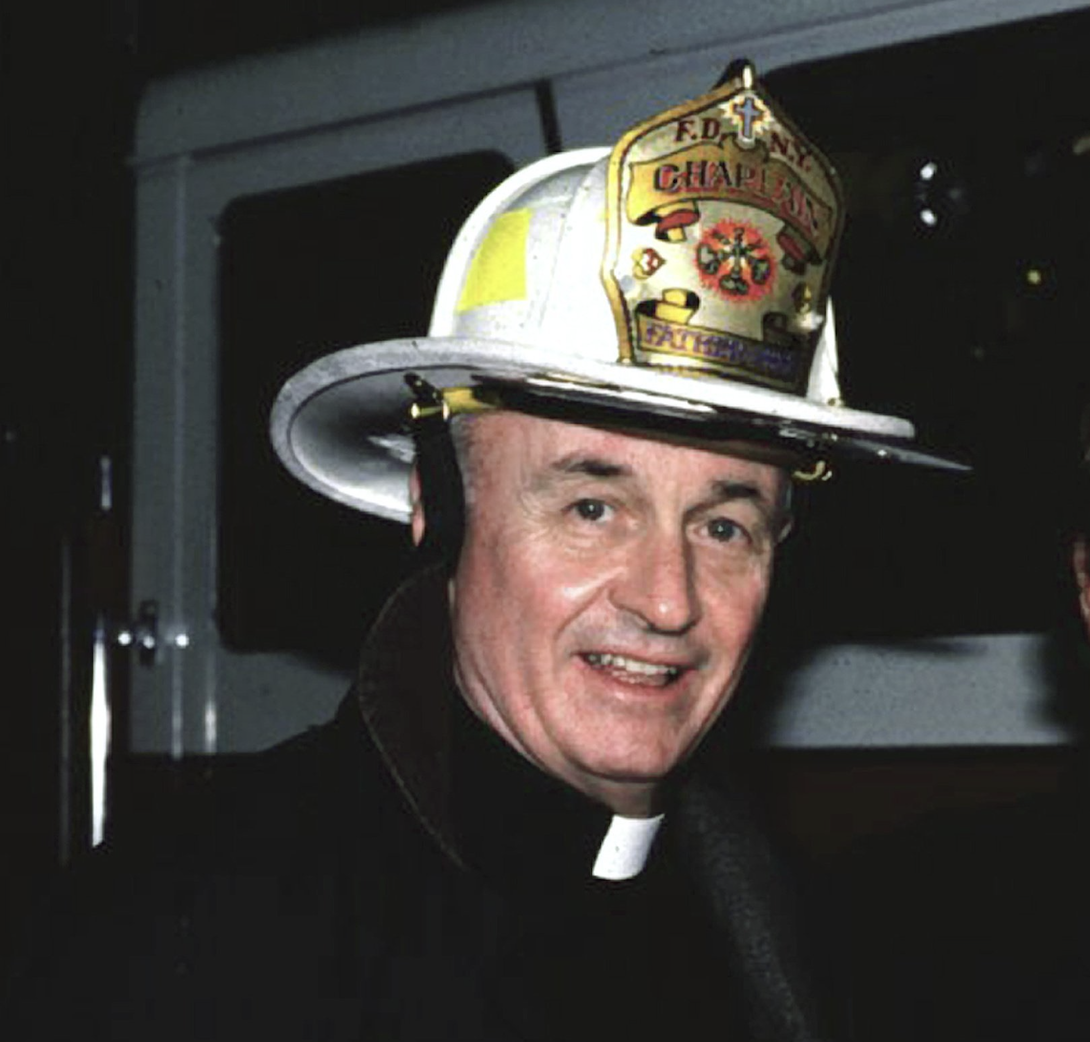
On this 25th anniversary of 9/11, I’d like to pay tribute to Mychal Judge, a Franciscan priest and New York Fire Department chaplain, who ran toward the World Trade Center after it had been hit. He ministered to the dead and dying in the North Tower until he was killed by an explosion. The coroner marked his body “DM [Disaster Manhattan] 0001-01,” making him the first officially recorded victim of the tragedy.
Judge’s final act catapulted him to worldwide notoriety, as images and stories of his courage circulated. Judge and the five men who carried his body away from the rubble became a face of the heroism shown by countless Americans on that fateful day.
A week following Judge’s death, the Village Voice identified Father Mychal Judge as a gay man, mentioning his support for “gay and AIDS causes” and his “longtime member[ship in] Dignity, the gay Catholic group.” This sparked controversy over Judge’s sexuality, with some Catholic voices arguing that such claims were slanderous or a co-opting of his legacy. Nonetheless, Judge’s gay identity was confirmed through the corroboration of many people to whom Judge had come out, his personal journals and his active participation in the gay community.
Judge had been a weekly attendee at the Dignity Mass at St. Francis Xavier Parish in Manhattan, and had joined a gay priests’ support group there. In the height of the AIDS crisis, Judge had established the “St. Francis AIDS ministry” through which he accompanied the dying. His biographer Francis DeBernardo concludes, “While Judge did not make a public declaration of his orientation, friends said he did selectively come out to those close to him” (Mychal Judge: Take Me Where You Want Me to Go, page 55)
Mychal Judge’s life offers a valuable model of integrated sexual identity and discreet pastoral care that still rings true a generation later.
Being outed after his death complexified the public image of a widely-adored public figure. Long before 9/11 brought him to national and international attention, Mychal Judge had established a reputation in New York as a pastor to the greatest and the least. He was a confidante to the likes of then-Mayor Rudy Giuliani and then-First Lady Hilary Clinton; he also knew the homeless people living on the streets around his parish and ministered to those dying of AIDS.
Some struggled to reconcile the man they had known with their mental picture of a gay man. DeBernardo’s book recounts the reaction of one firefighter “who was known among his aquaintances for making anti-gay remarks”: “When he heard about Judge’s orientation after 9/11, his reaction was, ‘If somebody really convinced me of that, all you could do was tell me I had my first gay friend’ (Page116).
As an LGBTQ Catholic minister, I relate to the complexity of Mychal Judge’s self-disclosure of his sexuality. Even a quarter of a century later, clergy and church employees still face restrictions and assumptions that shape how others perceive our identities. In each pastoral and personal relationship, gay ministers must consider the stakes of coming out and decide how to balance authenticity with the potential of scandal.
Mychal Judge’s life offers a valuable model of integrated sexual identity and discreet pastoral care that still rings true a generation later. His example offers these guideposts:
Figure out your sexuality for yourself
Mychal Judge spent his formative years in religious formation in the Order of Friars Minor, taking vows of celibacy in early adulthood. He could have sidestepped questions of sexuality, and may have done so for many years. However, in the 1960s, Judge suffered from poor mental health related to overwork. In the process of psychological treatment, Judge grew in his self-understanding. According to Father Ron Pecci, a fellow Franciscan, Judge described himself at that time as “‘omnisexual’—being attracted to all humans” (Page 29).
Over a decade later, Judge acknowledged that he was an alcoholic and entered the fellowship of Alcoholics Anonymous. In the process of self-examination guided by the 12 Steps, Judge continued to grapple with his sexuality. His friend Brian Carroll says that this was a transformative process for healing from shame he had carried about his sexuality. During this stage of his life, Judge began identifying himself as gay more often and attended AA meetings for gay men. “The AA experience was part and parcel of his coming out,” Carroll recalled. “He was able to accept his authentic self, to see the broken parts of his life as blessings” (Page 35).
Like many of us, Judge underwent a gradual process of coming to terms with his sexuality. His story bears witness to the truth that self-understanding unfolds over time, influenced by the communities around us. Contemporary culture sometimes communicates an expectation that we understand and accept our identities overnight. Judge models the slow work of discovering one’s sexuality over the course of a lifetime.
Being comfortable with your sexuality is a gift, whether you come out or not
Seven years after getting sober, Judge participated in a sabbatical program in Canterbury, England, with Franciscans from around the world. Known for his listening ear, Judge developed a reputation as someone other Franciscans could turn to when wrestling with their sexuality. His own comfort with the topic, born of his self-acceptance, allowed him to be a safe confidante for others.
Judge was able to serve his confreres in this way, regardless of their sexuality and regardless of whether he came out to them. DeBernardo writes, “Gay friars often assumed he was gay, while heterosexual friars thought of him as straight. For Judge, sexual identity itself was not the problem. The problem, as he learned from his own experience, was in denying sexuality, a common trap for vowed celibates” (Page 45).
His own freedom from shame released others from theirs, too.
Brian Purfield, a friend during his time in Canterbury, recalled, “I don’t think his sexuality was a big issue for him at that time… It was intuited or assumed by others. He wouldn’t deny his sexuality but he wouldn’t promote it either…. It was clear he was comfortable with his own life” (Page 45).
That comfort was the secret to the excellent pastoral care Judge gave others who were struggling. Whether he shared a sexual identity with them or not, he was comfortable in his own skin, which invited others toward integration. His own freedom from shame released others from theirs, too. In the words of his friend Brian Carroll, “He took away the shame. For some people, sexuality is a part of their shame…. Or addiction is a part of their shame. Mychal helped people embrace all the shame parts of themselves and turn them into something good” (Page 64).
Entering your own struggles will allow you to accompany others
In some ways, Mychal Judge’s legacy as a 9/11 chaplain has nothing to do with his identity as a gay man or a recovering alcoholic. And yet those aspects of his life shaped him into the person who rose to the challenge of that fateful day. DeBernardo concludes, “The courage it took to accept his identity prepared him for the courage he would need to minister in extremely dangerous emergencies” (Page 127).
That courage compelled Judge to run toward the devastation when everyone else was trying to get away. When a report came that people were trapped on the Mezzanine floor of the North Tower, Judge ran up the stairs toward them, calling back, “I’m needed up there. I have to go” (Page 106).
Why did he have to go? Because Mychal Judge believed in the power of accompaniment. His life had prepared him to tackle the difficult topics, the painful realities and the moments of despair when prayer is all that’s left. John McNeill recalls Judge’s approach to ministering to AIDS patients in seemingly hopeless situations: “He used to put it to me, if you descend into somebody else’s private hell and stand there with them, it ceases to be hell. That’s exactly what he did” (Page 60).
On 9/11, Judge ascended into the private hell of thousands of people trapped in the North tower, to accompany them in their final moments. He brought them the same loving presence he’d shared with alcoholics, AIDS patients, and parishioners. May today’s queer Catholic ministers accompany the suffering of our own generation, with the courage and integrity of Mychal Judge.
Mychal Judge, pray for us.