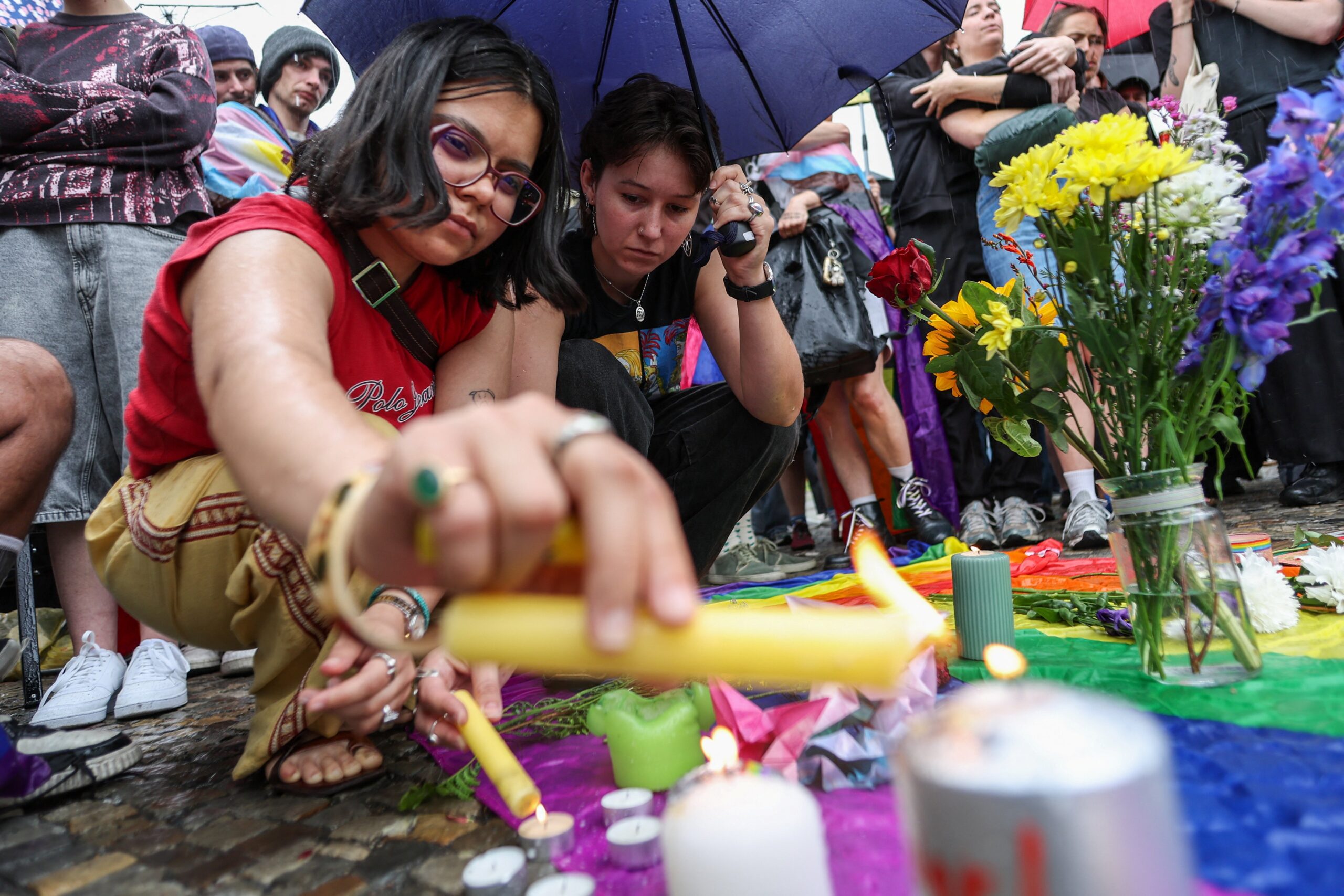
On July 25, after the Christopher Street Day parade, the annual LGBTQ pride event, a car drove into the crowd in the German capital city of Berlin during the city’s celebrations. One person was killed in the gruesome attack; 31 others were injured, some seriously. The alleged perpetrator was later shot during a police raid. He is said to have tried several times in the past to join the terrorist organization Islamic State abroad.
The news about this attack has shocked me. It was with sadness and deep concern for social coexistence that I followed what happened. Not only was a woman killed, not only were many people injured, some seriously. No, many people were traumatized and even more now live in fear. What happened on July 25 casts a long shadow over the future of the open society.
The heinous attack was very specifically aimed at the queer community as a whole. I said publicly that it is unbearable when queer people have to fear for their safety when they openly profess their love and identity. As the Central Committee of German Catholics (ZdK), we stand in solidarity with them.
It is unbearable when queer people have to fear for their safety when they openly profess their love and identity.
When I think about the attack, I see the following points.
First, the ideologically inspired rejection of same-sex couples is deeply rooted in our society and in the traditional ideas of the bourgeoisie. Culturally, this rejection was also part of the National Socialist ideas. A dualistic, procreation-centered gender anthropology is represented in many right-wing parties worldwide. This anthropology of the sexes still shapes the teaching of the Catholic Church today. Therefore, the church must ask itself what it is actively doing to defend the inalienable dignity of every human being and how it can counter this form of hatred and agitation.
Second, hatred and agitation have increased again in Germany in recent years. One reason is the successes of the right-wing, partly fascist party Alternative for Germany. The more their party program is successful in elections, the more queer people, but also people with a migration background and all those who do not fit into the right-wing ideology, have to fear for their safety.
Third, discrimination affects other groups. The backlash that can be observed against women in general is related to the above-mentioned attributions toward the female sex. Women begin to be reduced to their ability to give birth and to their social care work. Discrimination against those who do not fit into the rigid image must be seen as part of an entire system.
The church must ask itself what it is actively doing to defend the inalienable dignity of every human being and how it can counter this form of hatred and agitation.
And finally: We must not deceive ourselves about the financial resources that flow into the right-wing movements. The European Parliamentary Forum for Sexual and Reproductive Rights estimates the global financial flows of religious extremist and right-wing actors in Europe alone for the period from 2019 to 2023 at around 1.18 billion US dollars on this topic. The backlash disguises itself as protection of traditional values and the family, but in reality it aims to dismantle fundamental rights and pluralism.
On the basis of a Christian anthropology, which emphasizes the equal dignity of every human being, the ZdK contributes to the debates on gender diversity as a civil society actor. The ZdK is therefore committed, among other things, to a non-discriminatory treatment of transgender people within the church and in society. In a separate key issues paper, we commented on the Self-Determination Act passed by the German Federal Government. The political and legal paradigm shift toward the realization of self-determination and the preservation of the physical and mental integrity of all people is a great concern for us.
Of course, it is also necessary to ask what the Catholic Church can do to defend the dignity and safety of queer people.
While the struggle for respect was taking place in church, the ZdK tried to take steps forward by negotiating with the German bishops. On the Synodal Path we fought for the rights of same-sex couples. A decision on a reassessment of homosexuality by the magisterium has emerged (see www.synodalerweg.de). We also stood up for blessings for couples who love each other and forced our church to deal with gender diversity. Bishops and laypersons together also demanded to remove taboos about non-heterosexual clerics.
I am grateful that I was able to learn about the issues raised in the encounter and cooperation with affected delegates and also in the private environment of queer people. It is gratifying that German bishops are also speaking out offensively.—for example, Archbishop Hesse from Hamburg, who publicly supported the Christopher Street Day celebrations in Hamburg after the attack in Berlin.
German bishops are also speaking out offensively—for example, Archbishop Hesse from Hamburg, who publicly supported the Christopher Street Day celebrations in Hamburg after the attack in Berlin.
Unfortunately, in recent years, I have also had to realize how massive agitation and attacks on queer groups are, and on all those who stand up for them. I’ll give just one example from my own experience. After the European Continental Assembly in Prague in 2023, which was supposed to help prepare the World Synod, I was dubbed the “sister of the supreme devil” in Eastern European newspapers because of my attitude on these issues.
Of course, this will not stop me on my way: I fight for gender equality and queer people. My ZdK-Presidium, made up of six persons, has continuously advocated for the rights of queer people in talks at the Vatican since 2022 and maintains cooperation with other Catholic organizations in Europe on this matter.
Since the beginning of August, a newly planted maple tree in the Tiergarten in Berlin has been a reminder of the attack there. A bench in the colours of the rainbow has been set up. It is intended to express solidarity with the Christopher Street Day participants and stand for an open, democratic society. May the tree grow and flourish—even as solidarity with discriminated people worldwide needs to grow.