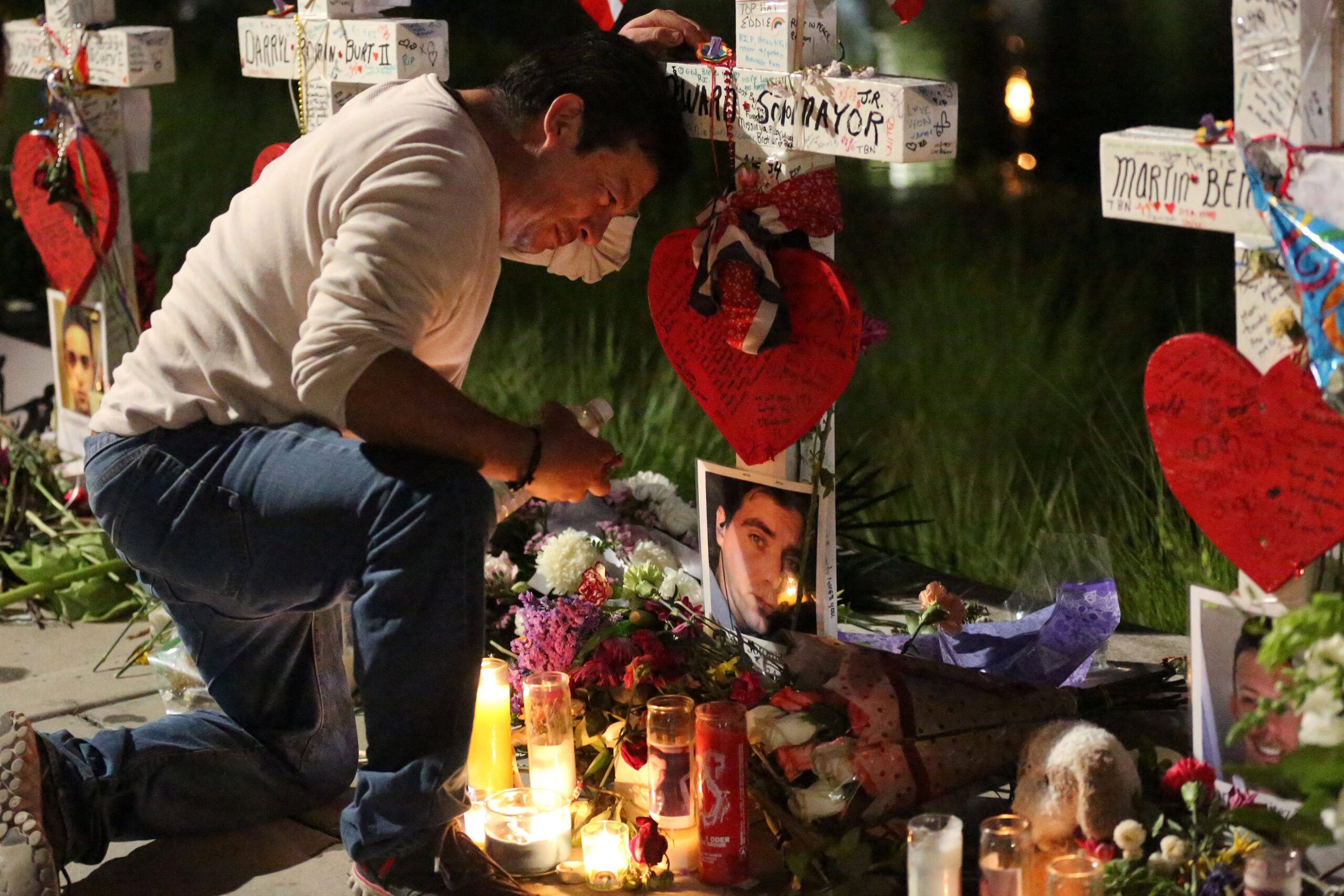
I can’t remember where I was ten years ago when I heard the news about Pulse, but I remember three distinct reactions to the massacre of 49 people at a largely gay nightclub in Orlando, Florida. First was horror. It was at the time the largest mass shooting in US history. The second was deep sadness, especially after learning that many of the victims were LGBTQ people. I imagined dozens of young people going for a night out, perhaps finally comfortable among their own community, and then being murdered.
The third reaction changed my life. It was a dismay over the response from the Catholic Church in the US to the largest mass shooting in our history, something one might expect to elicit expressions of intense grief, passionate outrage or radical solidarity. But only a handful of US bishops said anything and, out of that handful, some (including the Bishop of Orlando) did not mention the LGBTQ community. Prior to this, in similar tragedies, church leaders almost always named the group affected and expressed their solidarity. Again, except for a few bishops, there was little of that.
For some context, here is the response from the US Conference of Catholic Bishops to Pulse:
Waking up to the unspeakable violence in Orlando reminds us of how precious human life is. Our prayers are with the victims, their families and all those affected by this terrible act. The merciful love of Christ calls us to solidarity with the suffering and to ever greater resolve in protecting the life and dignity of every person.
Here is the USCCB’s response to a more recent tragedy, the terrible murder of three people in a mosque in San Diego, California, in May:
On behalf of the United States Conference of Catholic Bishops, I extend our profound sorrow and prayerful solidarity following the tragic shooting at the San Diego Islamic Center. We stand with Chief Imam Taha Hassane, the entire Muslim community, and all who mourn in the wake of this senseless violence, affirming our shared commitment to the dignity of every human life and the rejection of hatred in all its forms. In moments such as these, we are reminded of the call to be instruments of peace; as Pope Leo XIV has said, ‘Where violence wounds the human family, compassion and unity must be our steadfast reply.’ May God console the grieving, strengthen the injured, and guide us all toward greater understanding, justice, and peace.”
The difference is solidarity with a real community. The more recent statement says that “we,” the entire body of bishops, stand with the chief imam, “the entire Muslim community” and all who mourn. After Pulse, the bishops call for “us” to share in solidarity with “the suffering.”
I don’t want to condemn the statement of the USCCB after Pulse. Perhaps it was written under a deadline by a well-meaning staffer unfamiliar with the details. And many may consider it a reasonable, even moving, statement. What I do want to say is, on that day ten years ago, the lack of naming the LGBTQ community was for me discouraging. I remember thinking: What does this community need to do to be seen, to be recognized, to be named, by the church? Isn’t being murdered enough?
I remember thinking: What does this community need to do to be seen, to be recognized, to be named, by the church? Isn’t being murdered enough?
That prompted me to post a Facebook video the next day, which “went viral,” which led to an invitation a few months later to a New Ways Ministry gathering to speak about “Bridge Building,” which led to an essay printed at America Media, which led to a book called Building a Bridge, published one year after the massacre, which led to invitations to speak at parishes and colleges, which led to an invitation to speak at the Vatican’s World Meeting of Families in 2018, which led to a meeting with Pope Francis in 2019, which led to the Outreach ministry.
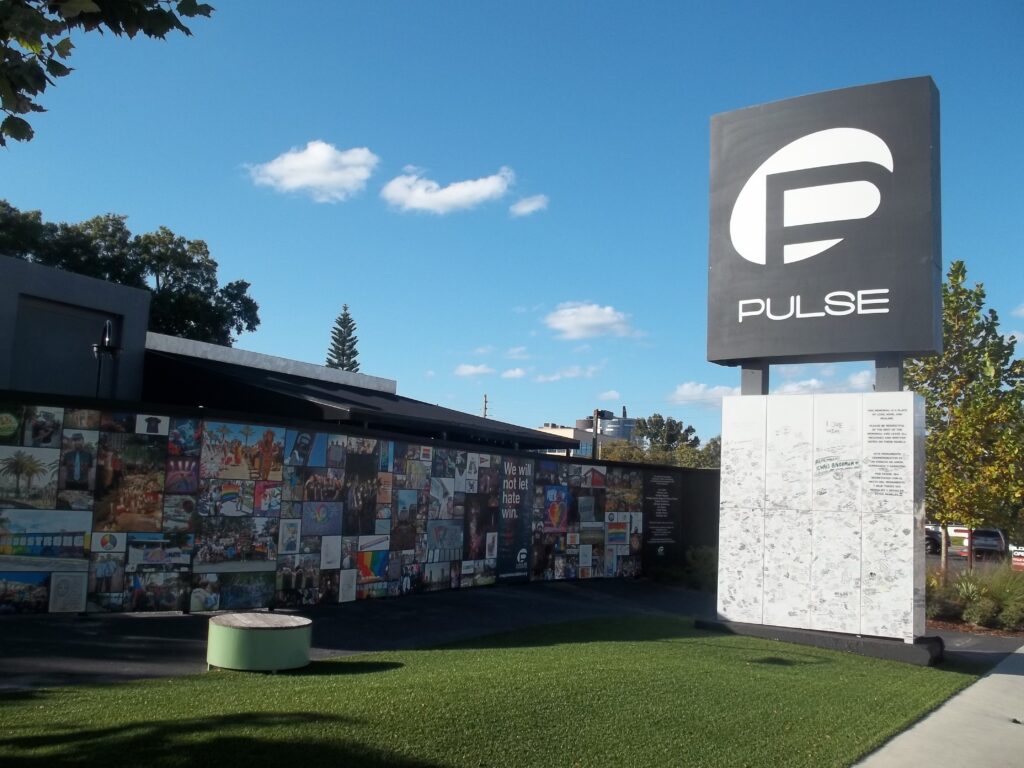
In an article to be posted on June 12th, Jack Consolie, who spent much of his childhood in Florida, recounts being at his grandparents’ house near Orlando on the day of the shootings, a memory seared into his consciousness. Jack would eventually come out as a gay man, and the memory of Pulse helped move him towards a life in Catholic ministry, as well as an M.Div. degree from Notre Dame. Today Jack is the assistant director of Outreach.
In his article, Jack asks how far we have come since Pulse. It’s an important question.
In many ways, we have come leaps and bounds in the church. Just think of what Pope Francis did during his papacy for LGBTQ people: he was the first pope to use the word “gay” in public; he appointed an openly gay man to serve on a papal commission; he met regularly with those ministering to LGBTQ people (including myself); he “rehabilitated” Sister Jeannine Gramick, SL, of New Ways Ministry; he called for the decriminalization of homosexuality; he permitted the blessing of same-sex couples under certain circumstances and, towards the end of his life, met regularly with transgender people. And in September, the message I heard from his successor, Pope Leo XIV, during an audience at the Vatican, was that he intended to continue his predecessor’s approach of welcome and inclusion.
In many ways, we have come leaps and bounds in the church. Just think of what Pope Francis did during his papacy: he was the first pope to use the word “gay” in public.
The effects of such welcome are being felt worldwide. Last year, a semi-official pilgrimage to the Vatican during the Jubilee Year was held for LGBTQ Catholics. As part of that pilgrimage, Bishop Francesco Savino, the vice president of the Italian bishops’ conference, celebrated Mass in the Church of the Gesù for a group of 1,300 LGBTQ Catholics, as well as their families and friends. And just last month, vigils against homophobia and transphobia across Europe prompted several bishops to reach out to LGBTQ Catholics.
In the US, the number of LGBTQ parish and diocesan outreach programs has increased, as has the number of bishops willing to reach out and even apologize. Ten years ago, when I published my book, people asked if I dared to use the term “LGBTQ,” which was deemed controversial. (Ultimately, we used “LGBT.”) Yet a few months ago, in an interview with Elise Allen of Crux, Pope Leo used the term twice. In a way, we are far from the desultory response from the church after Pulse. And we are closer to solidarity.
But in many places in the church, things have not changed. In Sub-Saharan Africa and Eastern Europe some church leaders still make homophobic comments and oppose laws protecting LGBTQ people. (After witnessing that kind of pushback at the Synod of Bishops, I met with several delegates to listen to their experiences and share my own.) In some places, then, we are not far from the muted response from the US church after Pulse; in other places, the church is even worse off.
In his beautiful encyclical “Magnifica Humanitas,” Pope Leo XIV asks us to embrace the many virtues of Catholic social teaching, including solidarity. He defines it as “the concrete recognition that the future of each individual is connected to the future of all” (73).
That “all” is an important word. Pope Leo’s comments follow Pope Francis’s desire for the church to be a place for “todos, todos, todos.” Leo’s “all” and Francis’s “todos” include LGBTQ people. For me, Pulse invites us, the church, to stand with them. Finally in true solidarity.