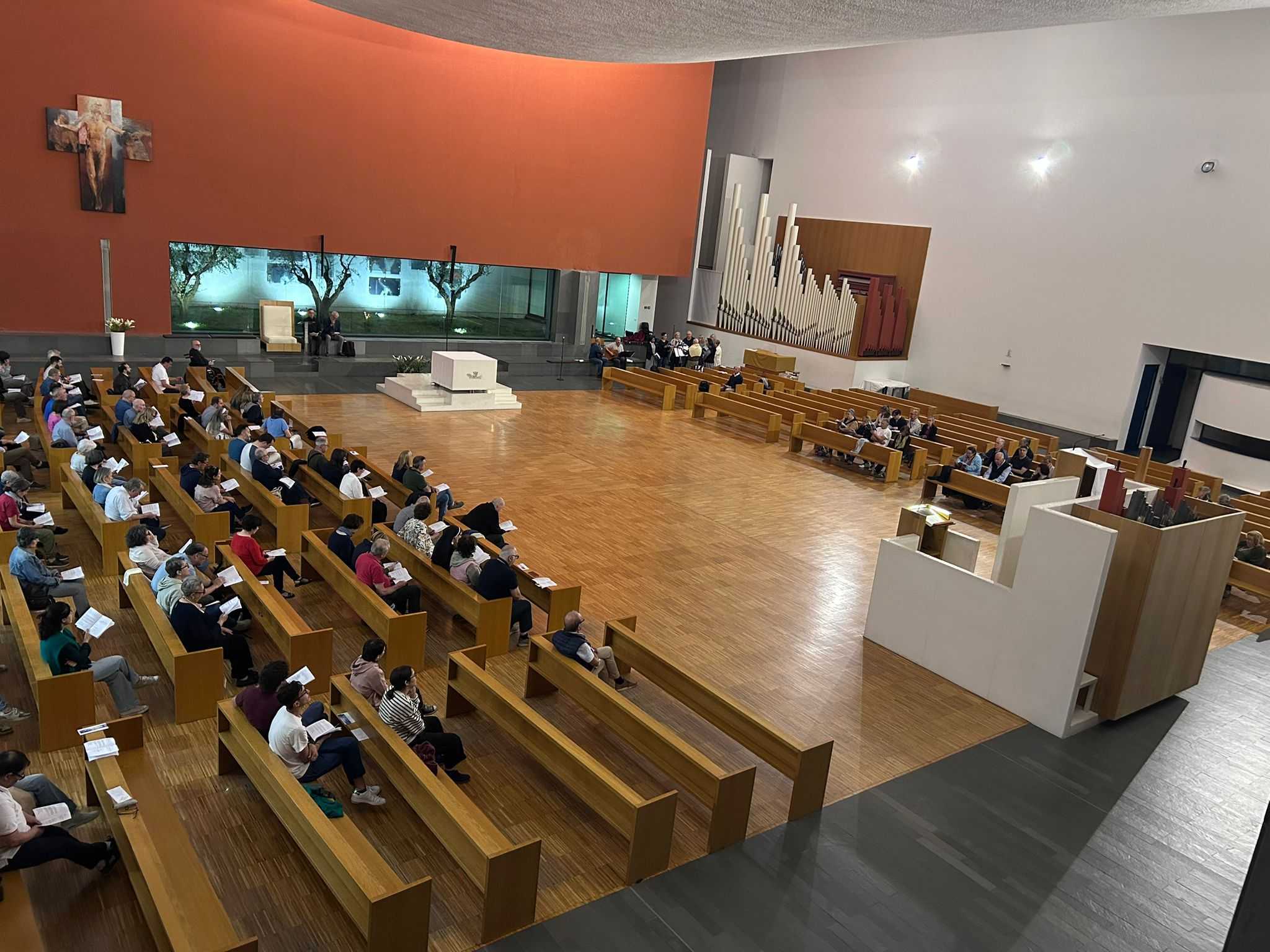
Below are the Reflections on John 20:19–23 by Archbishop Erio Castellucci of Modena-Nonantola and Bishop of Carpi, during the Prayer Vigil for the Overcoming of Homotransphobia held at the Parish of Jesus the Redeemer in Modena, presided over by Archbishop Erio Castellucci and Pastor Daniele Bouchard on May 21, 2026. Read in the original Italian here.
On the evening of that first day of the week, when the doors were locked where the disciples were for fear of the Jews, Jesus came and stood in their midst and said to them, “Peace be with you.” When he had said this, he showed them his hands and his side. The disciples rejoiced when they saw the Lord.
Jesus said to them again, “Peace be with you. As the Father has sent me, so I send you.” And when he had said this, he breathed on them and said to them, “Receive the holy Spirit. Whose sins you forgive are forgiven them, and whose sins you retain are retained.” – (Jn 20:19–23 )
It is a wounded person who suddenly appears in the upper room on Easter evening. He is not someone wounded who hides his wounds; quite the opposite – he puts them on display almost as if they were his identity card. “He showed them his hands and his side.” Eight days later he will do the same thing with the only one absent – Thomas – compared to the eleven, even inviting him to touch those wounds: “Put your finger here and see my hands, and bring your hand and put it into my side.”
A wounded man encounters a wounded community. These ten are marked not only by the temporary and occasional absence of Thomas, but above all by the definitive and tragic absence of Judas, the traitor. And this is an extremely grave wound because it lies at the root of the wounds of the Crucified One: a betrayal. Thus, a wounded man encounters a wounded community while displaying his own wounds. Here everyone is a victim of violence, mistakes, and tragedy.
And yet, precisely in this strange gathering, the wish for peace breaks forth; there is a flash of hope. “Peace be with you.” This blessing was not something to be taken for granted, because usually those who have been unjustly wounded respond with curses, recriminations and demands. But not here. The Risen One brings forth from his wounds not anger but peace, and he heals his wounded community with the medicine of peace.
It is striking that Jesus does not instead gather together a new group, as a coach might do if the team were relegated because of the players’ inability and negligence; and that would have been more than understandable, since almost all of them had disappeared! Instead, the Lord sends the very same people back into the field; he sends out the losing team once again.
The Spirit is the love of God; it is the strength that sends us back into the field after wounds, fears and closed doors.
“As the Father has sent me, so I send you.” But he does not send them back into the field – and now the field is the world – because he has noticed that they have changed. In fact, the very fact that they were locked inside the house for fear of the Jews shows that they were still living in fragility and doubt. He sends them back into the field because he equips them with a new energy: the gift of the Spirit. “Receive the Holy Spirit.” The Spirit is the love between him and the Father, a love that did not remain enclosed within the life of the Trinity but has poured itself out upon the cosmos and upon us. The Spirit is the love of God; it is the strength that sends us back into the field after wounds, fears and closed doors.
All of us are wounded, and all of us, unfortunately, have inflicted wounds. All of us are in need of conversion, as Pope Leo recently said, recalling the phrase with which Pope Francis had invited the young people of the world to be welcoming: “todos, todos, todos.” Pope Leo commented in this way: “It is an expression of the Church’s conviction that everyone is welcome, everyone is invited to follow Jesus, everyone is invited to seek conversion in their own life.”
Today we are here also to ask forgiveness for the wounds we have inflicted, to ask for the capacity for deep mutual listening, without prejudicial closure, without hasty judgments.
All of us are sinners in relation to one another, no one excluded. Each person bears the burden and the resources of his or her own personal history, of experiences that are sometimes painful and sometimes joyful, of choices and conditioning. And whoever considers himself superior, looking down on others from whatever pedestal he places himself upon, ends up falling into the greatest sin: the pride of the Pharisee who compares himself to the tax collector, boasting before God of his own superiority.
Today we are here also to ask forgiveness for the wounds we have inflicted, to ask for the capacity for deep mutual listening, without prejudicial closure, without hasty judgments.
Today we are here so that the Lord may transform our wounds into opportunities for peace. We are here to open ourselves once more to the gift of the Spirit, so that he may make us capable of welcoming our own wounds and those of others, make us incapable of inflicting new wounds, and make us eager to build together with everyone the Kingdom of God.