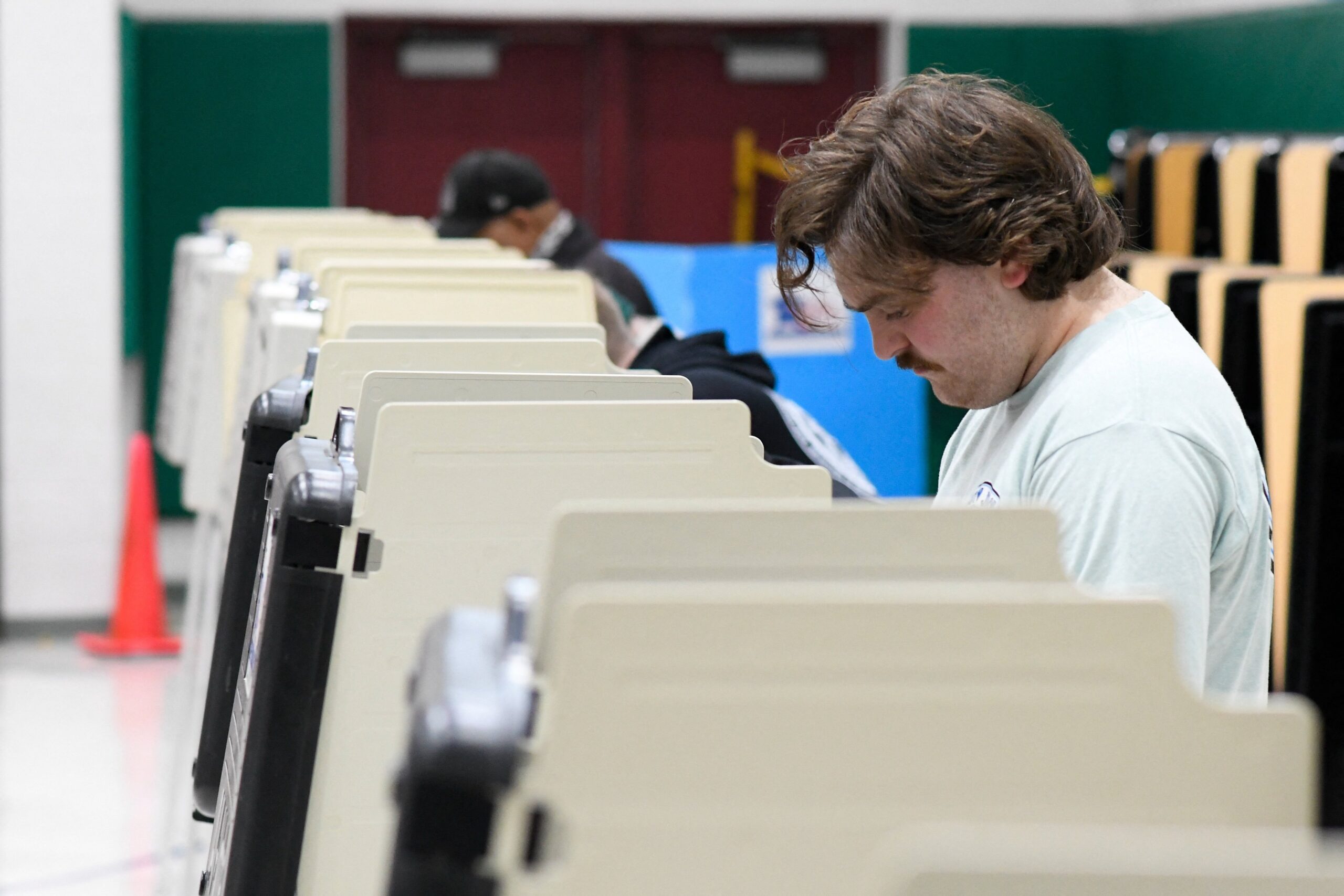
Across the country, voters in the midterm elections sent a message: people are deeply unhappy with the direction of the country and want something different. The flipping of numerous races and the victories of candidates who offered a different vision of American politics suggest that voters—including Catholics—are moving beyond the narrow confines of single-issue voting. They are looking at the bigger picture and weighing the economy, health care, democracy, human dignity and well-being in their communities. Furthermore, they are increasingly willing to vote in ways that communicate their displeasure with a political system that has failed to serve them.
The issue of human dignity is especially poignant for the transgender community, which was made a focal point of Republican spending during the lead-up to the election. Estimates put Republican spending on transgender-related television attack ads at approximately $183 million, with more than 217,000 advertisements aired nationwide. Yet, the results demonstrate that the effort to turn transgender people into the central cultural battleground of the election did not produce sweeping political victories.
Unfortunately, the response from many Democrats was not a show of solidarity with transgender people but a willingness to distance themselves from us, sometimes explicitly campaigning on restrictive positions in an attempt to appeal to voters. In spite of important victories for transgender-inclusive candidates, there were Democrats who treated transgender rights as a liability rather than a matter of fundamental human dignity, and many anti-trans bills were advanced across the country.
The broader LGBTQ community learned that solidarity must be measured by whether people are willing to stand beside those whose lives are most threatened.
As a transgender person, watching the celebrations surrounding these election results has been a complicated experience. I feel genuine relief for neighbors, families, immigrants, working people and other vulnerable communities who have spent the last several years watching their lives become political battlegrounds. I am glad when people who have been frightened by the direction of our country can breathe a little easier.
At the same time, there is a bittersweetness in celebrating a political victory while remembering that my own community was placed on the chopping block along the way. We watched some of the very people who should have stood beside us decide that defending our dignity was too politically costly.
There is perhaps a historical parallel here with the experience of gay communities during the AIDS crisis. As the country confronted a devastating public health emergency, gay men and their loved ones experienced not only illness and loss but also the painful realization that many political and religious leaders were willing to look away. The broader LGBTQ community eventually learned that solidarity must be measured by whether people are willing to stand beside those whose lives are most threatened, particularly when doing so carries a political or social cost.
This question of solidarity is also deeply connected to the Catholic faith and its understanding of the common good. Catholic voters have demonstrated a growing willingness to consider more than a single issue when entering the voting booth. As the U.S. Bishops have articulated many times, “the Gospel cannot be parsed in political or partisan terms.” Issues of poverty, health care, immigration, racial justice, economic inequality and the protection of vulnerable communities are not simply political issues but questions of central importance to Catholics who wish to live out their faith.
Catholic social teaching reminds us that protecting someone’s dignity and freedom does not require agreement with every decision they make.
Within Catholic social teaching, the principle of solidarity underscores the demand to move beyond just feeling compassion for someone experiencing hardship. In his encyclical “Sollicitudo Rei Socialis,”( Pope John Paul II described solidarity as “a firm and persevering determination to commit oneself to the common good” (§38). Solidarity, therefore, is about moving from empathy for another’s condition into accepting responsibility for the conditions that produce that suffering, recognizing that the well-being of our neighbors is inseparable from our own.
Pope Francis similarly described God’s presence as dwelling among people and fostering “solidarity, fraternity, and the desire for goodness, truth and justice” (“Evangelii Gaudium,” §71). His vision of the church was one that could recognize God’s presence in the ordinary lives of people, particularly through their efforts to build communities characterized by mutual care. Pope Leo XIV makes the connection between solidarity and the protection of vulnerable people particularly explicit in “Magnifica Humanitas,” insisting that social and economic progress must be “guided by the principle of solidarity, without sacrificing the most vulnerable to the rationale of profit” (§39). His words offer an important measure for evaluating our political choices: progress cannot be built on the exclusion or abandonment of those with the least power. Solidarity requires us to ask not simply whether society is advancing, but whether its most vulnerable members are being protected along the way.
Other leaders of religious faiths have also articulated the importance of this principle. In his book titled Solidarity: The Work of Recognition, the former Archbishop of Canterbury, Rowan Williams, describes solidarity as a shared labor of building an equitable community in which each person contributes to the agency and freedom of others. He writes that “embodied presence itself prompts conscious relatedness.” Being present with one another—in recent memory, demonstrated through the pastoral example of Pope Francis—helps us recognize our connections and responsibilities. Solidarity begins when we stop treating other people’s struggles as distant problems and recognize that we are participants in a shared human community.
The true measure of solidarity is not how loudly we celebrate political victories, but whether we are willing to stand beside those who remain vulnerable after the celebrations are over.
This brings us back to transgender people. We are not an abstract political issue, a campaign advertisement or a hypothetical theological debate. We are neighbors, family members, coworkers, parishioners and friends. We participate in the same communities and share the same hopes for a safe and meaningful life. Our dignity does not become less deserving of protection because some politicians have decided that our existence is politically inconvenient.
Catholic social teaching reminds us that protecting someone’s dignity and freedom does not require agreement with every decision they make. Just as religious liberty protects the freedom to seek truth and respond to God without coercion, civil protections ensure that transgender people can participate in society without discrimination or exclusion. Solidarity means recognizing that our responsibility to one another extends beyond political convenience or agreement. It requires listening to marginalized communities, standing with them when their dignity is threatened and refusing to sacrifice their rights for the comfort of others. The true measure of solidarity is not how loudly we celebrate political victories, but whether we are willing to stand beside those who remain vulnerable after the celebrations are over.