The following essay is excerpted from a forthcoming collection entitled: “Faithful Loves: Stories of LGBTQI+ Catholic Families.” Currently under contract with Paulist Press, the book explores how the faith of LGBTQ+ Catholics is lived out in the context of family.
The collection is being edited by the author along with Dr. Gael Pardoen (St John’s College, Durham University, United Kingdom) and Jason Steidl Jack (St. Joseph’s University, New York). New essays are still being accepted for inclusion in the anthology. Interested writers can learn more and submit using this form.
A child’s perception of a parent can affect his or her understanding of God, as psychological research demonstrates. If children view their parents as nurturing and powerful, they will likely see God in a similar way. In my work as a clinical mental health therapist, I have observed that many people with authoritative parents tend to view God as similarly demanding and judgemental. Our understanding of God is often linked to our experience of parenthood.
As I write this, my husband and I are preparing to become fathers. As parenthood looms, I find myself wondering how my child will view God. As I try to imagine God from a child’s eye view, I naturally turn to my own childhood.
My family’s understanding of God largely took shape in how we experienced the Eucharist. Each Sunday, my five siblings and I piled into the back of the family car, usually while my father warned us we were going to be late and fussed about whether we had eaten within the hour. When we entered a church, my grandmother turned toward the tabernacle where the host was kept, bowed her head and spoke in hushed tones. I found the “otherness” of the Mass to be both scary and awe-inspiring. When the bells rang during the liturgy of the Eucharist, I felt that I was being transported to a place beyond the monotony of daily life.
Our understanding of God is often linked to our experience of parenthood.
While I felt a deep sense of connection to the people I lined up to receive Communion with, often the same faces week after week, I struggled to reconcile that connection with the scary rules I was taught about when it was safe to receive. Anxious and literal-minded, I worried that if a curse word crossed my mind, I wouldn’t be able to receive Communion, or that if we missed weekly Mass while on vacation, I would die in a car accident and go to hell. People in our world reinforced this view of sin, fixating on going to confession before traveling—“just in case”—or receiving indulgences for deceased loved ones by repeating a formula of prayers.
I worry that my child will be like me, who spent my childhood anxious about my ability to approach the altar. I worry that he, like that younger version of myself, will view God as some blend of judge and accountant; that he will fret endlessly about his own sins before receiving communion or become consumed by his own ideas about God, reducing the divine to the size of his own understanding.
I want my child to know the spiritual nourishment of Communion, but how to explain to a child that the God who breathes us into life can be experienced in the breaking of bread?
I understood that when we piled into the car and went to my grandmother’s for Sunday dinner, God stayed there, in the tabernacle. It was only later that I understood that God continued to show up in the many meals that followed that one, special meal. Our focus was so often on worthiness that we failed to notice how the symbolic gesture of breaking and sharing bread steeped into the rhythm of our lives.
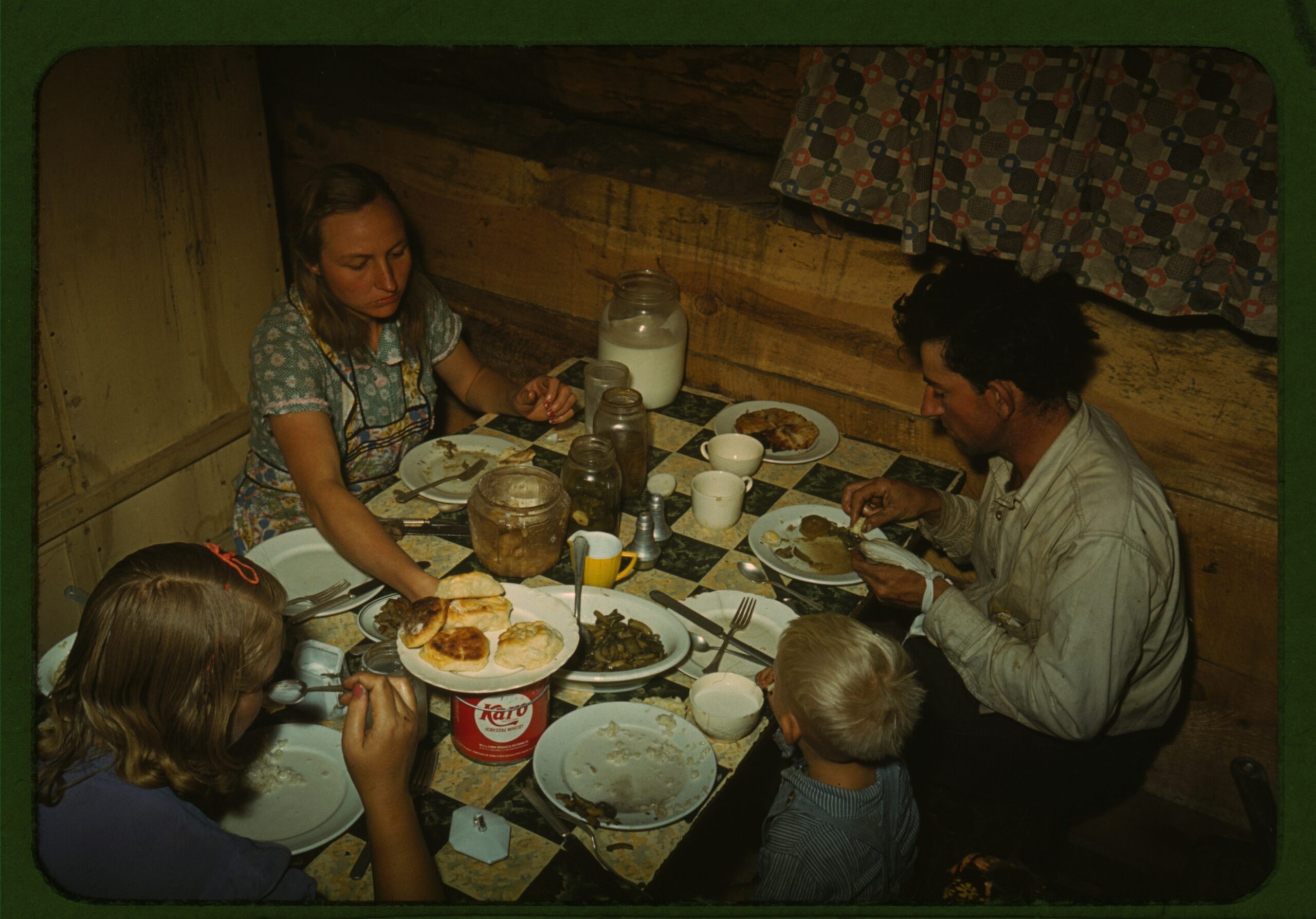
It wasn’t one meal but all of the meals. Each Sunday after Mass, my aunts, uncles and cousins crowded into the kitchen of my grandmother’s little row house for perogies and homemade waffles. Sunday dinner was a remnant of a different manifestation of the Catholic Church, one born in a small coal town in central Pennsylvania. My grandmother attended an Irish parish and my grandfather a Polish one. For them, church was a community of people around which life revolved. My grandmother introduced us to that world and we adapted it to our time. Whatever happened during the week in sports, school, or family, we knew what to expect on Sunday.
Many of the tangible elements from Mass were present: a common table, the sharing of food, a sense of being bonded by something larger. In time, receiving Communion at Mass opened my eyes and allowed me to see God’s love in the many small, everyday ways that it presented in family life. The perogies at our table were an extension of the Communion bread. Our weekly exchange of gossip was a continuation of the prayers we heard at church. The point of the Eucharist was not to be rewarded for good behavior. It was to lead a Eucharistic life.
Our rituals were passed down from one generation to the next. After my grandmother passed, my parents took over the hosting duties for Sunday dinners. After Mass we rushed home to prepare dishes filled with olive oil and Parmesan, perogies and clams on the grill. Wayward strangers made their way to the family table, like a priest with nowhere to go for the holidays or a widower my mother met at the deli.
The point of the Eucharist was not to be rewarded for good behavior. It was to lead a Eucharistic life.
When I heard God referred to as a parent, I thought of my father and mother cutting vegetables at the kitchen counter on a Sunday. I thought of my brother’s children rushing to greet him when he arrived at my parents’ house after work, or my mother calling me every day to talk about nothing and everything. For me, understanding God’s love was, for me, inseparable from the love I experienced when my parents cared for me, often with food. I hope that I can provide this for my son and that one day in the future, he will read this.
If that does happen, Henry, then know this.
If you are like your father, you will get anxious at times. You will look around for things to reassure you that you are okay. When this happens, I recommend that you look for many ways to stay in communion.
On some days, you may find God by coming to church with me and receiving a piece of sacred bread along with others. Many will be older than you. Some may look different than you. Others will annoy you or disagree with you about issues close to your heart, and that is the price of community. You may fight me on these outings but come to appreciate them in time.
I hope that you find God both in the church and outside of its doors. There may be days where we find communion on long walks in the forest with me and your other father, looking for God in the mountains, trees, birds and rivers. God can be found there too. We cannot put God into a box just so that we can understand.
You don’t have to have it all together to approach the altar. You can go there when you’re lost or when you’re found, in good times and in bad. I hope that visiting a church will make you feel that you are a part of something symbolic and something real, something eternal and something already here, something old and something new.
When you begin to wrestle with these things, try to remember that the most important thing is that it is God’s love that is drawing you outside of yourself and into that search for a place where the ordinary meets the extraordinary. As you wonder at the possibilities of what God can be, use that love as your north star.
Your father and I will be waiting for you at home, always, with food on the table that we want to break and give to you, just as our parents did for us. When you set about in that great search for something higher, may you recognize the love of God in the love that your father and I have for you.