The question arises every few years, whether in response to a new survey, a church document, a comment from a pope or bishop, a well-known priest leaving the priesthood and declaring his homosexuality, or even a new book or film: Should gay men be accepted into seminaries or be ordained priests? Likewise, should they be accepted into formation (training) programs for religious orders? A new paper has raised this question again.
To be clear, when we speak about gay men being ordained as priests or accepted into religious orders, we are presuming a life of celibacy (the promise that priests make at their ordination) and chastity (the vow members of religious orders make).
In 2024, the McGrath Institute for Church Life at the University of Notre Dame commissioned a study with the Center for Applied Research in the Apostolate (CARA) at Georgetown University on “how dioceses and seminaries assess seminarian’s suitability for ordination.” The results were published in September 2025. As a follow-up, the McGrath Institute convened a three-day conference of experts to reflect on the study, that same month.
This week, two authors, the Rev. Thomas V. Berg, who served for many years as a formator (a person working in formation) at St. Joseph’s Seminary in Dunwoodie, NY; and Timothy G. Lock, a licensed psychiatrist and director of psychological services also at St. Joseph’s Seminary, summarized the findings and set forth their recommendations in a paper called “Do You Know Them to be Worthy? (The title comes from the question asked by an ordaining bishop to the seminary rector or religious superior at an ordination Mass.)
The two authors are clear that some suggestions are their own: “At points, the conclusions presented here represent not a simple synthesis of participant opinion, but the authors’ own prudential judgment, shaped by—yet not reducible to—the perspectives offered at our summit gathering.”
Should gay men be accepted into seminaries or be ordained priests? Likewise, should they be accepted into formation (training) programs for religious orders?
The document, subtitled “Twelve Proposals for Bishops, Rectors, Seminary Formation Teams, and Mental Health Professionals in Assessing the Suitability of Men for Holy Orders,” directs nine of its proposals toward how psychological and mental-health resources can be used more effectively in seminary formation, and one toward supporting chastity and celibacy formation. Many of the authors’s proposals are wise and well researched, focusing on the important need for a healthy psychosocial and psychosexual formation for all seminarians. (The document focuses on seminary formation for diocesan priests, rather than formation in religious orders, like the Jesuits, Franciscans, Dominicans, Benedictines, and so on.)
However, in the last two proposals where the topic of homosexuality comes up (referred to as “same-sex attraction” or “SSA”), the paper makes claims that may strike anyone who has known celibate gay priests as surprising. (As an aside, the authors don’t explain why they avoid using the common term “homosexual” or “homosexuality.”)
In 2005, the Vatican’s Congregation for Education issued a document stating that men with “deep-seated homosexual tendencies” should not be admitted to seminaries or ordained priests. Interestingly, the McGrath/CARA survey states that almost a quarter of the bishops surveyed (22%) “agree” or “strongly agree” that they are “comfortable ordaining a man who experiences deep-seated same-sex attraction, provided he is firmly committed to celibacy.”
This fits with what I have heard from bishops and religious superiors since the Vatican document was issued. There seem to be three ways that bishops understand the ban on ordaining men with “deep-seated homosexual tendencies.” First, as 22% of bishops see it: “deep-seated” means that if a man’s homosexuality somehow makes it impossible for him to live celibately, he cannot be ordained; but if a gay man can live celibately, he can be ordained. Second, “deep-seated” means that if a man sees his sexuality as the most important or the defining part of his life, this would preclude ordination. Third, “deep-seated” means that if a man is gay, he simply cannot be accepted into seminary formation or be ordained.
This is an issue where it seems that the church does not yet have a settled judgment in practice: Indeed, a footnote in the report points out that when asked “how a candidate’s dominant attraction to those of the same sex would impact their judgment of his suitability for Orders,” 48% of bishops would consider it “worrisome, but not by itself disqualifying,” while 45% would consider it “alone disqualifying.”
While the authors, to their credit, acknowledge and value gay priests, they seem not to have explored how those priests were able to integrate their sexuality into fruitful celibate lives and ministries.
During a meeting with Pope Francis in 2024, I spoke with him about this topic and he allowed me to share his response, which is that he knew many “good, holy and celibate” seminarians and priests who were gay. Given the sensitivity of the topic, I asked Francis twice if I could share that publicly. “Why not?” he said. “I’ve said it before. And it’s what I believe.”
Father Berg and Professor Lock also make a distinction between two neologisms: “deep-seated same-sex attraction” and “transitory same-sex attraction.” Sexuality is complex and many people, say psychologists, find themselves on a kind of spectrum; likewise, some people experience homosexual attractions at an early stage in their lives and later don’t. But the language here, on “overcoming” homosexuality, is worrisome.
Following this new definition, when any candidate discloses that he experiences SSA, a memo should be added to his file indicating that he disclosed his experience of SSA on that particular date. This date stamp will allow vocation directors, rectors, and bishops to follow the seminarian over time and provide him with the appropriate means to work toward overcoming his SSA if it is indeed transitory.
It is one thing to overcome temptation or lust; it is another to overcome one’s overall sexuality. My sense is that the authors are speaking about what my health-class teacher in junior high school called a “phase.” But this could easily be misinterpreted as overcoming one’s sexuality overall, a dangerous proposal.
There is much to be said for the careful way that Father Berg and Professor Lock, both of whom have extensive experience in formation, look at these complex questions, especially in their sincere praise for gay priests they have known.
We were honest about the fact that if such conversations are hard and uncomfortable, it is also because many of us know brother priests who in fact experience SSA—brothers we love, with whom we minister, and who in fact have so often ministered to us, have baptized our children and witnessed our marriages and walked with us in the saddest moments of our lives, and some of whom have even played decisive roles in our own vocational discernment.
But the heart of their approach is a view of homosexuality as an immense barrier to living a healthy life as a priest.
Most of us, even as we know brother priests with SSA, often also know just how painful and problematic their road in life has been, attempting to wed that attraction with a celibate lifestyle.
One of the ironies of this paper is the near-exclusive focus, in the proposals dealing with the question, on the difficulty of living a healthy and mature emotional life as a celibate gay man. While the authors, to their credit, acknowledge and value gay priests, they seem not to have explored how those priests were able to integrate their sexuality into fruitful celibate lives and ministries.
In fact, the Catechism of the Catholic Church says that through chastity, gay people can live healthy lives. The tension between this teaching and the default exclusion of gay men from seminary formation is rarely remarked upon. On the one hand, we have papers, such as this one, which say that gay men cannot be priests because of factors that prevent them from living healthy, chaste lives.
In my almost 40 years as a Jesuit, I’ve known dozens of celibate gay priests who have led what Pope Francis called “good, holy and celibate” lives, modeling Jesus’s message of love and mercy.
On the other hand, we have the Catechism, which says, “Homosexual persons are called to chastity. By the virtues of self-mastery that teach them inner freedom, at times by the support of disinterested friendship, by prayer and sacramental grace, they can and should gradually and resolutely approach Christian perfection” (#2359).
Who else would you want to ordain a priest if not someone who can “resolutely approach Christian perfection?”
In my almost 40 years as a Jesuit, I’ve known dozens of celibate gay priests who have led what Pope Francis called “good, holy and celibate” lives, modeling Jesus’s message of love and mercy. Similar to the experience of Father Berg and Professor Lock, they have been for me, and for many of my friends, spiritual directors, pastors, professors and mentors. And they have done so in a church that sometimes ignores, denigrates or even insults them. The most compelling argument for openness to ordaining gay men to the priesthood is the presence of many holy and healthy gay and celibate priests.
Yet there is an inability in the church to admit this, for several reasons: First, a lack of reliable data (which means accurate estimates of the percentage of gay priests is hard to ascertain); second, embarrassment on the part of some church leaders that the priesthood would be seen as a “gay profession” if the true percentage were known; third, embarrassment among some gay priests about their own sexuality; fourth, a false conflation between homosexuality and pedophilia; and finally the persecution faced by the few gay priests who are more public about their sexuality, as this New York Times article details. All this conspires to keep this topic “in the closet.”
But whether they are gay or straight is not as important as another question. The real question is: Can a man model Jesus Christ in his love, mercy and compassion while living in faithful celibacy?
Thus, it is an unspoken reality, known and discussed in private conversations in chanceries, rectories, seminaries and religious order houses. A few years ago, I asked a US seminarian studying in Rome how many of his fellow seminarians were gay. “Half of them,” he said without hesitation. How many were open about their sexuality with their spiritual directors or seminary rectors? “Are you kidding?” he said. “None of them.” He explained that would mean expulsion.
Overall, saying that gay men cannot be ordained as priests means that gay men interested in the priesthood will either be driven away from their vocations, or driven underground in seminaries: the former a loss for the church, the latter a recipe for disaster.
I agree wholeheartedly with Father Berg and Professor Lock that seminary formation (and formation in religious orders) needs to include healthy psychosocial and psychosexual development. That is, we need emotionally mature priests. But whether they are gay or straight is not as important as another question. The real question is: Can a man model Jesus Christ in his love, mercy and compassion while living in faithful celibacy?
The authors’ answer for gay men who feel called to priesthood seems to be no. With respect for their studies and experience, my answer, based on my experience with many holy and healthy gay priests over the past 40 years, is yes.
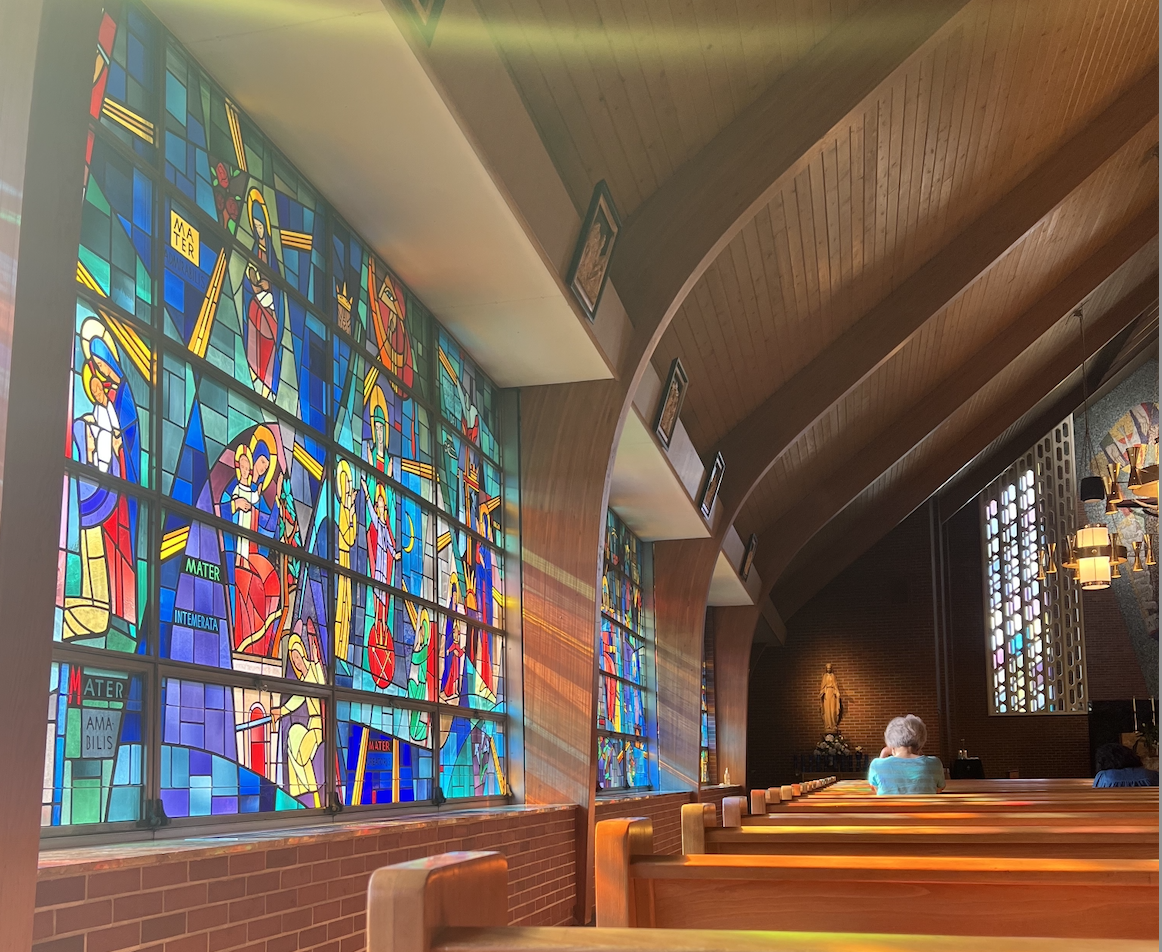
Correction, 7/24/2026: Due to an editorial miscommunication, this article was originally published with a version of the photo in which the person in the pews had been removed with photo editing software. It has been replaced with the unedited photo.