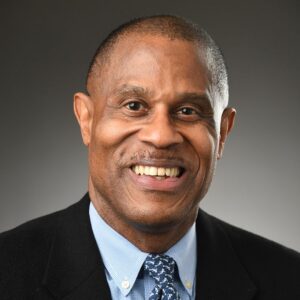
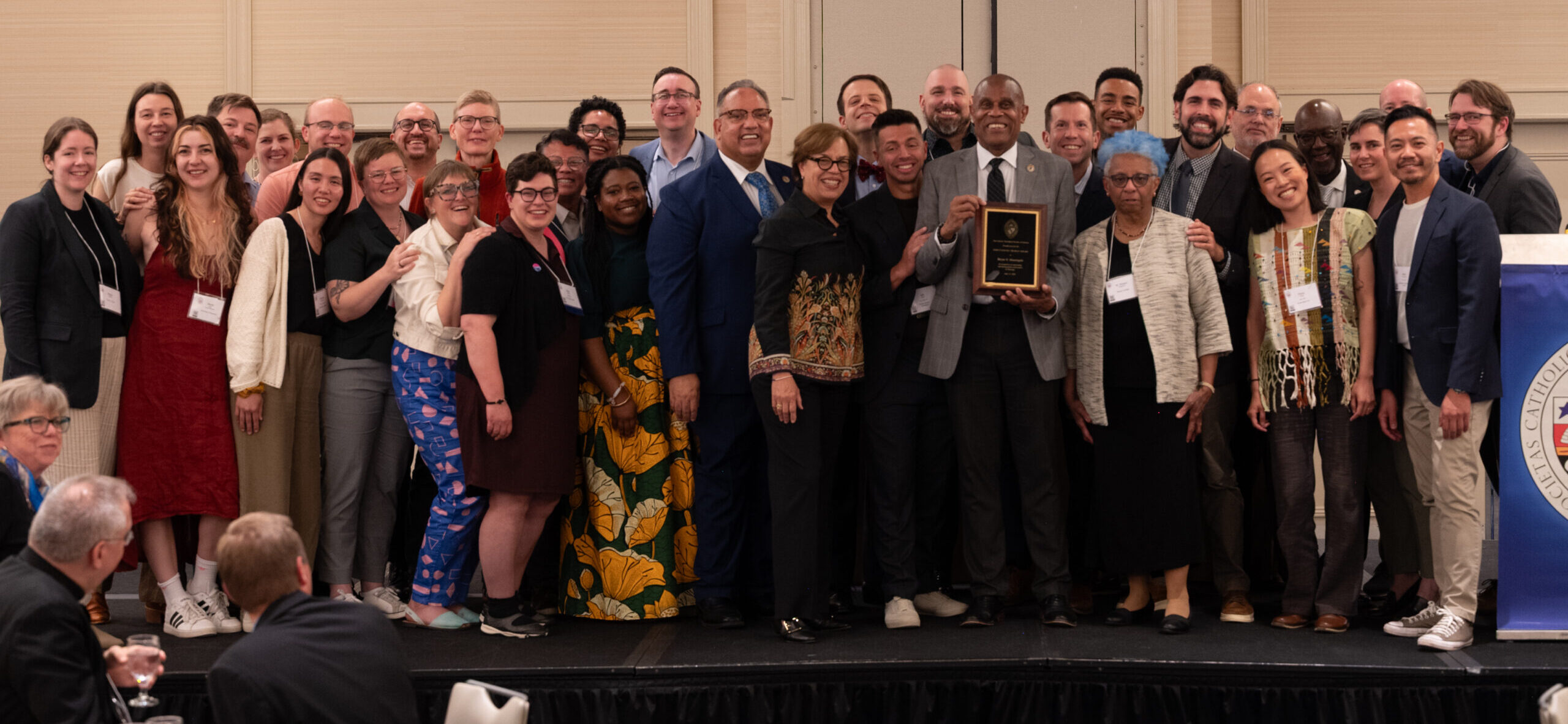
This is the full text of the speech given by Rev Bryan Massingale upon receiving The John Courtney Murray Award at the Catholic Theological Society of America Award Ceremony on Saturday, June 13, 2026 at CTSA’s annual convention in St. Louis, Missouri.
Thank you. Those words are too small to express the feelings in my heart. Yet, thank you. I want to begin by thanking my families. Yes, that’s in the plural.
First, my blood family. My parents, who instilled in their children a love for education. My grandmother, who gifted me with my first Bible when I graduated from high school—The Jerusalem Bible, because it had the most extensive footnotes. A Pentecostal “prayer warrior,” she loved all of her ministers but respected only the smart ones. My sister, the youngest of my siblings, who is here tonight. Although a grown woman, she is always my “little sister.” And my best friend.
There is another family I want to thank. LGBTQ folks often use terms such as “chosen family” or “found family” in speaking about networks of love, support and care that sustain us when our blood families struggle under the weight of heteronormative socialization. I use another term, my “gifted” family. Because their presence in my life is a gift. The fact that you would come—and some of you weren’t planning to be here and yet upended your plans at the last minute—testifies to the gift you are in my life. I thank you, my gifted family.
Thanks also to my colleagues at Fordham University, who made New York City not only a place to live but a collegial place to thrive. And to my dear friends and colleagues of the Black Catholic Theological Symposium (B.C.T.S.) for sustaining joy, powerful collaboration,and the grace of loudness!
I thank you, my colleagues of the Catholic Theological Society of America (C.T.S.A.), who in the past entrusted me with the leadership of the Society, and now honor me with your highest affirmation and recognition. I want to reflect upon the question: What did you do? Because in so many ways, this honor is about far more than me.
What would Catholic theological ethics look like if it took the Black Experience seriously as a dialogue partner?
First, this moment is not only about me, it is a deeper recognition of the “Catholicity” of the Black theological project. There is an enduring question that motivates my intellectual work and existential struggle: What would Catholic theological ethics look like if it took the Black Experience seriously as a dialogue partner? By the “Black Experience,” I mean that reality so well described by James Cone, the pioneer of Black Theology: “the experience of surviving with dignity in a society that does not recognize Black humanity.” A society that does not recognize Black as a legitimate way of being human. A society and church where folks are not conditioned to love Black bodies. But rather to fear, denigrate, disparage, overlook or ignore them.
I and my colleagues in the Black Catholic Theological Symposium do Catholic theology in the midst of a society and church marred by the evil of white supremacy. Celebrating Blackness as “stamped with the image of God;” demanding a church and society where Black beauty, intelligence, love and faith can flourish; lifting up Black existence as an essential theological locus out of the conviction that Black flesh is a place of divine encounter, revelation and manifestation: this is the core and the rationale of the Black Catholic theological project. (It’s a project more radical than most often acknowledge).
When Shawn Copeland received this award in 2018, I cried like a baby! I sobbed! (That’s not an exaggeration). I felt that at last we and our project were seen, heard, recognized. During her acceptance remarks, she passionately declared than she was not the field of Black Catholic Theology! She eloquently detailed how in honoring her, this Society honored the lives, passions and efforts of so many others. She called the roll of Black Catholic scholars who are pivotal in this endeavor.
Thus, in conferring this award, the C.T.S.A. confirms that I also am not the field. Because Shawn has already done so, I don’t need to do a roll call again. Instead, I will bring into this moment those who gave so much to this project and now rest in glory, our dearly beloved friends and colleagues Shawnee Daniels-Sykes and Jamie T. Phelps. I know that both of them are beaming tonight, dancing as they intercede for us in the presence of the saints. Among those holy ones are the African American future saints Servant of God Thea Bowman, Venerable Augustus Tolton, Venerable Pierre Toussaint, Venerable Mother Mary Lange, Servant of God Julia Greeley and Venerable Henriette Delille. Tonight is bigger than me. It is a celebration of Black Catholic faith.
As Audre Lorde declared, “There is no such thing as a single-issue struggle because we do not live single-issue lives.” I stand before you as both a Black theologian and a publicly gay/queer/same-gender loving one.
Tonight is bigger than me in another very important way. The Black Experience is a multifaceted reality. As Audre Lorde declared, “There is no such thing as a single-issue struggle because we do not live single-issue lives.” I stand before you as both a Black theologian and a publicly gay/queer/same-gender loving one.
I am not the field of Catholic queer theology. But naming this field’s members, much less its contours, is a challenge. There have always been more or less “out” Catholic LGBTQ theologians. Many have been and are members of this Society; some have served in its leadership. Yet, despite being more or less “open” about their sexuality—meaning that many either knew of it, know of it or would not be surprised upon hearing of it—often they rarely acknowledged their identities publicly. For many reasons—personal, political and ecclesial—they did Catholic theology in what I call “the open closet,” where others could know you are gay as long as there was no public acknowledgment or discussion of that fact.
I say this only to describe, not to accuse or condemn. Recall that not so long ago, staff from the U.S.C.C.B.’s doctrine committee joined the C.T.S.A. and monitored any convention session that examined topics concerning human sexuality. Repressive conditions led many of us to suppress who we are and camouflaged how we love.
Tonight’s honor is bigger than me, for it is a recognition of a new kind of theologian for the church: publicly-identified LGBTQ Catholic theologians, doing Catholic theology for the sake of the church and its understanding of God. We have always been here. Tonight we now have a visibility, acknowledgment and recognition never before granted.
As many of you know through experience, when a family member comes out as LGBTQ, the family itself begins a coming-out journey. Thus, tonight Catholic theology comes out of the closet. Tonight the world’s largest association of Catholic theologians acknowledges a “new thing” that was once deemed unthinkable: LGBTQ theologians who publicly and “pride-fully” serve the church and faith we love in complicated and yet real ways—a church that is all too slowly learning to love us as God already does.
Tonight’s honor is a recognition of a new kind of theologian for the church: publicly-identified LGBTQ Catholic theologians, doing Catholic theology for the sake of the church and its understanding of God.
This moment is bigger than me in still another way. By honoring me, the C.T.S.A. is saving lives. Allow me to illustrate by the following stories:
Last June, I presided and preached at the annual Pride mass held at St. Columba’s Parish in Oakland, Calif. While greeting people afterward, a Black woman grasped me by both hands, squeezing them ever so tightly, and with teary eyes said, “You don’t know me. But I know you and read about you. Thank you. Thank you for teaching me to love my gay son.”
In September 2024, I visited a safe house for LGBTQ+ refugees and asylum seekers from across the African continent in Johannesburg. I was the first clergy person to ever come to their home. They asked me heartrending questions: “We know you are gay, too. Do you ever think that they are right about us? That we are filthy degenerates bound for hell? Are we holy, too?”
Last month, I received an email from a group hoping to establish a sanctuary for gay men in Uganda, a country with some of the harshest anti-gay laws, where sexual minorities are hounded, harassed, denied housing, thrown out of schools, raped, imprisoned, tortured and killed. They wrote plaintively (and I paraphrase to protect them): “We need to be secret. Please pray for us. We know you are part of us. Can we talk sometime?”
This honor is about far more than me. It is a beacon of hope. Because somewhere, somehow, someday, a queer person, a gay man, a lesbian woman, a nonbinary individual—maybe in Uganda, perhaps in the Bronx, maybe in Honduras—will hear of what happened tonight and realize that the Catholic theologians of North America declared, “You belong. You have a place. You have worth. You have value.”
Tonight is about much more than me. By this recognition, the C.T.S.A. is saving lives. We may not ever know how, we may not ever know how many. But rest assured: This organization has saved lives. That’s why we do theology.
Saving lives. Bearing hope. This is the deepest meaning of our vocations, especially in this fraught hour in our national and global life. This leads to yet another way why this moment is about so much more than me.
I stand before you as a banned author. In April 2024, my Saturday morning was interrupted with the news that my book, Racial Justice and the Catholic Church, had been purged from the library of the Naval Academy in Annapolis. Why? Because that work is in direct opposition to the idolatrous ideology of white so-called “Christian” nationalism that is the heart of the immoral projects being advanced by our nation’s administration.
This so-called “Christian” nationalism believes that America was willed by God to be a place where the descendants of Europe should flourish under the rule of white, conservative, heterosexual men. And that those who differ from that identity only have that place in our nation’s history, institutions and even physical spaces that they allow. To this end they are re-writing history, forbidding the teaching of Black enslavement or LGBTQ social struggle; firing Black and women military leaders; erasing Black political participation through aggressive gerrymandering; engaging in ethnic cleansing in the name of immigration enforcement by evicting those deemed “un-American”; and establishing internment centers that must be called by their proper name—“concentration camps”—whose inhumane conditions reportedly include maggot-infested and spoiled food, wretched sanitation and inadequate if not absent medical care.
Saving lives. Bearing hope. This is the deepest meaning of our vocations.
All of this is done in the name of “God”—an idol that sanctifies only white, male, heterosexual bodies.
My book was the only Catholic theological book on the index of purged works. It was banned because it declared that the denigration of any human being is absolutely contrary to the will of God. It was banned because I believed that one cannot be an unabashed racist and call oneself a follower of Jesus. It was banned because I denounced the blasphemous conviction that God desires white political dominance and social privilege. It was banned because it named idolatry. (And said this in a language that folks could understand).
Thus in honoring me at this fraught time and awarding the kind of theological project I engage, the C.T.S.A. is taking a stand. It is declaring that authentic Catholic faith is subversive to any idolatrous political project. Our vocation, in such as this, cannot be to do theology as if everything is normal. We cannot be about “business as usual” by writing essays for refereed journals that only we will read. Our task, for the sake of God’s people, is to risk being banned—to call out, name, protest, criticize and denounce the idolatry of the present in the name of the God of life, who desires abundant shalom for all. For all without exception.
Because God’s vision of the world is one in which all flourish, without exception. As Catholic theologians, we are called to see the world as God does. To dream God’s dream for the world. And to use our craft to describe that dream and possibility for others.
That’s where I want to end tonight, on a note of dreaming, imagination and vision. It’s the cutting edge of my theological ethical work and the focus of the book I’m frantically trying to finish: Dreaming While Black: The Poetics of Justice. We dare to dream a different world. We dare to dream a different world because if the resurrection of Jesus and the descent of the Spirit mean anything, they mean that reality is not a closed system.
That’s what we remember every time we gather to celebrate the Eucharist. We remind ourselves that because we live in the Spirit, life is not a closed system. We recommit ourselves to a Eucharistic faith that compels us to dream with Jesus. A faith that compels us to act for shalom—wholeness and flourishing for all.
As Catholic theologians, we are called to see the world as God does. To dream God’s dream for the world. And to use our craft to describe that dream and possibility for others.
This award is about so much more than me. Tonight, you have given voice, visibility and recognition to undervalued segments of God’s beautiful people. And more importantly, to a way of doing theology and a way of being Catholic.
So, I thank you. I am grateful. Above all, I give thanks to the Infinite Loving Mystery who beckons, haunts and loves in ways I cannot express. I praise the Holy Mystery who, through the miracles of Creation and Incarnation, made Black gay/queer/same-gender loving flesh sacred and holy. Who has stamped Black queer flesh with the image of God and made it a manifestation of God’s presence and grace in the world.
Unpacking that truth of what God has done is what Catholic theology and ethics would look like if it took the Black Experience, in all its gendered and sexual diversity, seriously as a dialogue partner.