
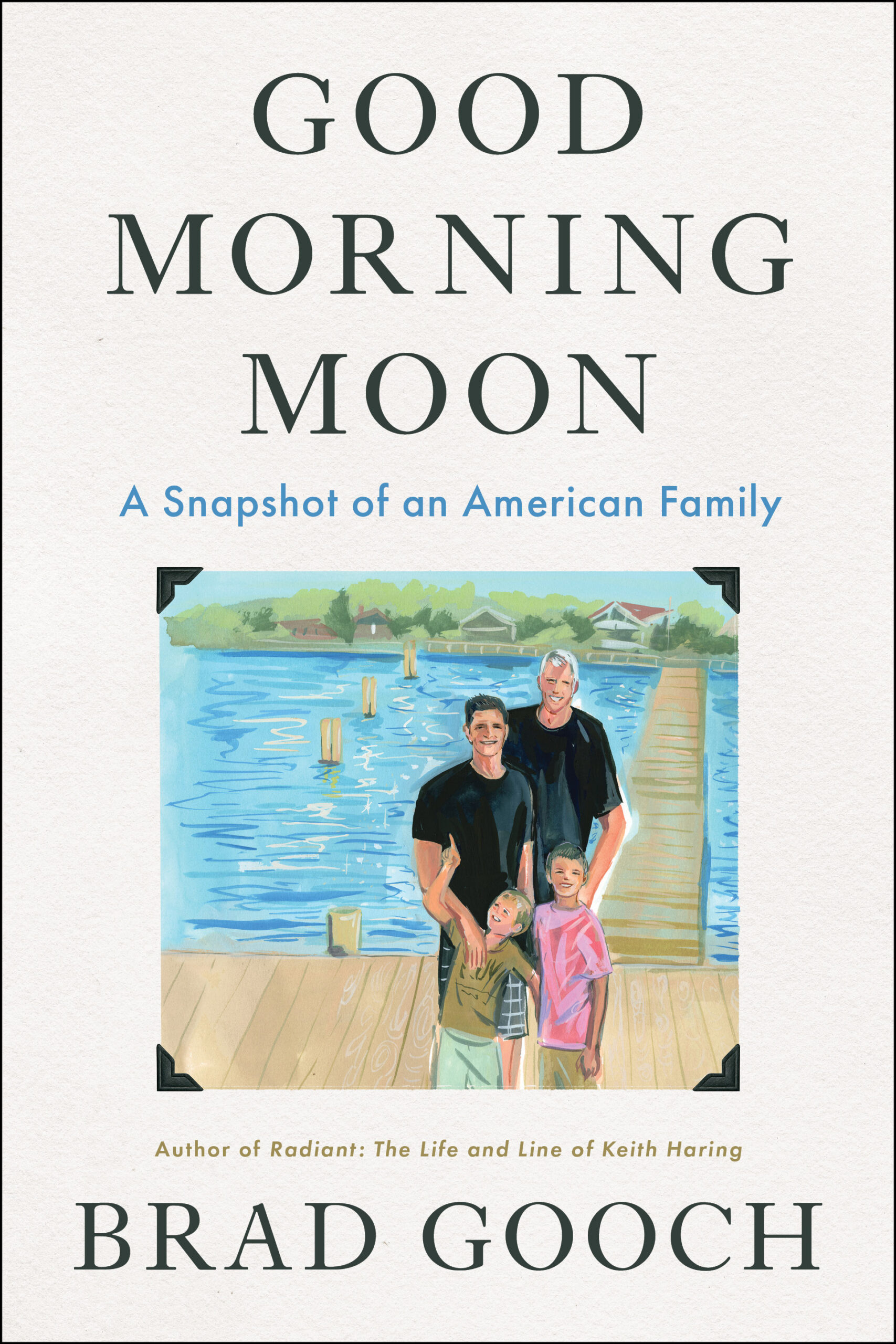
The following excerpt is taken from the book GOOD MORNING MOON by Brad Gooch, published with permission of Harper, an imprint of HarperCollins. Here he writes about his son Walter and his husband Paul.
The writing of birthday poems for Walter became a tradition, appropriately. On the bookshelf of my life, he was shelved in the Lyric section—perhaps since his conception and birth all took place under the sign of that most lyric of poets, Rumi. The books we write, whether fictional or nonfictional, novels or biographies, have a life on the page and then a much wider submerged impact affecting everything else going on during the years of the stirring of the pot.
I remember being at dinner at William Burroughs’s Bunker sometime in the eighties with Howard, and Burroughs, with a tumbler of vodka, talking about how fiction tampers with life almost as a kind of black magic so that he would be writing about someone from his childhood and receive a call that day informing him that his friend had died. He gave other examples. Before Walter was born, a philosophy professor and translator of Tibetan literature at the state college where I was teaching took me aside and said, “Don’t repeat what I’m about to tell you.” She told me of sensing something special about the baby to be born, a connection with Rumi. (I, of course, have repeated her comment many times.)
“Stop acting so small. You are the universe in ecstatic motion.”
After his birth, his godmother—Paul’s sister Carla—sent him a purple onesie with a wild and free translation of a Rumi line on the back: “Stop acting so small. You are the universe in ecstatic motion.” About the time he began to walk, he began to whirl, supposedly a common movement at that age. Our bedtime ritual was to carry him around to say good night to the paintings on the walls. One painting, a gift from the Iranian artist Y. Z. Kami, was created from paper squares of cutout Farsi words from Rumi’s epic poem, Masnavi, forming a swirl of a mandala vivisected by a cross. I would always say the word “Rumi,” as we came closer.
Walter’s first word—beyond “Daddy” and “Papa”—was “moon,” as he pointed at a full white moon when we were at the beach that summer following his first birthday. Among the bunch of words with prominent vowels that soon tumbled out, “Rowmi” was a rolling favorite. We were constantly reading to Walter, and he was a placid receiver of all these sounds. I read many of his books through the rose-colored spectacles of Rumi and Persian literature and kept hearing melodies and seeing familiar imagery from my readings in that rich repository, especially the beloved Persian imagery of moons. When my biography of Rumi came out around Walter’s second birthday, I gave a talk at Joe’s Pub, titled “From Rumi’s Moon to Goodnight Moon” on just this resonance.
In constant rotation among Walter’s books with cardboard pages was Maurice Sendak’s Where the Wild Things Are. A moon glows on every page as Max travels from his bedroom crowded with a forest of trees to the land of the clawed and toothed Wild Things. This moon then twitches illogically from crescent to full within a single page—a very Rumi swerve as his poetry was nearly surreal in its attempts to articulate a mystical point of view.
In Sendak’s other, even weirder classic, In the Night Kitchen, the moon is always there. Because everything is in reverse, and Mickey is up all night and goes to bed at dawn, the moon is yellow, and the sun rises white. The first thing Harold draws with his big purple crayon in Harold and the Purple Crayon is the silhouette of a crescent moon to accompany him on his walk, as he would need a moon if he were to have a walk in moonlight. Walter’s favorite—or was it really our favorite?—Goodnight Moon might well have been written by Rumi, Hafez, or Attar. Its full moon rises steadily through the starry panes of a great green room situated somewhere in violet space and quiet time. In the words of the great mystic Margaret Wise Brown: “Goodnight stars. Goodnight air. Goodnight noises everywhere.”
In the words of the great mystic Margaret Wise Brown: “Goodnight stars. Goodnight air. Goodnight noises everywhere.”
While Paul and I must have seemed to Walter two incredible hulks in the forest hovering, warm, and irrepressibly present in his earliest months, he was now beginning to have different experiences with the two of us, and his original world where all was in unison was developing separate continental drifts. The beach where, as a one-year-old, he said “moon” for the first time, was the beach of the Pines on Fire Island, the summer community synonymous with gay men having partied in the seventies and still partying then, cruising the bleached boardwalks between pleasure cottages with a low thrum of disco percussion always palpable beneath bare feet. We had not fully considered that there would be few other kids around, no playdates.
One evening, as we had a supper of hot dogs outdoors, young men on a nearby deck began gathering with iced drinks and a visible intent to party, dancing, their speaker’s volume as high as a deejay’s. In one of his first advances from word to phrase, Walter climbed on a metal chair and, joyfully taking in the party scene not a hundred yards away, yelled out what sure sounded like “Hey guys!”
The quieter mornings were consolingly untouched, as the Atlantic below filled all space with a profound white noise. Thoreau would have been content with the solitude. My most redolent memory of that vacation is Paul and Walter heading off each morning to find a breakfast of a scrambled egg on a bagel and a side of muffin to eat together on the steps over the dunes.
Excerpt from the book GOOD MORNING MOON by Brad Gooch. Copyright ©2026 by Brad Gooch. Used with permission of Harper, an imprint of HarperCollins. All rights reserved.