“At the Savior’s command and formed by divine teaching, we dare to say in our native languages….” I’m at a bilingual Mass in my local parish when I hear this instruction slipped in before the Our Father. In order to accommodate a diverse congregation, the priest encourages everyone to use the language with which they are most comfortable.
The priest’s words unleash a cacophony of voices: different languages, rhythms and volumes pour out in a jagged flow of sound. This Our Father sounds totally unlike the unified drone typical in an English-language Mass, which flows from the faithful in a cadence we’ve heard since birth. I’m used to intoning the prayer smoothly, in perfect unison. Instead, at a bilingual Mass, the acoustic chaos leaves me floundering to find a foothold among the other voices. Even though about half of the congregation is saying the same English words I am, I can’t seem to find my place. So I launch out alone, carefully recalling the prayer instead of relying on the current of voices to pull me along. After a few moments, our prayers wind down and the noise draws to a ragged end.
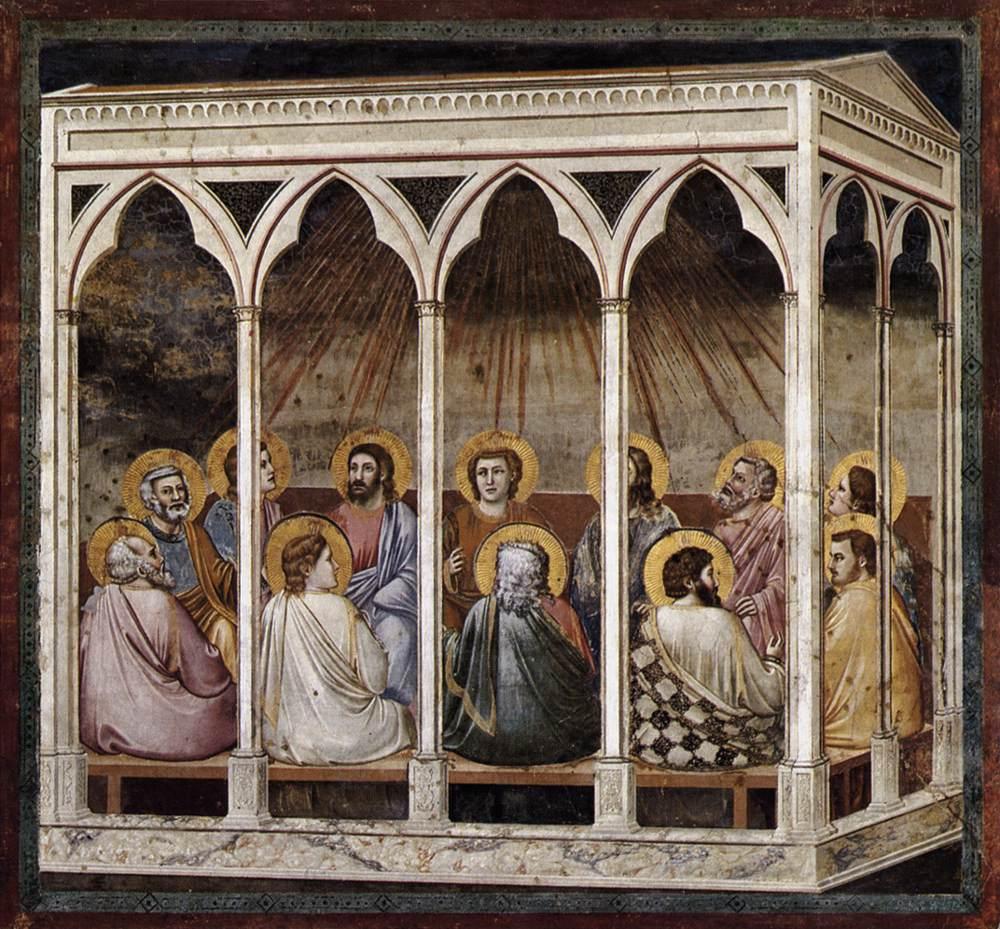
That first Pentecost, described in the second chapter of Acts, must have felt and sounded a lot like the multilingual Our Father— a truly chaotic, disorienting, seemingly disjointed cacophony of words. As the Holy Spirit descended on the house where Jesus’ disciples were gathered, it enabled them to proclaim the Gospel in a variety of languages. I doubt this was a well-harmonized, orderly gathering. Everyone must have been talking over one another in different languages, the sound rising to such a pitch that it caught the attention of passersby. Despite the chaos, members of the crowd could pick out individual voices speaking to them. “How does each of us hear them speaking in our native language?” the listeners wondered.
The Holy Spirit whispers to each of us, through our own desires, “Reach out, connect, relate.”
This scene captures a moment that is both communal and personal. The Pentecost experience was likely shared by hundreds of people, many of them strangers, swept up together in a baffling moment to receive a joint revelation. And yet I can only imagine the intimacy of hearing the good news spoken as if right to me, in my own language, like God reaching out to me personally.
The Spirit spoke in many languages on Pentecost, but delivered the same announcement. Like my parish reciting the Our Father together, the disciples were conveying the same message, at the same time, in different words. What sounded like divergence was actually unity.
As an LGBTQ Catholic, I have experienced God’s revelation similarly through my own experience of gender and sexuality. God speaks to each person through their inmost desires and sense of self. For example, through sexuality, God reveals our relationality and points to God’s own relational nature. This is the unified message that God communicates to all beings through our sexuality. Just as at Pentecost, God chooses to communicate this message in a multitude of ways, speaking the language of each of our sexual orientations. The Holy Spirit whispers to each of us, through our own desires, “Reach out, connect, relate.” We may speak different languages of sexuality, but the message of love is the same.
Sometimes talking about one’s own sexual orientation or gender identity can feel like speaking a different language, and talking across those differences requires an act of translation. LGBTQ+ Catholics often “code switch” to talk about our lives in hetero- and cis-normative spaces, including, perhaps especially, in church. When I attend Mass, read Scripture and receive spiritual input that is from a straight perspective, I interpret it into my own context.
For example, our tradition often uses the metaphor of Christ as bridegroom and the church as bride to describe the committed devotion between the two. Having never been in a straight marriage, that analogy doesn’t mean much to me, so I reinterpret it in light of the loving partnership between my wife and me. I’m so used to doing that work of translation that I often fail even to notice it. Perhaps this is what life was like for all of those diverse crowds in Jerusalem, who were functioning perfectly fine in their second language. There is a good chance they had already heard the remarkable story of Jesus, told to them in their second language of Greek or Amamaic.
Suddenly, on Pentecost, they heard the same message proclaimed in their own native tongues, and everything changed. This miracle was not about the Spirit communicating to people’s minds; it was about speaking directly to the heart. God was willing to translate Godself into each and every tongue in order to communicate more intimately. This shows us God’s tremendous desire to draw close to each person, of every background. The Spirit did not ask those first century listeners to translate, but translated Godself into their language.
Suddenly Jesus’ call took on a new vividness and immediacy when I saw her following Christ as a faithful lesbian on the path of discipleship.
Having a lesbian spiritual mentor for the first time was my Pentecost moment. I had known many holy people who communicated God’s love to me throughout my life, but there was something different about hearing the Gospel in her voice and seeing it in her life. Suddenly Jesus’ call took on a new vividness and immediacy when I saw her following Christ as a faithful lesbian on the path of discipleship.
God does not ask us to code switch ourselves into straight ways of expression; no, God so loves us that God code switches into our own expressions of sexuality and gender, to meet us in our own human particularity. God met me through that mentorship experience, and God invites all of the faithful to join in the work of proclaiming divine love as she did for me.
The crowds on Pentecost were baffled by the disciples’ linguistic agility, saying, “We are [from many lands], yet we hear them speaking in our own tongues of the mighty acts of God.” The Holy Spirit still calls today’s church to proclaim God’s mighty acts to all people—of every land, every race, every language and indeed every gender and sexual orientation. LGBTQ+ Catholics have a special role to play in this by declaring God’s goodness in our own lives. When we do so, we proclaim the Gospel that others may receive the good news in their native tongue.