
This essay appears in the French volume “Homos Et Cathos: L’Église à l’épreuve du réel” (Gays and Catholics: The Church Put to the Test of Reality), published by Desclée De Brouwer. Read the introduction from Cardinal Jean-Paul Vesco here.
Here is a phrase from the Gospel that every Christian believer, regardless of denomination or sexual orientation must take on board
If any want to become my followers, let them deny themselves and take up their cross and follow me. For those who want to save their life will lose it, and those who lose their life for my sake will find it. For what will it profit them if they gain the whole world but forfeit their life? Or what will they give in return for their life?[1]
It is very clear: the path from belonging to the “kingdom of this world” to belonging to the “kingdom of God” involves a certain sort of imitative following of Jesus which includes self-denial and taking up one’s cross.
And here are two ways to understand that passage as it might be read by LGBT people or those who love them. The first way (which was the one I assumed to be true as a child, and which seems obvious to many people) goes something like this:
Of course, as a gay person you can be a follower of Christ. It is perfectly clear that your homosexuality is your cross, so your path to following Christ is to deny yourself, meaning give no possible outlet to your homosexuality – maybe even not tell anyone about it. Live your life as if it weren’t part of you, either by remaining single all your life, or, if you wish, marry someone of the opposite sex and have children as if you were not afflicted by this burden. The grace and courage with which you bear your cross, sacrificing yourself for the sake of the kingdom, will surely be rewarded with the life of heaven.
And this is pretty much the current teaching of the Roman congregations, as set out in their 1986 document “Homosexualitatis Problema,” later taken into the Catechism of the Catholic Church [2] I will refer to this later as Position 1.
The second way to understand this passage (which is now where I find myself, and which I will later refer to as Position 2) goes like this:
Of course as a gay person you can be a follower of Christ. Your homosexuality is not in itself your cross. However in the circumstances in which it is going to befall you to participate in the Body of Christ, honest living of who you are may very well be part of your cross. You will be tempted to pretend that you are not gay so as to fit in; you may well find yourself doing anything, including trying to point the finger at others, so as to avoid being seen as “one of them.”
.Your proper denial of yourself will mean refusing to grasp onto false identities and privileges, being prepared instead to run the risk of being the outcast, the shamed one. And you will be brought to life as you don’t run away from the place of shame. You will be bearing your cross by not shrinking from it as others put it upon you. That may be a brutal experience by which you will lose the world, but through that loss you will receive your life.It is equally possible that your homosexuality may have little or nothing to do with the cross you find yourself coming to bear as you are brought to life. It may well be that your following of Jesus will lead to your loss of security, reputation, and so on, in quite other ways: as you stand up for precarious immigrants, a shunned whistle-blower, or some other victims of injustice, defying the convenient unanimity of “the righteous”. In living as one who knows that it is better to be dead than to be complicit in such things, and bearing the losses gracefully, you will be receiving your belonging of the heavenly kingdom.
In the first position, homosexuality is something to be sacrificed. It is in principle a bad thing, and one that should be excluded from your sense of self if you are to be good. In the second, homosexuality is simply something that is, which may, for contingent reasons to do with social perception, over-define you, making your path to honesty and becoming fully human more difficult. Or it may not, being a relatively banal part of a life where your witness to the kingdom is to be found dealing with quite other issues.
One says: Sacrifice yourself, so as to be good. The other says: On your way to becoming who you are called to be while following Jesus, be prepared to give yourself away by standing up in the midst of violent sacrificial practices.
So the question—and it is a burning question with which many LGBT children have to deal from a very young age is: Which is it? And how do we know which it is?
So the question—and it is a burning question with which many LGBT children have to deal from a very young age, and often without much, or anything, in the way of adult support—is: Which is it? And how do we know which it is?
And here the formation of our conscience is central. For either our conscience leads us to attempt a “sacrifice” that would amount to a denial of who we truly are, or our conscience is formed as we learn to take part with Jesus in the risky undoing of the world of sacrifice from within. [3] The work of the Holy Spirit would seem to be the path of taking us out of the former and into the latter.
So, who will teach me which is the true characterization of homosexuality? As something I ought to sacrifice, or as something which is a small but maybe important part of my becoming the sort of person who can give themselves away over time, and lovingly, in the midst of sacrificial reality?
Here it is important to remember that we have no divine revelation concerning homosexuality. The word itself did not even exist until the late 19th century. As contemporary Scripture scholars recognize: The matter is scarcely of any importance in our sacred texts, if it appears at all. And there is certainly no attempt in those texts to define or analyze who or what gay people are. In other words: our only knowledge of this matter, of what it consists in, and therefore of what might be right or wrong about it, is human. And that means that all learning about this matter is horizontal, sideways, relational, among us. There is no outside divine voice of objectivity seeking to pronounce on the matter from outside us. Rather, the presence of the Holy Spirit is the divine voice of objectivity opening us up to what really is from alongside and within us.
For either our conscience leads us to attempt a “sacrifice” that would amount to a denial of who we truly are, or our conscience is formed as we learn to take part with Jesus in the risky undoing of the world of sacrifice from within.
For Position 1, which we saw above, to be true, it would need to be the case that “homosexuality” is some sort of defect, vice, or pathology, in a person who would otherwise be heterosexual. And that, of course, is the position taken by the Roman congregations in their previously quoted document. The homosexual inclination, they say “must be considered to be objectively disordered.” Why must it? Because that characterization is absolutely necessary if “homosexual acts” are to continue to be considered “intrinsically evil [4] as they had been traditionally. In other words, the characterisation of the tendency is put forth (as it happens, for the first time in church teaching) specifically for the purpose of justifying a traditional prohibition, one that it reckons could not properly be maintained without it.[5] This is claimed as something deriving not from divine revelation, but from “natural law,” meaning something that should be evidently clear to any thinking human being without need for any “religious” backing.
For Position 2 to be true, it would need to be the case that reasonable human beings, over the last few centuries, have come to the conclusion that there is much better evidence for a same-sex orientation being a regularly occurring and non-pathological minority variant in the human condition, than there is for it being some sort of defect in an otherwise intrinsically heterosexual human being. What is it that has led to this social learning? Well, a variety of factors, the first of which is the gradual loss in the belief in the dangerousness of such people, from early modernity to the 19th century. This was then followed by the massive military mobilizations and de-mobilizations in the first half of the 20th century, with gay men and lesbian women finding others like themselves and being able to live relatively unbothered lives (by comparison with previous centuries) in large and anonymous cities. This in turn led to medical and psychological professionals being able to study the lives of such people, even and especially when they did not present as “criminals”, “patients” or “problems to be solved.” Simultaneous with this process was the increasing capacity of such people, from the late nineteenth century onwards, to tell their own stories, narratively in books and in early cinema.
By the mid 1950’s it had become clear to a significant proportion of the medical profession that there was no evidence for the assumption held by an early generation of psychologists: that there was something pathological at the root of the same-sex orientation. And this has since been confirmed abundantly. At least, but not only, in Western Societies, more and more people have been able to “come out” and have been perceived by friends, neighbors and colleagues to be more inclined to flourish, to have healthy relationships and work participation when they are “being themselves” than when they are sacrificing “who they are” on the altar of religious demand or of social nicety. Such that, now understood inductively, the “natural law which should be evidently clear to any thinking human being without the need for religious backing” clearly perceives this to be the case, while only religious a prioris that refuse evidence deny it. This is just something that some people are, and their life of grace and route to flourishing will flow not despite this, but assuming it and turning it by grace into something much more.
Assuming then, as I do that Position 2 is true, while Position 1 has failed to convince even on its own terms,[6], then let us turn back to our starting verse, concerning picking up the cross. I think this verse, and its parallels, are much richer than when they are used in a moralistic way to urge against certain forms of “sinfulness”. In the first place, in all three synoptic Gospels this passage comes in the aftermath of Peter’s confession. It goes along with the first time Jesus tells his disciples, and those with them, that he must go to Jerusalem and be killed. And it is part of the preparation for his disciples to share in the way he must go. The end of the passage in all three synoptic Gospels is a passage about shame and glory, with the latter being made available by Jesus only after, or in the midst of, what he is to go through.
More and more people have been able to “come out” and have been perceived by friends, neighbors and colleagues to be more inclined to flourish, to have healthy relationships and work participation when they are “being themselves”
There was a time when exegetes assumed that the phrase about “taking up the cross” must have been a later addition, put into Jesus’ mouth after the resurrection, since even if he had had some inkling that he was going to end badly at the hands of the authorities, how would he have known exactly which of the many forms of execution he was to suffer? However, I think that if we understand that what he is teaching is specifically about shame, it makes much more sense that Jesus used it. Why: crucifixion was the most shameful of the forms of death by which the Roman Empire humiliated its “miscreants,” and one which had the additional shame, if you were a Jew, that it was a sign of your being cursed by God. All of which would have been part of Jesus’ and his disciples’ shared cultural baggage. Furthermore, the one condemned to the cross traditionally had to carry one of the beams to the place of execution. So the shameful journey into the place of shameful exposition is well described by the phrase “taking up the cross.” And the notion that this should be done voluntarily as part of a dangerous path of being despoiled of being is much more striking than we are used to. And yet this is shown as the only path to the direct opposite of shame, which is glory. The first is the reputation being put on you by “all who pass by,” while the latter is the reputation given you by the one who, in occupying death and shame, is going to re-signify everything and make available the heavenly reputation which will give you being.
This is exactly what is taught also in John’s Gospel, when Jesus says “I AM the way, the truth, and the life” [7] in the context of Jesus going to be glorified. In other words, we will receive who we really are, our own little (who am I fooling – enormous!) share in “I AM,” as we are prepared to follow him in the way of loss of reputation and maybe even life, so as to bear witness to the truth, and be seen, by being full of abundant life, not run by fear of death and shame, to having become a witness to what it is like to be a dwelling place of the Father.
What is new is the privilege of entering into this way as LGBT people, becoming witnesses to Jesus’ detoxification of the place of shame and death by being prepared to undergo the shame, not because some religious teaching is saying “You are not that; sacrifice that part of yourself”, but because our Lord is saying, “You, loved as you are, will come to be even more who you really are, with me, as you join me in this way.”
Footnotes
[1] Mt 16:24-26 cf Mt 10:38; Mk 8:34; Lk 9:23; Lk 14:27
[2] Para12. “What, then, are homosexual persons to do who seek to follow the Lord? Fundamentally, they are called to enact the will of God in their life by joining whatever sufferings and difficulties they experience in virtue of their condition to the sacrifice of the Lord’s Cross. That Cross, for the believer, is a fruitful sacrifice since from that death come life and redemption. While any call to carry the cross or to understand a Christian’s suffering in this way will predictably be met with bitter ridicule by some, it should be remembered that this is the way to eternal life for all who follow Christ.”
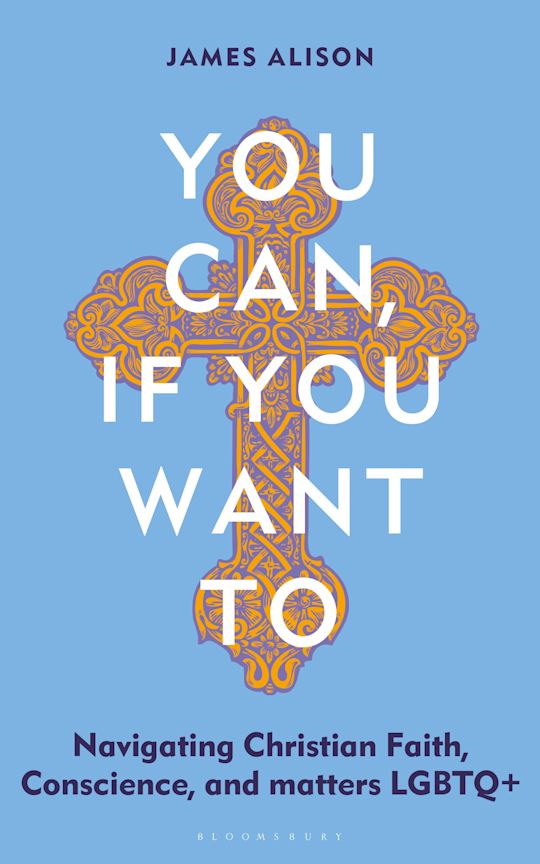
[3] The difference between the two understandings of sacrifice is unpacked more fully in my You Can, If You Want To: Navigating Christian Faith, Conscience, and matters LGBTQ+ (Bloomsbury Continuum 2025)
[4] Homosexualitatis Problema Para 3
[5] Hence the “must be considered” of Para 3.
[6] Lest I be accused of “jumping the gun” on this: The Vatican Secretariat of State notoriously perceives the German Synodal Way as moving ahead “too fast”. Yet even in their letter to the German Bishops of 23rd October 2023, where the Secretariat of State claims that the teaching on “homosexual acts” is non-negotiable, its authors made no attempt to insist on the 1986 thesis of the “objectively disordered inclination”. They claim, rather than show, that the teaching on “homosexual acts” is justified. Yet once it has been authoritatively claimed that X is necessary in order to justify Y, and then it turns out that X is, at best, uncertain, it is surely true that the case for Y, however traditional, is much weakened, unless a new and more comprehensive justification of it emerges. No such new justification has been put forward.
[7] John 14:5