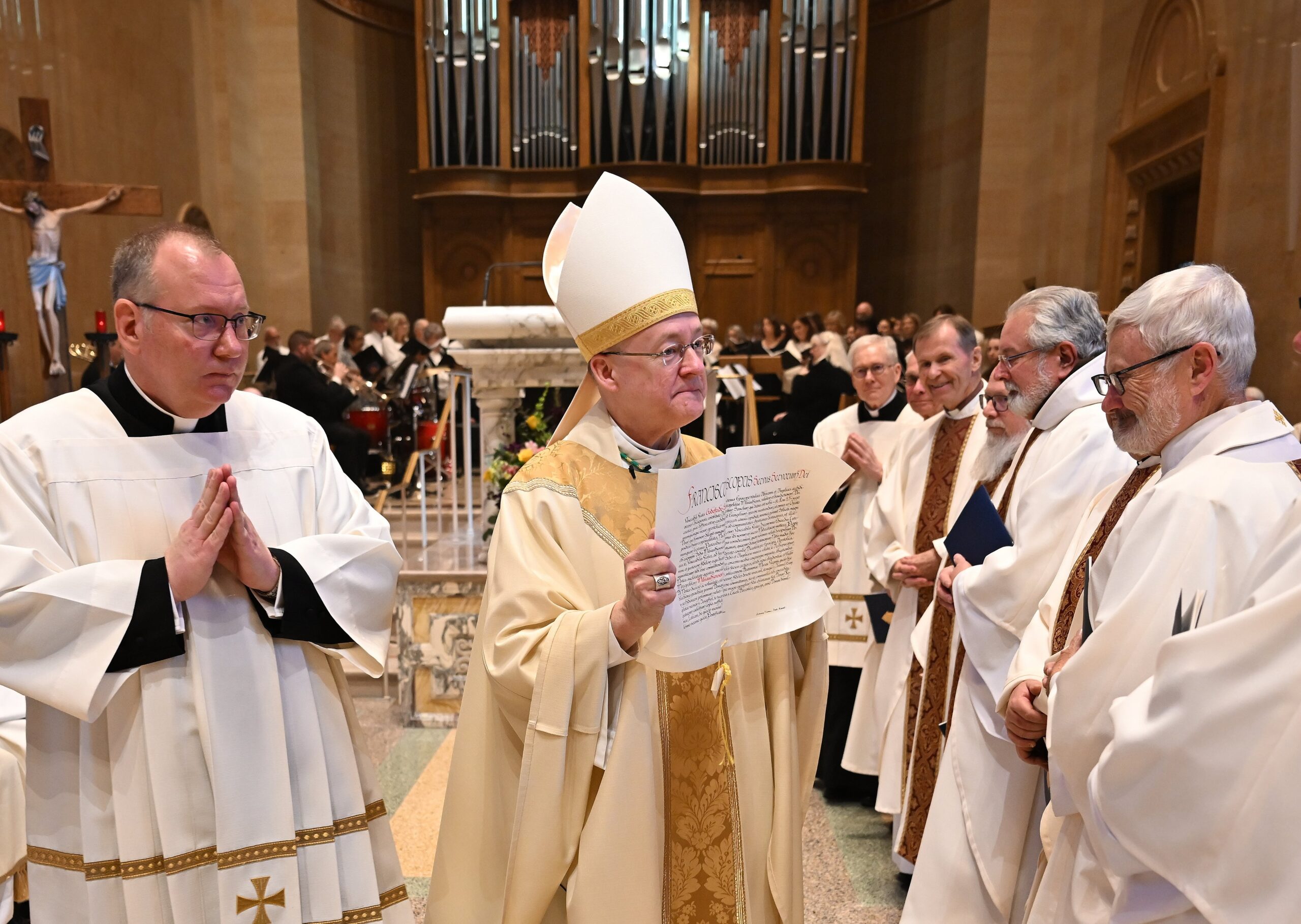
When Archbishop Jeffrey Grob of Milwaukee took his seat at a New Ways Ministry listening session, he did something that deserves to be named clearly and publicly: He listened. In a church that has far too often defaulted to managing its LGBTQ members rather than encountering them, that act of presence was not small. It was, in the deepest sense of the phrase, profoundly Catholic.
To understand why, we have to understand St. John Paul II—not as the institutional figure some invoke to foreclose conversation, but as the philosopher-pastor he actually was.
Karol Wojtyła came of age in Kraków under two successive totalitarian regimes, Nazi and Soviet, which shared a defining pathology: They both treated human beings as objects to be controlled, sorted and managed according to ideology. It was in resistance to that pathology that the young Wojtyła was drawn to two secular phenomenologists, Max Scheler and Edmund Husserl, whose philosophical method began not with abstract systems but with the irreducible reality of lived human experience. From this encounter with phenomenology, Wojtyła built what would become his signature theological contribution: personalism.
This is why listening is not peripheral to John Paul II’s theology. It is its very cornerstone. You cannot encounter a person you will not hear.
At its heart, personalism insists that every human being is a unique subject of infinite dignity—not a case to be categorized, not a problem to be solved, but a person to be encountered. The great moral failure, in Wojtyła’s framework, is not disagreement. It is the refusal to see. It is treating a person as an object, something to be acted upon rather than someone to be met.
This is why listening is not peripheral to John Paul II’s theology. It is its very cornerstone. You cannot encounter a person you will not hear. You cannot honor the dignity of someone whose experience you have decided in advance to dismiss. The pastoral impulse to manage, to respond to LGBTQ Catholics with policies, referrals and programs before a word of their experience has been received, is by the standards of the Pope so often cited to justify it, a failure of the deepest kind.
Archbishop Grob’s presence at a listening session is a direct embodiment of what John Paul’s personalism actually demands. It is the church saying, before anything else: You are someone worth hearing.
And it is, of course, something older than Wojtyła. It is the pattern of Christ himself.
We see it most beautifully in the story of the disciples on the road to Emmaus. Two disciples walk in grief and confusion, and the risen Christ falls into step beside them. He does not open by correcting their theology. He asks them a question, “What are you discussing?”, and then he listens. He receives their experience, their shattered hopes, their honest bewilderment, before he speaks a word of illumination. The encounter comes first. The teaching flows from within it.
This is the Gospel model of pastoral care, and it is what Archbishop Grob honored by showing up.
This is the Gospel model of pastoral care, and it is what Archbishop Grob honored by showing up.
For those of us who are lay Catholics, who love this church and are sometimes anguished by it, moments like this matter enormously. Our LGBTQ brothers and sisters have often experienced a church that knows its position on them before they have entered the room. What many of them hunger for, what many of them have never been given, is something simpler and more fundamental: to be heard. To have their lives treated as real. To be encountered as the irreplaceable persons they are.
Archbishop Grob’s attendance will not resolve every theological question. It is not meant to. But it signals something essential: that the listening itself is a form of fidelity, that presence is a pastoral act, and that a church willing to hear is a church capable of accompanying.
We need our leaders to show us how this is done. When a bishop sits down and listens, he gives permission to every pastor, every deacon, every lay minister in his archdiocese to do the same.
For that witness, Archbishop Grob deserves our gratitude. And for all of us who follow a Christ who asked questions before he answered them, it is an invitation: Go and do likewise.