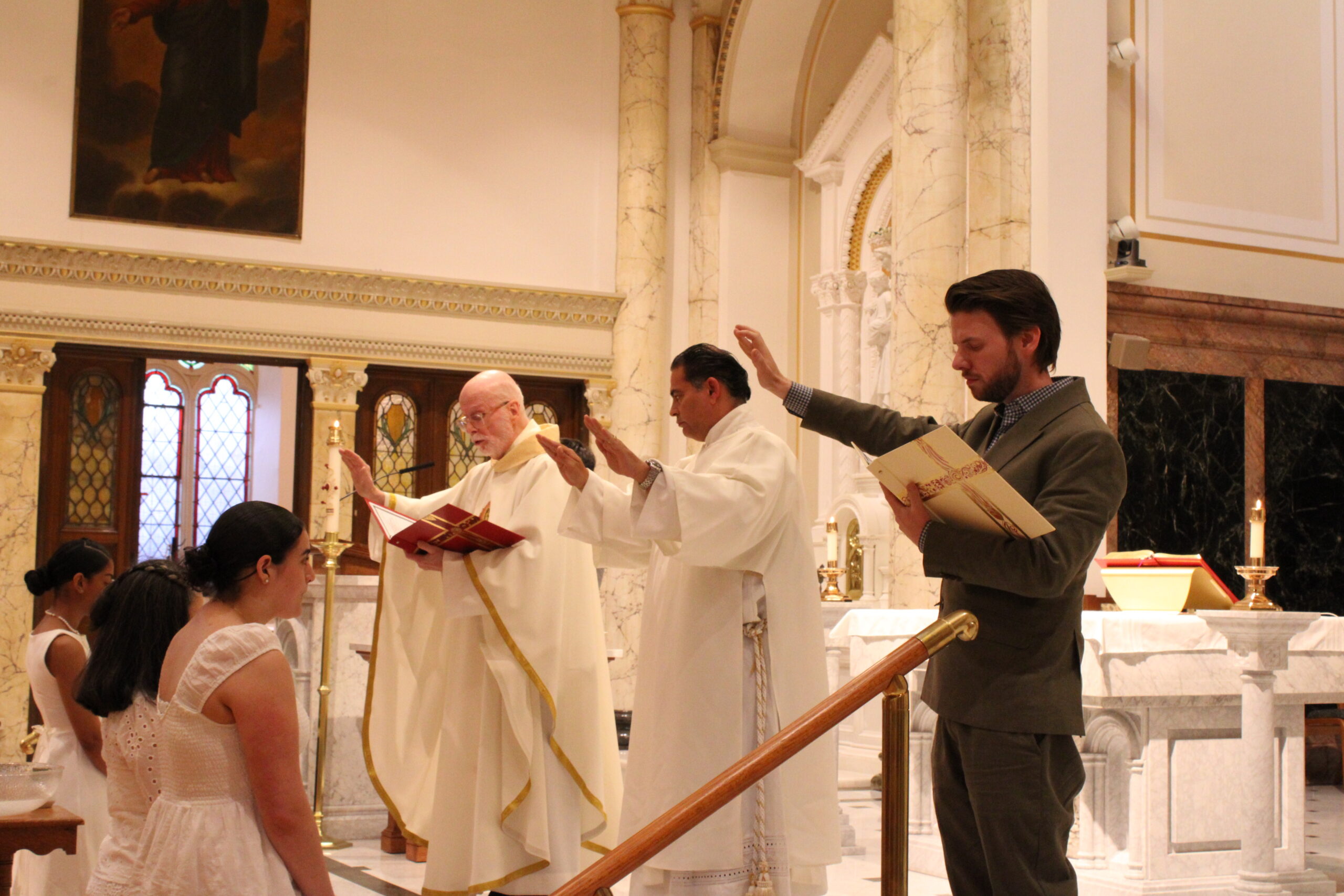
For many people, the decision to explore the Catholic Church through the Order of Christian Initiation of Adults (O.C.I.A.) is not just a single moment but instead a long, often quiet journey that did not start with an email to the O.C.I.A. coordinator at the local parish. It is a journey shaped by questions, hopes, memories, wounds and grace. For members of the LGBTQ community, this journey can feel especially complex. Some people approach the church carrying deep love for their faith. Others arrive with hesitation, shaped by painful experiences or messages that made them feel unseen or unwelcome. Many come with both at the same time.
Though there are many other Christian denominations that take a different theological stance on human sexuality, for a member of the LGBTQ community to consider the Catholic Church speaks to something deeper. To walk with LGBTQ people as they consider entering the Catholic Church is not about solving every question or resolving every tension before the journey begins. It is about listening, honoring their conscience and trusting that God is already at work long before someone ever walks into an O.C.I.A. session. The church’s role is not to stand at the gate with a checklist, but to walk alongside, pointing again and again to Christ, who calls each person by name.
O.C.I.A. itself is not a program designed to produce instant certainty. It is a process of conversion that unfolds over time. It assumes that faith grows through relationship: relationship with God, with Scripture, with the sacramental life of the church and with the community of believers. This is especially important for LGBTQ inquirers, many of whom have learned, sometimes from church spaces themselves, that they must be cautious about revealing who they are. Authentic accompaniment begins when the church creates an environment where people are not reduced to labels, debates or abstract issues, but are recognized as beloved children of God.
The church’s role is not to stand at the gate with a checklist, but to walk alongside, pointing again and again to Christ, who calls each person by name.
For LGBTQ people, the question is often not simply, “What does the church teach?” but “Is there a place for me here?” O.C.I.A. must be a space where that question is taken seriously. This means acknowledging the real fears people carry: fear of rejection, fear of being tolerated but never truly welcomed, fear that their spiritual life will always be viewed through suspicion. Walking with LGBTQ inquirers requires both honesty about the church’s teachings and clarity about something even more foundational—that every person, without exception, is created in God’s image and invited into a life of holiness.
Accompaniment begins with listening. Before offering explanations or theological frameworks, the church must listen to stories. LGBTQ inquirers often come with rich spiritual histories: years of prayer, service, searching and longing for God. Some may have left the church in the past because they felt harmed or erased. Others may be encountering Catholicism for the first time and are unsure how their identity fits within it. Listening does not mean agreeing with every conclusion someone has reached, but it does mean honoring the journey that brought them to this moment.
Listening also means resisting the temptation to rush. O.C.I.A. is not about pressure or timelines. The church trusts that God works patiently, and so should we. For some LGBTQ inquirers, simply being able to sit in a room where their presence is not questioned is already a profound experience of grace. The work of the church is to protect that space, ensuring it remains one of safety, reverence and genuine encounter.
Walking with LGBTQ people through O.C.I.A. also calls the church to be clear about what conversion truly means. Conversion is not about becoming someone else; it is about becoming more fully who God created us to be. It involves ongoing discernment, growth in virtue and deeper intimacy with Christ. This is true for every person in O.C.I.A., regardless of sexual orientation or gender identity. LGBTQ inquirers should not feel singled out as if they alone are being asked to wrestle with difficult teachings or to surrender parts of their lives to God. Every disciple is called to conversion and that call unfolds uniquely in each life.
Conversion is not about becoming someone else; it is about becoming more fully who God created us to be.
The sacraments play a central role in this journey. For many LGBTQ inquirers, the Eucharist represents both the deep desire and the deep ache to belong fully at the table of the Lord. O.C.I.A. invites people to reflect not only about what the sacraments are but also what they reveal about God’s desire for communion with humanity. Accompaniment means helping LGBTQ inquirers understand that the sacraments are not rewards for perfection but gifts for the journey. They are encounters with Christ that strengthen, heal and draw us deeper into love.
Community is equally essential. O.C.I.A. should not feel like a classroom detached from parish life, but an entry point into a living, breathing community of faith. For LGBTQ inquirers, this is often where hope is either confirmed or diminished. When parishioners greet them warmly, include them naturally and speak about faith with humility rather than judgment, the church becomes credible. When silence, awkwardness or coded language dominates, the message received is often louder than any official statement. Walking with LGBTQ people means forming parish communities that understand hospitality not as politeness but as a spiritual discipline.
This accompaniment also challenges the church to reflect on its own conversion. Walking with LGBTQ inquirers is not a one-directional process. Their questions can deepen the church’s understanding of mercy, conscience and the complexity of human experience. Their presence invites pastors, catechists and parishioners to examine how well the church reflects the wideness of God’s love. This is not a threat to faith; it is an opportunity for growth.
Importantly, accompaniment does not mean ignoring the reality of struggle. Many LGBTQ inquirers wrestle deeply with church teachings, with their own sense of vocation and with how to live faithfully and authentically. O.C.I.A. should be a place where those struggles can be named without fear. The church does not need to offer easy answers; it needs to offer faithful companionship. Christ did not walk with his disciples by resolving every confusion immediately. He walked with them, asked questions, broke bread with them and stayed—even when they misunderstood.
Ultimately, walking with LGBTQ people through O.C.I.A. is about witnessing to the heart of the Gospel.
Pastoral accompaniment also requires discretion and care. Not every LGBTQ inquirer will want their identity to be a topic of discussion and that choice must be respected. Walking with someone means following their lead, not forcing disclosure or making assumptions. It means honoring the internal forum of conscience and trusting that God’s Spirit speaks there in ways no program or curriculum can fully anticipate.
Ultimately, walking with LGBTQ people through O.C.I.A. is about witnessing to the heart of the Gospel. Jesus consistently moved toward those who felt uncertain about their place: those on the margins, those burdened by fear, those longing for healing. He did not demand that they resolve everything before drawing near. He invited them into a relationship and from that relationship transformation flowed.
For LGBTQ inquirers, O.C.I.A. can become a sacred space where God’s invitation is heard anew: “Come and see.” The church’s task is to make sure that invitation is credible, embodied and grounded in love. When the church walks with LGBTQ people—patiently, humbly and faithfully—it proclaims something powerful: that the journey toward God is not reserved for a select few but open to all who seek Christ with sincerity of heart.
In the end, accompaniment is an act of hope. It trusts that God is larger than our fears, wiser than our categories and more faithful than our doubts. To walk with LGBTQ people considering the Catholic Church through O.C.I.A. is to stand on holy ground, witnessing God’s grace at work in real lives. It is not always neat or easy but it is deeply Gospel-shaped. And it reminds the church of who she is called to be: a pilgrim people, walking together toward the fullness of life in Christ.