
This essay first appeared in our weekly Scripture reflection newsletter on March 25, 2023.
Ezekiel 37:12-14; Rom 8:8-11; Jn 11:1-45
You can find the readings for the Fifth Sunday of Lent here.
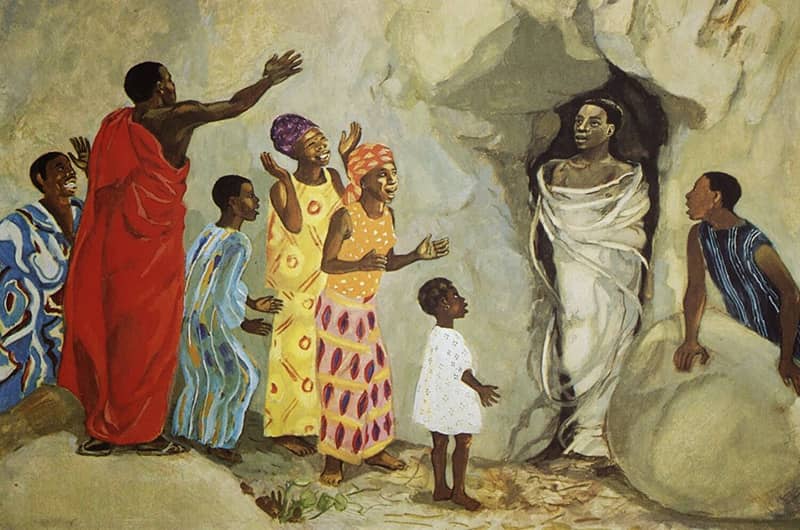
For the last five years, I’ve been writing a book on the Raising of Lazarus, the Gospel story for the Fifth Sunday of Lent. To my mind, it is unmatched in the New Testament for sheer drama: Lazarus’s sisters Martha and Mary asking Jesus to come and heal their brother, whom they call, touchingly, “he whom you love”; Jesus’s mysterious delay in arrival; the sisters’ forceful response when he finally arrives after their brother’s death (“Lord, if you had been here our brother would not have died!”); Jesus’s weeping at his friend’s tomb (most scholars say not out of sadness, but anger); and, finally, the accomplishment of what is usually called Jesus’s greatest miracle: raising a person who had been dead for four days, with the words that the Gospel tells us he shouted, “Come forth!”
At least those are the words we often think of Jesus saying, perhaps because we’re so conditioned by old movies. In reality, and as we read in today’s translation from the New American Bible, they are simpler in the original Greek: “Come out!” As an aside, I called my book Come Forth because I thought if I called it Come Out, people would think it was more about LGBTQ people than Lazarus!
But for us today, perhaps as important as what Jesus does, is what Lazarus does. Lazarus listens to Jesus and leaves behind death.
But what can the story of what happened over 2,000 year ago in Bethany, a few kilometers from Jerusalem, a town today called “Al Eizariya”—in Arabic, the place of Lazarus—say to us today? Plenty!
In the phrase “he whom you love,” used by the two sisters to describe Lazarus, we are reminded that Jesus had not only disciples but friends. In Jesus’s delay in coming to see Lazarus, we are reminded of Jesus’s utter freedom, especially in John’s Gospel, but also in our lives. In the sisters’ remonstrating with Jesus for his lateness, we see the importance of honesty in speaking with God. In the use of the term “the Jews” over and over, we are reminded of the need to be exceedingly careful with the way that John’s Gospel characterizes the Jewish people. In Jesus’s tears, whether from anger or sadness, we see his humanity on full display. And in his raising of Lazarus, we see Jesus’s power even over death. As he tells the sisters, he will not only give life; he is life.
But for us today, perhaps as important as what Jesus does, is what Lazarus does. Lazarus listens to Jesus and leaves behind death.
Jesus is calling you into the light, into new life, to leave behind all that keeps you dead, bound, entombed.
What does that mean for us? Well, all of us have things that prevent us from living fully, living wholly, living the way that God desires us to live. Maybe it’s an old grudge, maybe it’s a disappointment from long ago, maybe it’s an unhealthy pattern of living—you’re too mean or resentful or self-centered. These are the things that we are called to “let die” in the tomb. These are the things that God asks us to leave behind, so that we can walk into the sunlight, like Lazarus did.
But how can we “come out”? How can we leave behind those dead parts of ourselves? One way is to look at Lazarus. In a number of fictional versions of this story—novels, plays and poems—Lazarus doesn’t want to come back. He’s happy where he is, presumably in heaven. But, as I see it, to come out of the tomb, to come forth into new life, he first had to know who was calling him. Lazarus can walk out of the tomb because he is so close to Jesus. He trusts him–because he knows him.
It’s the same for us. We can walk out of our tombs confidently because we know who is calling us. So you might ask yourself today: What do you need to “let die” in the tomb? Because Jesus is calling you into the light, into new life, to leave behind all that keeps you dead, bound, entombed. Every day of our life, Jesus is calling to you, saying, “Come out!”