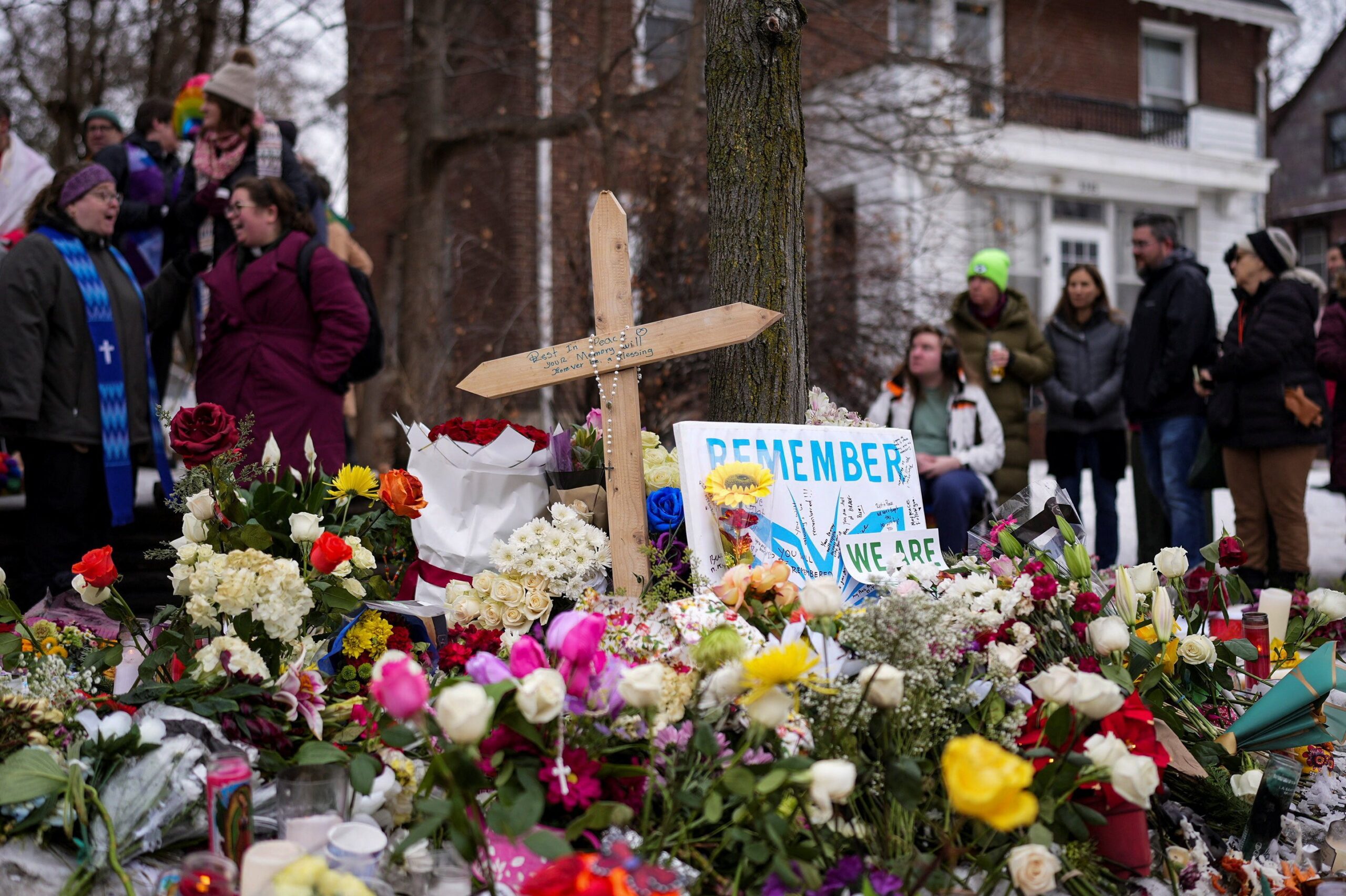
After Renee Good was gunned down by an ICE agent on the streets of Minneapolis, a good number of her fellow citizens were shocked and appalled by what they saw in videos of the incident replayed over and over—to them a likely act of criminal homicide. Others, watching the same footage, reached the opposite conclusion, insisting that the agent’s use of deadly force was justified.
Public opinion seemed murky and malleable enough in the immediate aftermath of the shooting that some members of the Trump administration and the nation’s right-wing media saw an opportunity. They held Renee Good up as the accountable party for her own death and something else as well: an emblem, a symbol of something that required discrediting and negating.
No one in the Trump administration, from the president on down, bothered to wait for the results of an actual investigation—indeed a prospect that grows unlikelier by the day—before issuing their jury-poisoning pronouncements.
As ugly as all that was, what followed was worse, as misogyny and homophobia became accelerants in the escalating national discourse.
Calling her death a tragedy, Vice President JD Vance nonetheless described Good as a “deranged leftist” who was attempting to run down a law-enforcement officer.
Department of Homeland Security Secretary Kristi Noem denounced Good as a “domestic terrorist.” The NY Post assured that she had been a left-wing “warrior,” wokified at the “social justice charter school” that her six-year-old child attended.
Others merely mocked her as a naive suburban do-gooder who “fooled around and found out” (to use a PG version of this expression). Many seemed to take some degree of satisfaction in the mortal “finding out” part of that formula without exhibiting a shred of empathy or an apparent grasp of the demands and limits of constitutional and legal order.
As ugly as all that was, what followed was worse, as misogyny and homophobia became accelerants in the escalating national discourse.
The radio host Erick Erickson mocked Ms. Good as an “AWFUL”—“Affluent White Female Urban Liberal.” Others suggested that women like Ms. Good were emasculating American men, even undermining Western civilization, what’s left of it anyway, richly deserving whatever comeuppance landed on them.
Perhaps no comment was as vicious as that offered by Catholic influencer Matt Walsh, who wrote on X: “This lesbian agitator gave her life to protect 68 IQ Somali scammers who couldn’t give less of a shit about her. The most disgraceful and humiliating end a person could possibly meet.”
The church teaches that Catholics are to treat LGBTQ people with “respect, compassion and sensitivity.”
Mr. Walsh’s observation of course neatly inverts Catholic catechism 101 as it exemplifies the disheartening cruelty of contemporary politics. Renee Good was a mother, a wife, a widow, a poet, a citizen. She was a resistor to mass deportation, a campaign likewise deplored by millions of her fellow citizens. But the messy, complicated reality of her life was quickly cast aside by many politicians and commentators.
What’s left to hold aloft and wave before a mob thirsty not only for a reason to excuse her killing but a justification to hate on the victim directly? Ms. Good was a woman and a woman married to another woman.
Why call out her marriage or her sexuality? Why else but to signal to their audience that her gender and her sexuality made Renee Good less than them, a negligible, throwaway thing, unworthy of their attention, even of their grief—certainly not a beloved, valued child of God.
The church teaches that Catholics are to treat LGBTQ people with “respect, compassion and sensitivity.” That sometimes doesn’t satisfy people who want to engage in wholesale condemnation of LGBTQ people because of their sexuality. Others are too—properly—focused on their own sinfulness to feel comfortable judging anyone else’s. These statements, while challenging in many parts of the world, where LGBTQ people are barely acknowledged, may not provide much comfort to LGBTQ people in the West who still feel invisibilized and, worse, attacked.
At the foundation of our teaching is an appeal to protect and esteem as beloved all whom the Lord holds dear.
At the foundation of our teaching is a simple appeal to appreciate the human dignity of each one of us, to protect and esteem as beloved all whom the Lord holds dear. That embrace leaves out, well, nobody—a cosmic benevolence gifted freely to all.
Left largely unexplored in efforts to define Renee Good was another complicating truth about her: she was a Christian, and her faith likely shaped her willingness to put herself in harm’s way for people she did not know and would never meet.
“Renee was a Christian who knew that all religions teach the same essential truth: we are here to love each other, care for each other, and keep each other safe and whole,” her wife Becca Good wrote in a loving tribute.
In her last moments Renee appears a cheerful resistor engaged in good trouble. “That’s fine, dude; I’m not mad at you,” she said, smiling at the man who is about to kill her. They would be her last words.