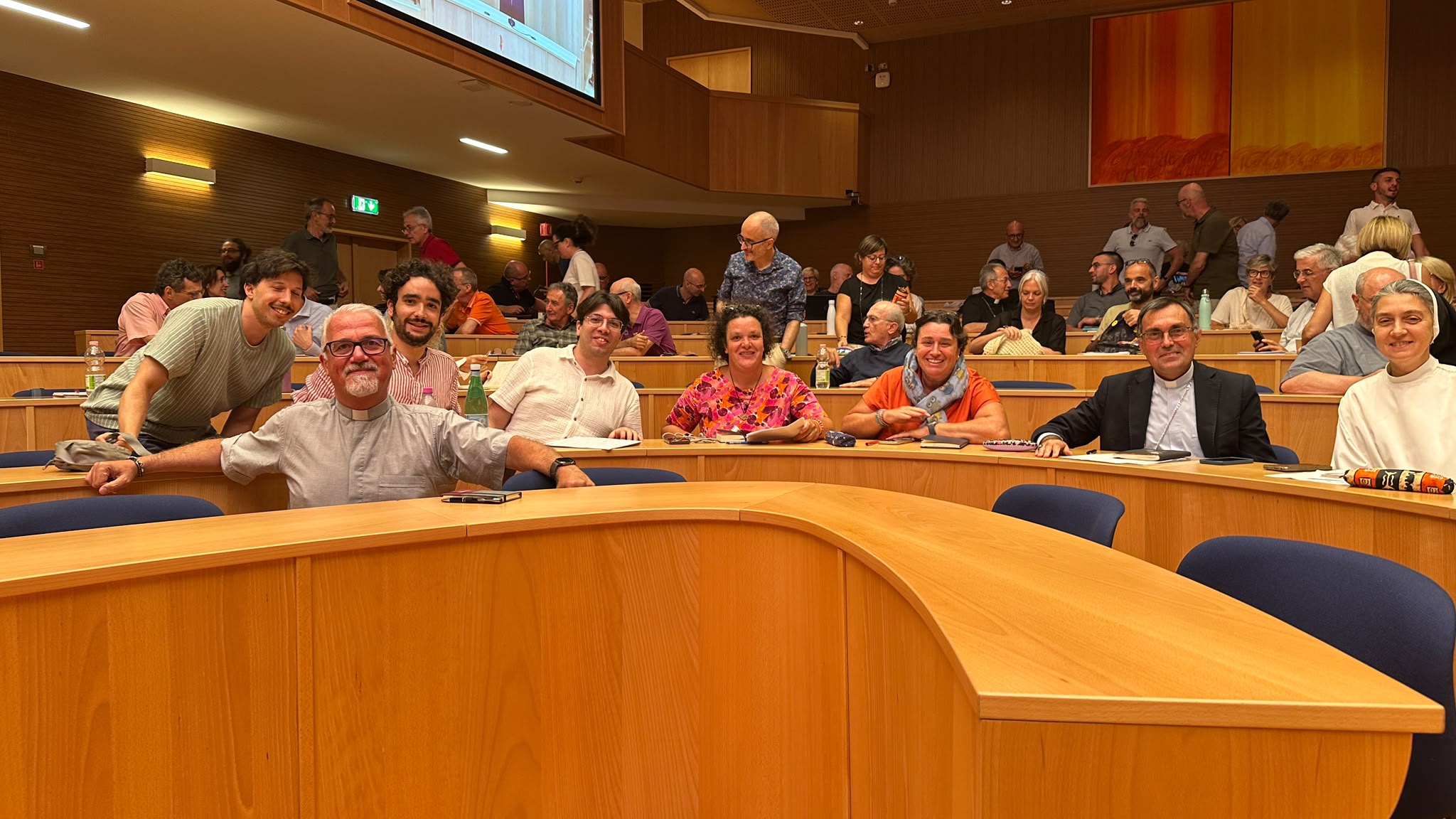
Editor’s note: These remarks were delivered by Archbishop Gherardo Gambelli, Archbishop of the Diocese of Florence, at the first national conference for pastoral workers, “Good practices in pastoral ministry with people in same-sex relationships and transgender people” in Rome at the General Curia of the Society of Jesus on September 4, 2026. These remarks were originally published in Italian with “Progetto Gionatta“.
Chapter 11 of the Acts of the Apostles presents us with Peter’s orderly account in Jerusalem, before the circumcised believers, of the so-called Pentecost of the Gentiles in Caesarea. The 2025 prayer vigil for overcoming homophobia and transphobia drew inspiration from this passage in Acts. I think it is worthwhile to reflect on its conclusion. Peter says:
Then I remembered what the Lord had said: ‘John baptized with water, but you will be baptized with the Holy Spirit.’ So if God gave them the same gift he gave us who believed in the Lord Jesus Christ, who was I to stand in God’s way?” When they heard this, they quieted down and glorified God, saying, “Then God has granted even the Gentiles repentance that leads to life!” (Acts 11:16–18).
The initial reproach – “You went into the house of uncircumcised men and ate with them” – gives way to: “They quieted down and glorified God.”
Many of the good practices involving people in same-sex relationships and transgender people in our Diocese of Florence are closely connected to the synodal journey. They are a fruit of the communal discernment that we have learned and rediscovered in recent years, beginning with Pope Francis’ address in Florence in 2015.
During the listening phase of the synodal journey of the Churches in Italy, some members of the Kairos group (an LGBTQ Christian group) were able to share their testimonies, and this gradually helped break down many prejudices, fears, reservations, and stereotypes.
We practiced communal discernment through the five “filters” that Professor Vito Mignozzi has clearly identified on the basis of a reading of Acts 15 (V. Mignozzi, Discernere comunitariamente, Queriniana, 2025).
The first is the criterion of reality: communal discernment means seeking real solutions to real problems that disturb the life of the Church. Reality is more important than ideas (Evangelii Gaudium, 231).
Communal discernment means seeking real solutions to real problems that disturb the life of the Church. Reality is more important than ideas.
The second filter is that of narrative. Acts 15:12 says: “The whole assembly fell silent and listened to Barnabas and Paul.” It means taking on the perspective of victims, as Pope Leo also recalls in Magnifica Humanitas, no. 216.
The third filter is reference to Scripture: “The words of the prophets are in agreement with this” (Acts 15:15). Here, the text of Acts 10, but also Acts 6 and many other passages, have helped us sustain a faith put to the test when someone is accused because he or she has lived out fidelity to the Gospel, to Jesus as a sign of contradiction. No. 85 of the Synod’s Final Document says in this regard: “For discernment to be genuinely ecclesial, it is necessary to make use of the appropriate means, including a suitable exegesis of biblical texts that helps interpret and understand them while avoiding partial or fundamentalist approaches.”
The fourth filter is the search for what is essential. This criterion is expressed in the letter sent by the Church of Jerusalem: “It seemed good to the Holy Spirit and to us…” (Acts 15:28).
The way forward – and this is sometimes where we encounter the greatest difficulty – is one of gradual progress, as highlighted in no. 30 of the Guidelines for the First Synodal Assembly:
We are aware that, in order to move from the exclusionary logic of inside/outside to one of involvement and recognition, in some cases and on certain issues further study, dialogue and shared discernment are still needed, so that we may gradually arrive at shared decisions. In necessariis unitas, in dubiis libertas, in omnibus caritas: In necessary things, unity; in doubtful things, freedom; in all things, charity.
The fifth filter is the experience of joy. This means that the goodness of a discernment process is also judged on the basis of its results – not abstract or merely quantitative results, but, we might say, qualitative ones – which can be seen in the spirit of the people of God who are called to receive decisions or proposals (cf. Mignozzi, p. 58).
Diocesan gatherings, and in particular the diocesan assemblies that we have held regularly twice a year since 2024, are opportunities to continue the synodal journey. At these gatherings, good practices for the accompaniment and integration of people in same-sex relationships and transgender people at the parish level are shared.
I would like to share some experiences of joy that have emerged as the fruit of a process of discernment in which consensus takes shape through what makes hearts burn.
One person who had taken part in a formation meeting organized by the diocesan coordination office for inclusion ministry described his journey of conversion in terms similar to Peter’s in the house of Cornelius: “I am truly beginning to understand that God shows no partiality, but welcomes anyone who fears him and does what is right, whatever nation they belong to” (Acts 10:34–35).
Priests, deacons, seminarians, men and women religious have also taken part in these formation meetings, led with great competence by experts in the field, during which they received thorough answers to their questions and concerns.
Parents who take part in meetings with other couples who have people in same-sex relationships or transgender children feel relieved when they discover that they are not the parents of people who have been excommunicated or declared heretics.
I am thinking in particular of a couple of women who show extraordinary care for others and a faithful adherence to the Gospel that is capable of inspiring wonder in those who encounter them. Christianity – and good practices – grow through attraction.