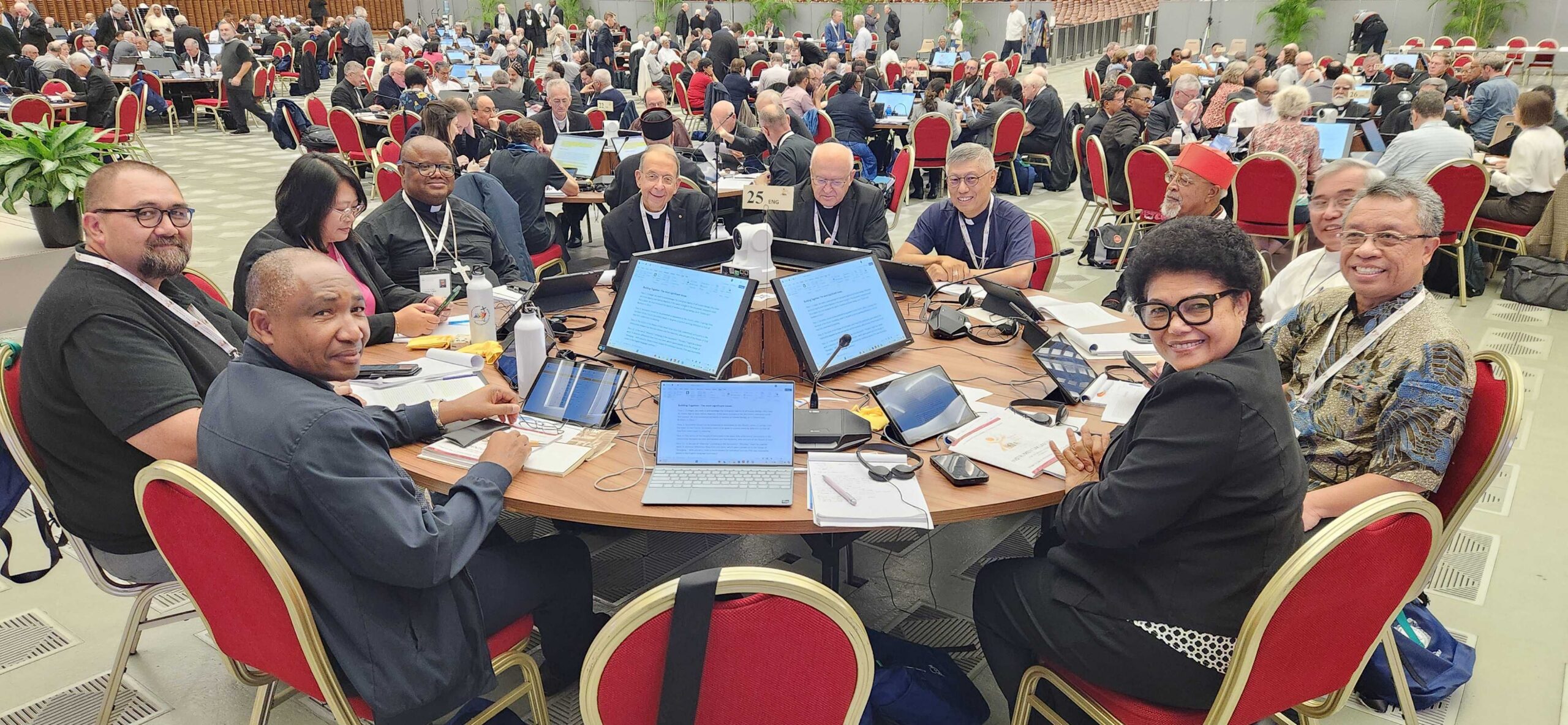
In its final report, released yesterday, Study Group 9, tasked by the Synod of Bishops with looking at “emerging issues,” proposed new questions about the church’s approach to homosexuality and gay people, with implications for LGBTQ people in general.
In many places, the final document is written in highly theological language, but it can be summarized, above all, by a desire to listen to the experiences of those affected by church teaching, particularly those who are “most vulnerable,” “out of the game” or “outside the box,” like LGBTQ people in the church. It was this impetus that led to the inclusion (and publication) of two powerful testimonies by married gay men as part of the Study Group’s discernment.
Taken together, the questions set forth by the Synod can offer a new way forward in the church’s discernment about homosexuality and LGBTQ people. What follows is taken directly from the final report:
Excerpt taken from Study Group No. 9: “Theological Criteria and Synodal Methodologies for Shared Discernment of Emerging Doctrinal, Pastoral, and Ethical Issues”
The questions that follow are intended to foster the practices of synodal discernment that need to be enacted within Christian communities – the outcomes of which cannot be anticipated with pre-established formulas.
Possible pathways and questions for synodal discernment
• Recognizing the centrality of the Word of God in the life of the Church, it is important first of all to dedicate time to deepening our understanding of the biblical passages that – directly or indirectly – are proposed in interpreting the meaning of homosexuality from the perspective of biblical anthropology. It is necessary to go beyond a mere repetition of their current presentation and take into account the insights gained from diverse exegetical readings. To accompany this reflection, we suggest the authoritative pages of the Pontifical Biblical Commission’s 2019 document entitled, What is Man? (Ps 8:5): An Itinerary of Biblical Anthropology (in particular, pages 160-170).
• Regarding the recent Magisterium of the Church, it is worth noting that the two documents from the Congregation for the Doctrine of the Faith concerning the homosexual condition – “Persona Humana” (1975; PH) and “Homosexualitatis Problema” (1986; HP) – despite differences in nuance, both firmly deplored “that homosexual persons have been and are the object of violent malice in speech or in action” (HP 10). For this reason, “Homosexualitatis Problema,” which is specifically dedicated – as its subtitle indicates – to the pastoral care of homosexual persons, called upon bishops “to provide pastoral care in full accord with the teaching of the Church for homosexual persons of their dioceses” (HP 15), grounded in Scripture and the living Tradition of the Church.
• Furthermore, it should be duly noted that “Persona Humana” formulates, for the first time, the distinction between homosexual acts and the homosexual condition or tendency (PH 8), incorporating an insight from the psychological sciences. In this light, the Christian community is invited to ask: how can we more deeply understand the human and moral experience of believers with same-sex attractions, drawing not only on the light of the Word of God but also on a transdisciplinary approach?
• And further: how are our communities called to address, in concrete terms, situations of polarization and division regarding believers with same-sex attractions, as well as attitudes of rejection or fear? If we agree that pretending the question does not exist is not a “good practice,” how can we learn to listen to each other’s difficulties, fears, and resistances, recognizing their presence and their underlying reasons?
• In this perspective, we must ask ourselves whether, to what extent, and in what forms the current pastoral practices in our communities are truly capable of welcoming the life stories of believers with same-sex attractions – sharing in the faith experience they carry and accompanying their journey in the light of the Gospel. In a word, how can we conceive and manage a pastoral ministry that allows itself to be challenged by this testimony? How can we propose the demands contained in the Church’s proclamation and teaching, actualizing them with evangelical relevance?
• The stories we have heard do not lack a critical awareness of the impact – not only personal but communal, both social and ecclesial – of the experiences witnessed. In this regard, what does the experience of suffering, solitude, and exclusion recounted in these stories say to and bring to the Christian community? Is it merely a matter of “non-conformity” to conventional ecclesial and social standards to which the person must be realigned, or does this “suffering” speak of something deeper?
• Finally, while listening to the Word of God lived in the Church, it is necessary to address with parrhesia the currently recurring question of whether one can speak of “marriage” in relation to persons with same-sex attractions, equating their relationship to heterosexual conjugal union without recognizing the differences. These include, primarily, the evident impossibility of procreation per se linked to sexual difference, regarding which techniques of medically assisted procreation pose further difficulties. Consequently, we must ask how the Christian community is called to interpret and address questions relating to the educational commitments toward children within family, ecclesial, and social life, in relation to the de facto unions between believers of the same sex.
(From Study Group 9’s final report.)