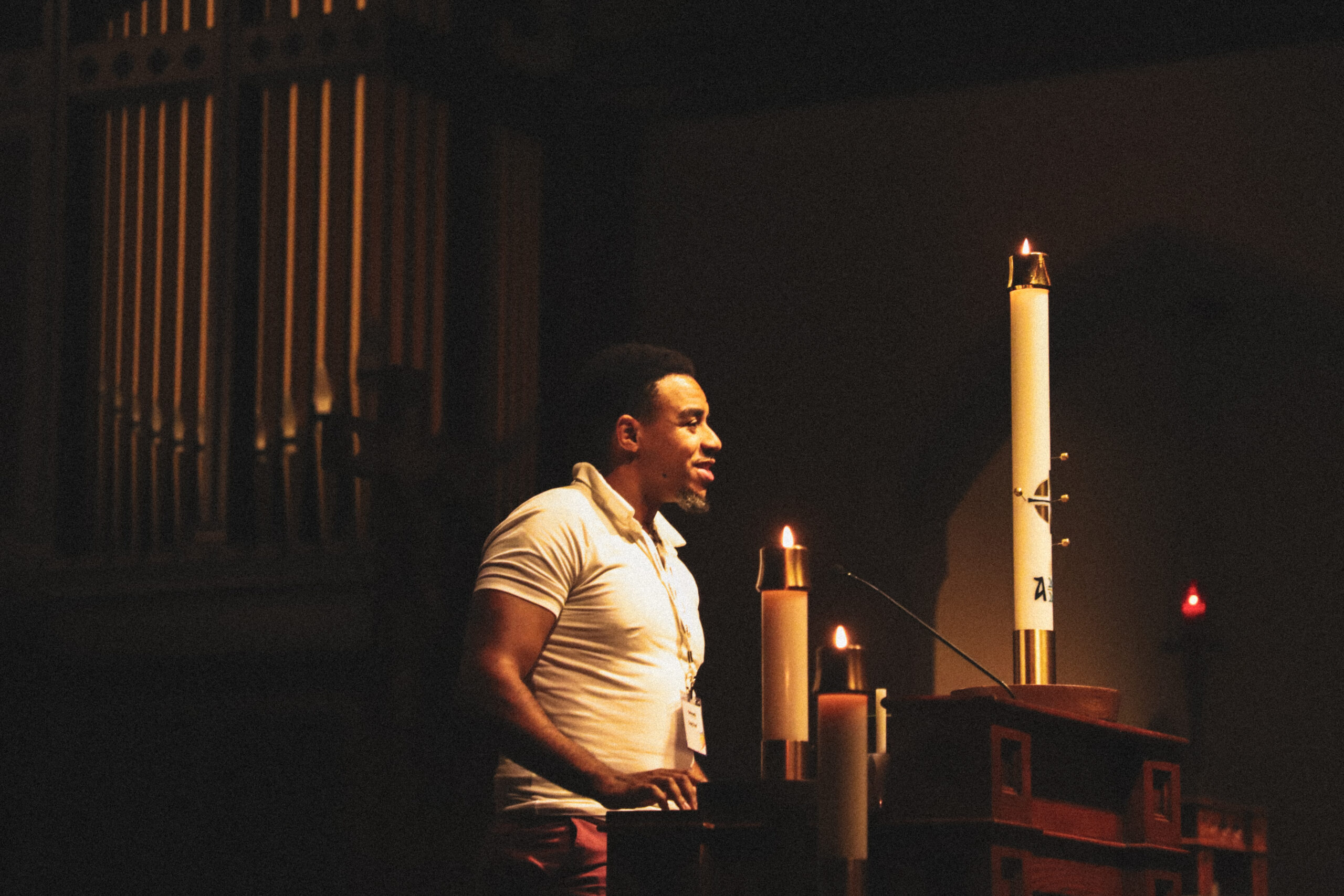
This is the full text of the reflection given by Craig Ford, Jr., PhD., at night prayer at Outreach 2026 on Friday, June 19 in Dahlgren Chapel at Georgetown University. The text has been edited for style.
Night prayer invites us to think about endings—a whole spectrum of them, in fact. Of course, the endings of some of our days are more comfortable for us to contemplate than others. For example, last week my flight was delayed for two hours, which in my case meant we didn’t leave until 9 PM. We arrived on the runway in my connecting city, only to sit on the tarmac for an additional fifteen minutes. Then, by the time the plane arrived at the gate, my connecting flight had already taken off, without the opportunity for me to run through the airport like I was auditioning for a new release of Home Alone. At this point, it was 11 PM. And I wouldn’t be able to rest my head until sometime after 1 AM, which is when I was finally able to enter my hotel room. Suffice to say, I couldn’t wait for that day to end and to contemplate its significance. My rating: two stars.
But night prayer not only invites us to think about the endings of some of our days, whether stressful, joyful or somewhere in between. It also invites us to think about the ending of all of our days—that is, night prayer invites us to contemplate the day on which we take our last breath, the day in which we leave all these things—including our wigs, crop tanks and merengue moves—behind. And I imagine that this makes many of us— maybe even all of us—a bit uncomfortable.
My friends, I want to say clearly that this desire for “more” is the holiest thing about our existence.
It’s not hard to speculate about why. We live in a world that valorizes the eternal presence of youth and beauty. Medical doctors and plastic surgeons can chemically combat the signs of aging with prescriptions, procedures and injections. Our phones confront us with the illusion of infinitude: infinite time, infinite wealth, infinite fitness, infinite desirability. And so we get caught up in the game. We imagine that our lives can continue almost indefinitely, punctuated by having more experiences, more money, more time. More, more, more.
Now, you might be expecting some condemnation to follow, but I actually want to move in a different direction. My friends, I want to say clearly that this desire for “more” is the holiest thing about our existence. That’s why the consumerist echo-chambers of our phones want to hijack this dimension of our being that channels us upward towards the infinite and instead redirect it, like the waters of a dammed river, horizontally and downwards, squandering this holy energy into the finite and the fleeting, into possessions and devices, into distinctions and honors. For this desire for “more” conducts us towards the most noble versions of ourselves: the desire for “more” propels us out of the closets where many of us LGBTQ+ Catholics often find ourselves and into the light of authenticity; the desire for “more” propels us to love deeply and meaningfully; the desire for “more” propels us towards protest, towards justice, towards goodness. Yes, my friends, this desire for “more” is the holiest thing about our existence.
In night prayer’s examination of our conscience, we are meant to ask ourselves this one question: where is the “more” of our lives headed?
In the calmness of the night, our desire for “more” is calling out to us again, especially today where we celebrate Juneteenth, the end of slavery. For my ancestors, this day meant that the ceilings placed onto our collective striving by the dehumanizing forces of white supremacy—ceilings which we ourselves began to lift through our faith and relentless desire for freedom—were beginning to be noticed by others. Others began to notice that they could join alongside us in our journey towards liberation. Now, 160 years later, forces in our society are attempting to refortify those ceilings. But no ceiling can place a limit on the “more” towards which God has called us, especially when the voices of my ancestors join with the voices of their descendants, and when all of our voices gathered here are lifted up together in prayer, in song, in protest and yes, through our choices at the ballot box. (Don’t forget to vote!) This desire for more, the holiest thing about our existence, is calling to us yet again, and in so many ways.
In night prayer’s examination of our conscience, we are meant to ask ourselves this one question: where is the “more” of our lives headed? Where is this holiest thing about ourselves being directed? Towards the ends set by the infinite, by the God who desires justice, who loves mercy and wants us to walk humbly with God, as we read in scripture? Or is it being directed towards the ends set by the finite and the fleeting, towards that which can never satisfy us?