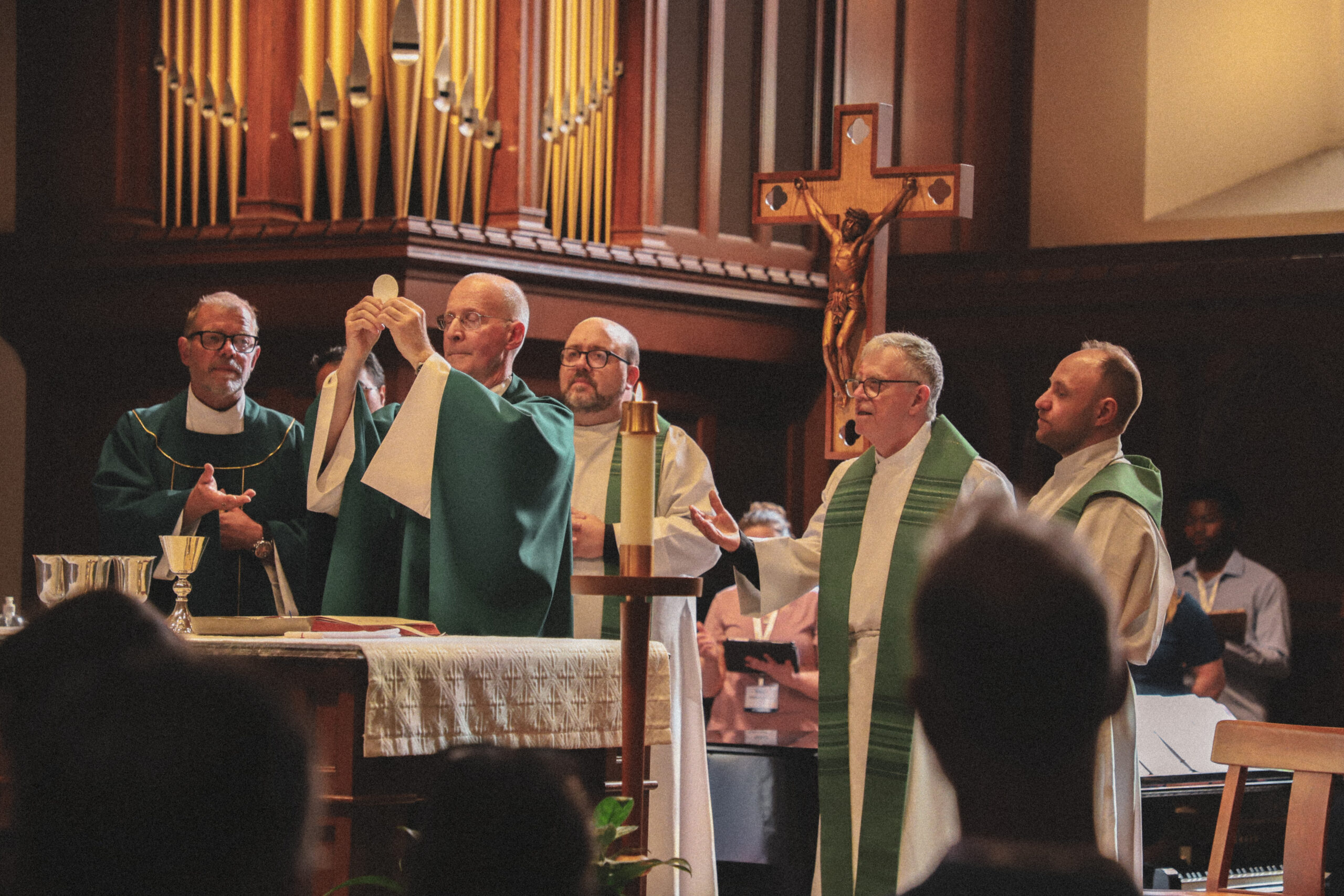
Editor’s note: The following is the text of a homily given during Mass on June 19, 2026, in Dahlgren Chapel at Georgetown University, during the Outreach 2026 conference.
What does it mean to be an LGBTQ Catholic?
Good question! Of course it means something different for everyone. The question becomes even more complicated when you ask: What does it mean to be a Black LGBTQ Catholic? Or an LGBTQ Catholic who has just come out? Or an LGBTQ Catholic who saw his friends die of AIDS in the 1980s? Or someone who is transgender and Catholic? Or someone who doesn’t use the term and calls themselves a queer Catholic? Or someone who follows the church’s teaching on chastity and feels left out of many LGBTQ spaces?
As Thomas Merton wrote, “For me to be a saint means to be myself.” The journey to discover yourself in God is a lifelong one.
The answer will be different for each person. As Thomas Merton wrote, “For me to be a saint means to be myself.” The journey to discover yourself in God is a lifelong one. But wherever you are on that journey, we hope you feel welcome here this weekend and, more broadly, in the church.
But back to that question: What does it mean to be an LGBTQ Catholic? Well, today’s beautiful readings offer us some answers.
The Book of Isaiah is a book of prophetic literature. And, in our First Reading, Isaiah promises the people of Israel hope, in a time following the violent invasions by Assyria but before the Jewish people’s exile. So, Isaiah is speaking a word of comfort, but also a word of advice: specifically on how to live.
As in the passages from Isaiah that we read during the Advent season, Isaiah promises God’s people a beautiful future: the desert becomes and orchard and the orchard a forest.
In other words, here is a message for LGBTQ Catholics: Even amidst tough times, don’t ever despair. Nothing is impossible with God. Now, for Christians, the Book of Isaiah is oriented towards the Messiah, toward Jesus Christ. And Jesus’s entire life could be summarized by that message: Nothing is impossible with God. That’s what the Angel says to Mary at the Annunciation, at the very beginning of Jesus’s earthly life; and that’s the message of the Resurrection, at the end of his earthly life and the beginning of his resurrected one. Things can change.
Now you might say, “Prove it.”
Well, let’s take the most obvious example: just look at how much things have changed in the wake of Pope Francis’s election. And think of how impossible everyone thought it would be for an American Pope to be elected. But nothing is impossible with God. Wait and see. But while you’re waiting, says Isaiah, work for right and justice, in all spheres: with LGBTQ people, with whom we work this weekend; and today on Juneteenth with our Black brothers and sisters. But we work for justice not today and during this weekend, but at all times! Justice will bring about peace. Work for that impossibility, with God’s help.
St. Paul, in his Letter to the Colossians, gives us more wisdom. Now of course he understood homosexuality in an entirely different way than we do today. But in today’s reading he gives all Christians, all Catholics, all of us, instructions on how to live. You know, as an LGBTQ Catholic it can be hard to figure out how to respond to stuff going on in the church. For every step forward, that is, for every bishop who offers comfort, and welcome and even an apology, there is another who doesn’t. It can feel like a roller coaster. So what do we do, well, beyond love, which overarches all things? And other virtues that makes sense: compassion, kindness and humility? What do we do?
Well, let me focus on two things that might be tough for all of us. FIrst, patience. That means patience even with people in the church, even with its leaders. You know, when I was at the Synod of Bishops a few years ago, I was surprised by how many homophobic comments I heard. It dawned on me that this work of welcoming LGBTQ Catholics would take some time. I needed patience. And I needed to be forgiving of people too. But it’s hard. “As the Lord has forgiven you, so must you also do.” Necessary but hard.
When Jesus sees the crowd, the translation is that he “had compassion on them.” The Greek is much stronger: it uses the word splanchnon, which means that his viscera, his innards, his guts were moved. That’s how much he feels for people.
But something else that Paul recommends: peace. Some of you may know this, but the first time I met Pope Francis something funny happened. I thought it might be the only time I met him so I deluged him with LGBTQ stuff. And halfway through the meeting, I thought, “Oh no, I’m dominating the conversation. Maybe he wants to talk about something else.” So I said, “Holy Father, what can I do for you?” And he said, “You can continue your ministry in peace.” “Con paz,” he said. For me it was those last two words, con paz, that meant the most. We’re asked to do all this, as far as we can, in peace. Calm, trusting, at peace.
Finally, our Gospel points us to something important. When Jesus sees the crowd, the translation we read is that he “had compassion on them.” The Greek is much stronger: it uses the word splanchnon, which means that his viscera, his innards, his guts were moved. That’s how much he feels for people. And why does he feel this? It’s something that I noticed about this reading just a few days ago. Because they were “harassed and helpless.” Another translation is even more apt: “troubled and abandoned.” In our lives we will see many people who feel troubled and especially abandoned. Our hearts are supposed to be moved that much. So we’re called not only to work for justice; not only to be at peace, but to let ourselves be moved.
So what does it mean to be an LGBTQ Catholic? It means to know that you are a beloved child of God. It means to know that nothing is impossible with God. It means to work for right and for justice at all times. It means to have patience with the church but also to move forward in peace. And it means to let your heart be deeply moved by all who feel troubled and abandoned and to love them with all your being. What does it mean to be an LGBTQ Catholic? It means to be a disciple of Jesus Christ.