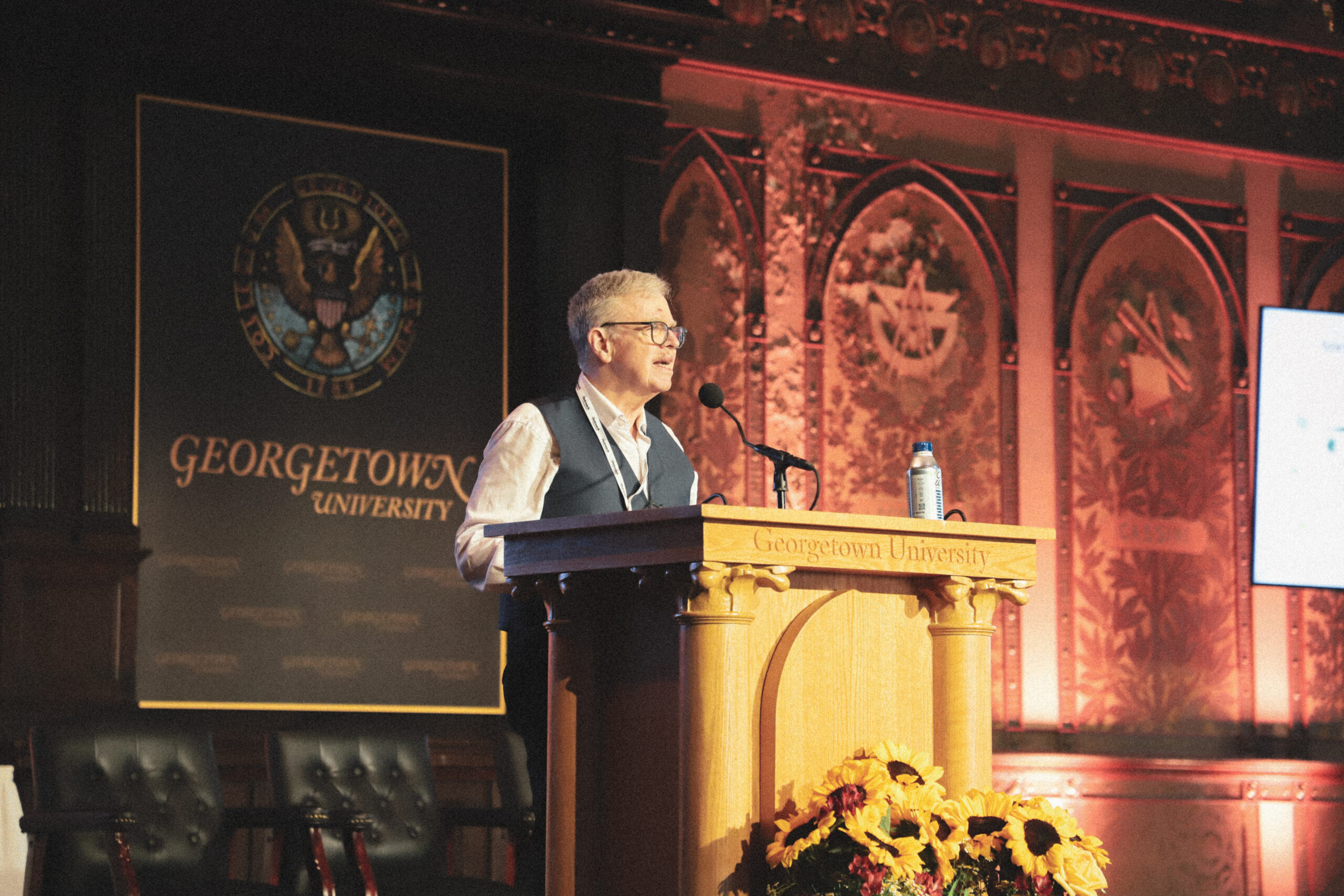
Editors’ note: The following essay is the text of a keynote address delivered by James F. Keenan, S.J., at Georgetown University’s Gaston Hall during the Outreach conference on June 21, 2026. It has been edited for style, clarity and length.
I want to introduce you to three related topics: the importance of vulnerability for Catholic ethics today; the importance of recognition for Catholic ethics today; and, finally, reflections on a few virtues that I think you will find particularly attractive: prudence, mercy, justice, fidelity and self-care.
Preliminaries: What gets conscience going?
I want to share with you my ongoing discovery. Years ago, I became worried about teaching and conscience formation. It seemed to me that, like many faculty members, I was designing ethics courses so that students could respond to matters at hand. For instance, for many years I taught a course called H.I.V./AIDS and Ethics and taught it precisely so that students could answer innumerable questions about innumerable H.I.V./AIDS matters. While at the end of the course I knew that they could respond to most challenges about H.I.V./AIDS, I was not at all sure they would. I began to see that they knew how to act, but the outstanding question was would they?
I began to realize that the beginning of the moral life was not turning to one’s conscience, but whether one bothered to hear the cry for help. I began to think about this one day after class as my students were leaving and going down the hallway, and a student from another class collapsed. Some attended to him; but many just walked by talking to their friends, others shrugged their shoulders: Who was that?
That’s when I started to wonder: They know what to do, but will they begin the process of responding in the first place?
So, when there’s the cry for help, why should one respond?
This is the great New Testament question as well. There we find that failing to respond in the first place is really the New Testament’s main concern. It emerges, in fact, as the predominant form of moral failure in the New Testament. There, in the New Testament, people do not fail by responding; rather, they fail beforehand: they fail to bother to respond in the first place and therein fail morally.
The good Samaritan parable (in Luke 10:30-37) begins with a man lying beaten and robbed on the. road outside a city. A priest and a Levite pass by the man on the road in the parable. But a Samaritan, a stranger in the area, stops to take care of the man.
Again in Luke’s Gospel, the rich man literally steps over hungry and impoverished Lazarus as he begs for help (Lk 16.19-31).
In Matthew’s parable on the Last Judgment, the sheep and the goats are separated (25:31-46). The sheep fed the hungry, clothed the naked, etc. The goats did not. The sheep enter the heavenly kingdom; the goats are turned away.
In these parables, it is not that someone did something wrong; rather they did nothing. They do not seem to even notice the people in absolute need. And what makes it all the more problematic is that they knew what to do; certainly the priest and the Levite would know what to do for the injured man on the road. In fact, they knew better than the Samaritan where to take the wounded man. Similarly, the rich man lacked no resources to respond to Lazarus. And, finally, the goats are no different than the sheep in terms of ability to feed or shelter. All could have answered the call.
Is there something about the moral life that gets the conscience working? If we are forming consciences in the classroom intellectually to do something, how do we help people to recognize the need to respond in conscience in the first place?
I think there are three steps to the moral life: being vulnerably disposed and then actually recognizing and then finally responding in conscience.
I now believe that the beginning of the moral life is first being vulnerably disposed to the other, and then subsequently actually recognizing the other, and then finally acting in conscience to respond to the recognized need. In other words, I think there are three steps to the moral life: being vulnerably disposed, then actually recognizing and then finally responding in conscience. I believe what most non-responsive people lack is not knowledge, but the vulnerability that is the active disposition to recognize another.
Let us return to the good Samaritan parable. Neither the priest nor the Levite was vulnerably disposed to the injured man, and therefore neither recognized him as injured and in need. On the other hand, the good Samaritan’s recognition of the man gives evidence of his vulnerability to the injured man. Then, after the Samaritan recognized the man as being in need, he in conscience went about considering the details of what he needed to do: assess the man’s condition, clean the wounds, get him to a safe place, make inquiries about the appropriate place in which to leave him, negotiate and secure from the newly found innkeeper his oversight of the injured man, dispense with his funds, redesign his return to this particular inn and innkeeper so as to take the man with him, etc. The good Samaritan’s conscience got a workout, but the work of his conscience only began after his vulnerable disposition recognized the man. The vulnerable recognition led then to the conscience question: Now what do I do?
In a manner of speaking, the great moral issue is not what we did, but whether we even gave another in need the due recognition.
Returning to this first movement, then, what the goats, the rich man, the priest and the Levite have in common is that they were not vulnerable to and, therefore, did not recognize the other. I believe that these instances of “overlooking” others happen precisely because these agents were not incited or prompted to see or imagine the others as like them. In that same moment, they (and their cultures) gave them permission not to be bothered by the others or by their situation. Lacking the vulnerable disposition and the habit of recognizing these people, they passed them by.
Before moving on, let us acknowledge that assuredly, they knew ethics. Certainly, the priest and the Levite did. But they only knew ethical conduct for those whose dignity they recognized: the priest and Levite for their colleagues, the rich man for his business partners. But they are not interested in ethics for those whom they do not recognize, They practice ethics with selective bias. If they had recognized them as worthy, then they would think in conscience about what they needed to do.
If you want to know why many people are not responsive to queer youth, to trans people, to older gay and lesbian people, it’s not about ethics; it is about vulnerability and recognition.
Vulnerability as Foundational
Like many others, when I first thought of vulnerability, I considered it singularly as being related to the description often used of a vulnerable adult. There I thought of someone at risk, without defenses, wounded, weak, at sea, as primarily a health condition that raises in others concern. From the writings of the philosopher Judith Butler, among others, I began to see vulnerability as less about being wounded and more about being responsive. Let me explain.
The breakthrough happened when I recognized that the word vulnerable does not mean “having been wounded,” but rather “being able to be wounded.” I began to see how it means being exposed, open or responsive to the other; in this sense vulnerability is the human condition that allows me to hear, encounter, receive or recognize the other even to the point of taking the risk of being injured.
Vulnerability is a capacious openness to the other.
Vulnerability is a capacious openness to the other.
Judith Butler realizes that too many people think of vulnerability as primarily being in an unstable context. She, rather, wants us to understand that all of us as human beings are vulnerable to one another; when one is at particular risk, however, she describes them as in “precarity.” Let me say, that I, on the other hand, continue to use the phrase “people with vulnerabilities” especially for those with disabilities simply so as to not further alienate this precarious population. Still, by keeping the term for them as well, we are recognizing by vulnerability not only their precarity but even more their capacity to respond to another in need. 1
One of Butler’s followers, the feminist philosopher Erin Gilson 2 considers the implications of equating vulnerability with precarity. If vulnerability means primarily precarity, is what a person in precarity most wants is an invulnerable person? Somebody suffering precarity is usually not looking for someone without vulnerabilities; the last person they may want is someone who is invulnerable. They are looking for someone who is open to them, not only so as to receive assistance, but more important, to be recognized by them as such.
The reductively negative view of vulnerability as being in need, being precarious or even being wounded is problematic because what a person in need needs is not an invulnerable person but a vulnerable one. Gilson advertises her book as a corrective to the discourse.
Once we stop thinking of vulnerability as weakness we are free to use it correctly.
Butler recognizes how foundational vulnerability is: “Ethical obligation not only depends upon our vulnerability to the claims of others but establishes us as creatures who are fundamentally defined by that ethical relation.” Vulnerability is what defines and establishes us as capable of being moral among one another.
Again, emphasizing the priority of vulnerability, she contends: “This ethical relation is not a virtue that I have or exercise; it is prior to any individual sense of self. It is not as discrete individuals that we honor this ethical relation. I am already bound to you, and this is what it means to be the self I am, receptive to you in ways that I cannot fully predict or control.” Vulnerability essentially is what most qualifies my self as one among others. It is the foundational disposition, capability that we were born with as a human being. We are made vulnerable.
Butler returns to the priority of vulnerability, as prior even to the moan from another in need: “You call upon me, and I answer. But if I answer, it was only because I was already answerable; that is, this susceptibility and vulnerability constitutes me at the most fundamental level and is there, we might say, prior to any deliberate decision to answer the call. In other words, one has to be already capable of receiving the call before actually answering it. In this sense, ethical responsibility presupposes ethical responsiveness.” Our vulnerability is our answerability, what allows and prompts us to recognize, to respond, to communicate—in short, to love.
Vulnerability essentially is what most qualifies my self as one among others. It is the foundational disposition, capability that we were born with as a human being.
Theologically, Butler’s natural, created answerableness resonates with a variety of creation narratives that capture the vulnerability of the human. Though not from a theologian, T. H. White’s wonderful The Once and Future King provides an account of creation that captures it beautifully.3 God gathers all the embryos of each and every species of animal life and on the sixth day offers each embryo the opportunity to ask for an addition that will distinguish their species. The giraffe embryo gets a long neck for tree food, the porcupine asks for quills for protection, and so it goes for the entire animal kingdom. The last embryo is the human who when asked by God what he wants, responds, “I think that You made me in the shape which I now have for reasons best known to Yourselves, and that it would be rude to change…. I will stay a defenceless embryo all my life.” God is delighted and lets the human embryo have no particular protection, to be the most vulnerable of all newborns and says: “As for you, Adam…. You will look like an embryo till they bury you.”
Behind White’s imaginative portrayal of creation is his remarkable vision of the human embryo as the bearer of human vulnerability. By positing the human as willing to remain vulnerable, White is able to disclose further God’s delight in that the human now is in God’s image, precisely because of the decision to “stay as a defenceless embryo all my life.” White concludes his account with God revealing to the human: “Adam…eternally undeveloped, you will always remain potential in Our image, able to see some of Our sorrows and to feel some of Our joys. We are partly sorry for you, Man, but partly hopeful.”
The vulnerability of God
Human dignity, rooted in the image of God, participates in the vulnerability of God. This insight of our vulnerability being connected to God’s resonates with the late, wonderful Irish theologian Enda McDonagh’s work, Vulnerable to the Holy: In Faith, Morality and Art. There he begins his treatment on vulnerability with God. God reveals to us God’s self as vulnerable by the birth of Jesus in Bethlehem, his life in Nazareth and his death on Golgotha. Thus, sounding like White, McDonagh writes that to be made in God’s image is to made vulnerable. Our dignity is rooted in God’s vulnerability.4
Are you now with Butler that vulnerability is the movement in us to recognize and respond to another, in short, the capacity to care? To take you further. Let’s look at the parable of the prodigal son. Think of the parable not as about the prodigal son but rather about the vulnerable father. He’s the main actor in the story (Lk 15: 11-32).
The stability in the story is the vulnerable father, as the precarious son returns and the resentful one tries to leave; the enduringly vigilant, attentive and responsive father is so because he is vulnerable.
We begin with the younger son asking for and then wasting away his inheritance. He returns to his father with plans to be his father’s servant, but the father rushes to him, embraces him, welcomes him back and offers a feast. The son’s own precarity is evident at the beginning, but at the center of the parable we see the vulnerability of the father, who recognizes his son in the distance, runs to him, embraces him, re-incorporates him and works to restore all that was unstable, threatened, exposed and jeopardized. Like the vulnerable good Samaritan, the vulnerable father recognizes his son as the precarious one, whose humanity was not recognized by those who left him to eat with the pigs.
Still, as the vulnerable father attends to the prodigal son, he remains vulnerable to his older son, who does not suffer from precarity but from resentfulness. Moreover, we should not think that the father is surprised by the older son’s resentment. Even before he begins to run to his younger son, he knows that his movement toward that son will surely trigger the older son’s own insecurities. Yet he still takes it. Here, then, we recognize the father’s own vulnerability that anchors both sons. The stability in the story is the vulnerable father, as the precarious son returns and the resentful one tries to leave; the enduringly vigilant, attentive and responsive father is so because he is vulnerable. So when the older son refers to his brother as “that son of yours,” the father wants him to recognize his brother, “this brother of yours was dead and has come to life.” But the brother needs to be vulnerable before he can recognize; without it, due recognition just does not happen.
Recognition
There’s a lot going on here with recognition, but I want to introduce you to the work by the psychoanalyst and feminist theorist Jessica Benjamin, who reflected on infancy and mutual recognition among infants. Mutual recognition is the wonderful central experience of a 10-month-old infant meeting another. After being the object of the attention of people much bigger than themselves, mutual recognition is where an infant is able to finally recognize another infant that seems much like itself and yet not. When they are with fellow infants they recognize the others as others and are curious and responsive to the other infant. Indeed they are wonderfully resonant with one another.
Benjamin writes, “Mutual recognition is the most vulnerable point in the process of differentiation.” She adds, “In mutual recognition, the subject accepts the premise that others are separate but nonetheless share like feelings and intentions.”5
Indeed, from that first recognition where we acknowledge the other’s and our own humanity, we learn to develop a sense that the other in need is another human being.
As we mature, the experience of mutual recognition happens time and again as part of our growth as moral agents. The mutual recognition in infancy becomes the foundation for subsequent expressions of due recognition whenever we encounter humanity in its greatest precarity or neglect. What the students in the hallway failed to have was an experience of mutual recognition.
Indeed, from that first recognition where we acknowledge the other’s and our own humanity, we learn to develop a sense that the other in need is another human being. What we learn in infancy is literally a first lesson: in our vulnerability we can recognize that we are related one to the other. Then, we move from an awakening to a form of identification. Later, as children, we realize that that form of identification calls us to a form of responsiveness, especially when the other is neglected, in need or oppressed. The awakening to and the identification with another’s humanity are therefore the first steps across the moral threshold. That’s why for those of us in the LGBTQ community, recognition of who we are is so important. But only through being vulnerable to another can we recognize.
Still, remaining vulnerable is not easy. Isabel Wilkerson, in her magnificent Caste: The Origins of Our Discontent, helps us to see that sometimes societies do not want us to recognize the humanity of another.6 She talks of society as the “wordless usher,” who takes us to our assigned seats with a flashlight that keeps our gaze focused, not letting our eyes avert to any lower caste, whom we dare not recognize. As we go about our daily lives, caste is the wordless usher in a darkened theater, flashlight cast down in the aisle, guiding us to our assigned seats for a performance. The hierarchy of castes is not about feeling or morality. It’s about power—which groups have it and which do not. It is about resources—which caste is seen as worthy of them and which are not, who gets to acquire and control them and who does not. It is about respect, authority and assumptions of competence—who is accorded these and who is not. In short, it’s about who gets recognized.
What we see here is that our ability to recognize is dependent on our vulnerability. Our vulnerability to each other is integral to this project, but that vulnerability prompts us to ask, Is our recognition up to speed? And here is where conscience and the virtues appear, in this third part.
Virtues
I have two definitions that are well known by readers of Father Jim Martin. The first is the definition of sin, which I say is the failure to bother to love. It is actually a very comprehensive phrase. That bothering to love begins with recognition; failure to bother to recognize is the beginning of the failure to love. The second is about mercy, which I define as the willingness to enter into the chaos of another. Here we can say, mercy begins by being vulnerable. But let’s take stock of where we are.
When we vulnerably recognize, we move away from the wordless usher who takes us comfortably to our seats as simple spectators from the periphery. When we vulnerably recognize, we approximate grace. What we do in Outreach is above all recognize, especially with an ease and a grace that we might not do as easily as elsewhere.
Indeed, here at this conference the matters of vulnerability and recognition are the conditions by which we are able to gather as members of the LGBTQ community. We know existentially the significance of being recognized and we know that those who give us that recognition empower us to be truer humans, better Christians. Some don’t want us to be recognized, but they are the very people who are not vulnerable to us. Similarly, when we go and do likewise by recognizing others, we feel that vulnerability run through our veins.
What we do in Outreach is above all recognize, especially with an ease and a grace that we might not do as easily as elsewhere.
I’d like to offer here a few virtues so that our work of recognizing and responding to others might continue, for after all, the virtues enable us to be agents of moral change.
The ones I’d like to address are Prudence, Justice and Mercy with a fleeting reference to Fidelity and Self-Care.
How many of you know the Church of the Gesù in Rome? It’s stupendous. It’s the first Baroque church ever built, and it’s built in the very center of Rome, just behind the Piazza and Palazzo Venezia.
As soon as you enter the Gesù your eyes go right up to the enormous cupola; the light coming from the cupola draws you there and then. In the cupola you see this extraordinarily tall solitary statue. It’s Prudence. She’s looking in a mirror. Prudence is always identified by the mirror because Prudence wants to understand how her earlier actions turned out. True prudence checks out how well you have done and how well you are doing. It asks you to be familiar with yourself, your strengths and your weaknesses. It asks you to review your day, review your week, review your life. It believes that the way forward is by knowing what you can do well and not so well, not so as to sit out a session, but so as to do better next time. The reflective life is a condition for the prudent life.
Since prudence is about getting to the end of action, it’s a very active virtue: it’s about getting to your goal. Unfortunately, we let prudence drift away and think the exhortation to be prudent means to be cautious; but it means go forward wisely and successfully. Unfortunately, just as contemporary folks have modified vulnerability to take away some of its agency, the same has happened with prudence being identified with caution.
When I teach prudence, I use the Rev. Dr. Martin Luther King Jr.’s “Letter From the Birmingham jail” as a model of prudence. You might remember that the letter is subtitled, “Why we can’t wait.” It was Dr. King letting white pastors know that they should be joining him in his march to racial freedom. In that letter, he let his readers know why the civil rights movement could not wait for White America. The movement had to move forward. That’s prudence. When Jim Martin moves the agenda forward, that’s due to his prudence. When Outreach members move its agenda forward, it’s due to your prudence.
This was an insight dear to Thomas Aquinas, who noted frequently, “To stand sill on the way of life is to move backwards.” Thomas’s insight is to realize that if the Lord calls us to follow him, then he is moving forward. If we stand still, we move away from him as he goes ahead.
The Christian is a pilgrim; Because pilgrims need to move forward, they need prudence. When my students read Dr. King’s letter, they don’t read caution, they learn instead strategy. That’s prudence.
This was an insight dear to Thomas Aquinas, who noted frequently, “To stand still on the way of life is to move backwards.”
That is why we Jesuits have an examen of conscience twice a day. It’s to move forward. The reflective life is a condition for the prudent life.
The last time I was asked to write about prudence I wrote about Dorothy Day’s prudence in America magazine.7 During the 1950s and 60s, especially during the Cold War, schools and government buildings practiced for potential nuclear attacks frequently. Drills had us students suddenly hiding under our desks. During these drills, Dorothy Day would refuse to participate; but instead of remaining at home, she would announce that she would be sitting right in the middle of Central Park. She effectively let everyone know prudently that preparing to protect yourself from a nuclear bomb was not a good idea. If you want to know what prudence is, look to people like King and Day; they were strategists with well honed prudence.
I’d like to propose more contemporary examples. First, several of Pope Francis’ summons for meetings were incredibly prudential. First, he held meetings with the popular movements.8 Then he started the Synods on the Family and then the last synod. Wisely, one followed the other as he prepared the church to see the steps he would take and who he would want to walk with him.
Another example of prudence is Jim Martin’s Outreach leadership in advancing the recognition of LGBTQ persons and communities in the church. His legacy also reminds us how sequential his steps are. Like Dr. King and Dorothy Day, he rarely moves forward alone. But when he moves with others, they are each taking steps interiorly and exteriorly. Martin’s movements are quintessentially prudential. He has taken a multi-vector approach of opening not only in the public square but also in the Catholic Church. And his being received by sitting pontiffs like Popes Francis and Leo has been very prudential, as well.
Let me add, the fruit of his prudence can be seen in the Vatican’s publication of the important Report by Synodal Group 9.9 That report rightly highlights how significant the church’s own vulnerability and recognition of the LGBTQ communities are.
I also think that besides older LGBTQ theologians, newer queer theologians today emerge as examples of prudential leadership, as they lead many of us familiar with gay and lesbian theology to engage queer theology. As with any prudential movement, there is a hesitancy in recognizing and affirming the newer movement, and the word “queer” is unsettling. But that is exactly what so many are doing, taking the harm out of “queer” and therein making it an occasion of celebration.
The Southern Poverty Learning Center writes about their decision to recognize the importance of using the word.10 Like them, other advocacy groups welcome the way the LGBTQ community continues to evolve in its self-identity. Many in the LGBTQ community have embraced the word that was once meant to label people so as to humiliate and exclude; their embrace of the name takes its teeth away. Now queer ethicists write not only to invert its exclusionary power but also its pain. They celebrate it much to the consternation of those who have used it to bully and ridicule.
But the embrace gives us an even greater collective identity. Let me explain. The social embrace of “Queer” allows for a recognition that the word becomes exclusionary and now more liberative. And here is where queer ethicists prudentially lead. Xavier Montecel argues that it is “an ethics that must emerge if the Church is willing to acknowledge queer people as bearers of divine presence and possibility.” Noting that “there is something in the reality of being queer in this world that propels us forward as moral persons.” he offers to “explore this terrain of queer virtue.”11 That forward movement is what prudence promotes. There is something about the resiliency of being queer that allows one to go forward even when others hesitate.
Ish Ruiz helps us to see how queer theology empowers us for that journey.12 Ruiz shows us that queer Theology has the instruments for that prudential advancement. Indeed, he has fought eloquently and prophetically for the rights for the LGBTQ+ community in two books: LGBTQ+ Educators in Catholic Schools: Embracing Synodality, Inclusivity, and Justice 13and Cornerstones: Sacred Stories of LGBTQ+ Employees in Catholic Institutions.14
Craig Ford pushes forward with a queer natural law that argues against a gender essentialism. For instance, he endorses such a natural law in “Transgender Bodies, Catholic Schools, and a Queer Natural Law Theology of Exploration.”15 If you want to see his earlier thoughts, look to “What Makes Jesus Salvific for the Queer Community? A Moltmann-Inspired Essay in Christology.”16 More recently, he turns to the queer natural law so as to look anew at matters of race and gender in his “Black Queer Natural Law: On Brownness and Disidentification.”17
The prudence I want to espouse here is a strategic, forthright, forward-looking, deliberate prudence about rightful and vulnerable recognition and human dignity.
Finally, Flora Tang makes clear in “What Queer Theory Taught Me About the Saints,” that the saints are often themselves instructive as queer saints. Yet she prompts us “to go beyond clinging onto narratives of queer certitude and move toward an openness to fragmented narratives that do not tidy up voices of mourning and unfulfilled hopes for a queer and decolonized church.”18
Let me add that I do not think the prudence of queer theologians is much different from the prudence of civil rights activists nor of Catholic peace activists or of Catholic feminists. While the word “queer” might agitate or unsettle some, these theologians are trying to highlight how their insights are probably a lot more resonant with believing communities than what is presently recognized. They want to make the provocative word actually more instructive and therein more redemptive than many are willing to consider. Indeed, the wordless usher tries to steer us clear of things queer. And yet like matters from gay and lesbian theologies, even queer theologies will in time be engaged as more insightful than simply disruptive.
But let’s get back to prudence itself. The prudence I want to espouse here is a strategic, forthright, forward-looking, deliberate prudence about rightful and vulnerable recognition and human dignity. That’s what prudence is actually all about. Because it wants to go forward and wants to be more inclusive, it is invariably disruptive; indeed, that is what prudential movements prompt.
On that note, I would like to add that another historical model of prudence can be found in the way American women religious navigated and established hospitals and schools in this great country sometimes with and sometimes without the support of the local bishop. These historical models of prudence are worth a look.19
Let’s leave prudence and in moving toward a conclusion, turn to justice. I think here we could say a lot about the virtue of justice, which is the virtue of giving to each their due, as Thomas Aquinas tells us. But I want to turn to justice in relation to the virtue of mercy for a moment. I define mercy as the willingness to enter into the chaos of another—a very gay or queer movement, no? Indeed, lots of queer people seem more adept than others at entering into the chaos of another. But here what I want to do with you is make another corrective, as I did with vulnerability and prudence.
When people think of bringing mercy to justice they think of mercy tempering justice, as in asking the court to be lenient to a convicted criminal. But that is a secondary image of mercy. In fact, mercy rarely seeks to mitigate justice. Rather, when we descend into the chaos of another, it’s often to work with those others to secure their own justice. As Jon Sobrino has taught us and so many of the liberation theologians have noted as well, mercy is not interested in delaying justice but rather in advancing justice so as to bring in the reign of justice to so many who do not have it. The kingdom of God is the reign of true justice and the work of mercy is to advance the inbreaking of that reign. That was Dorothy Day’s interest, just as much as Gustavo Gutiérrez’s and Ivone Gebara’s. True mercy is found in our advocacy of the demands of justice, not its mitigation. The savior on the cross dies for us to have a more just world.
On that note, let me move to a conclusion.
Justice, fidelity and self-care
Thirty years ago, I proposed a new set of cardinal virtues. I was basically disenchanted with the Platonic, Augustinian, Thomistic model of cardinal virtues: which highlights prudence, justice, fortitude and temperance. I basically believed that that foursome really only promotes justice as our end and prudence as the way to secure justice. Thus, fortitude and temperance are auxiliary virtues for the ability to be prudent so as to secure justice. My question is, is justice the only virtue we should be pursuing as the end of our relational life or are there others. I want to suggest that as a matter of fact, sometimes I need to do something other than to be just.
As a Jesuit I know that; there are some people that we have what I call specific call to love them according to the very specific way we are related to them. I say this is fidelity.
In my essay in Theological Studies in 1995, entitled “Proposing Cardinal Virtues,” I argued for a more relational anthropology. I advanced the insight that the cardinal virtues arise from our mode of being as relational, arguing that “virtues do not perfect what we have or what we do; rather they perfect who we are in the mode of our being, which is as being in relationships. Virtues do not perfect powers or ‘things’ inside of us, but rather ways that we are relational.”20 In this relational context I proposed my own list of cardinal virtues, which are justice, fidelity, self-care and prudence, explaining, “as persons, we are relational in three ways: generally, specifically, and uniquely”21 and each demands a cardinal virtue. “As relational beings in general, we are called to justice, that is to treat all people equally whether we know them or not, and therefore because we belong to the human race we are called to love without prejudice, without any attachment. That’s what it means to love justly, to be free for all persons.
But what about particular persons? Am I not called to love them specifically. When my dad died, I called my mother every day to see how she was. I didn’t do that for anyone else. Are there not family members, spouses, and friends, some particular students we have and teachers, as well, that prompt us to have specific responsibilities to them, that are not about justice, but what I call fidelity. It seems to me that while we should love everyone equally and justly and without discrimination, there is a very small portion of the human race that we are called to love very specifically or faithfully. As a Jesuit I know that; there are some people that we have what I call specific call to love them according to the very specific way we are related to them. I say this is fidelity.
But then, there’s me! Am I called to love myself? This is another type of relationship, not between two persons but one, where, like justice and fidelity, I’m called to bring a specific support or care, let’s say, love, for self. And so as to love myself uniquely, we should each love ourselves through self-care. What do I mean by self-care?
Do I love myself well enough that on my death bed I leave with a modest sense that I lived as best I could? Do I develop a conscience, am I a person for others, am I taking care of this body of mine such that God would be pleased with me. In other words, if we see self-care as normative, with normative guidelines, am I at the end not responsible for myself? That’s what I mean about self-care. Do I recognize my worth as well as I recognize the worth of others, through justice or fidelity? Do I treat the stranger and relative as I treat myself.
There are effectively three types of relationships to which virtue wants me to respond: a detached responsible and just treatment of all human beings, a faithful care for my friends and family, and an abiding regard for myself. Now, where does prudence fit in? Prudence guides us to these three ways of being responsible to all people equally, to family and friends specifically, and to myself uniquely. But since I cannot engage all three loves always simultaneously, I need to prudently determine when I need to focus on justice, fidelity or self-care. Prudence helps me to arbitrate that.
So, look around the room. To probably all in this room, you are united in justice and fairness. To a few of them, a number probably growing in this conference, you are now related in friendship and are called to treat them faithfully. But then there’s you. You are here for the issue of justice and in fidelity to those of Outreach, but your’re also here for yourself. And prudence helps you with each of these relationships. Prudence helps you to discern when you need to be just, faithful or self-caring. (And by the way, you are going to need temperance and fortitude for each of these virtues; but again, that’s for prudence to decide.)
So let me invite you to be more vulnerable and to recognize better; let us see the virtues in a new light retrieving the original meanings of vulnerability, prudence and mercy; and let us realize that straight, queer and LGBTQ ethicists are further developing ways of appreciating our humanity and that God invites us in conscience to move forward on the way of the Lord in a variety of relationships that constitute each of us as we are and as we can be.
Thank you.
- I find Mary Jo Iozzio’s writings on the topic of disabilities and her work with people with disabilities very helpful: Disability Ethics and Preferential Justice: A Catholic Perspective (Washington, D.C.: Georgetown University Press, 2023); Radical Dependence: (Waco: Baylor University Press, 2026) ↩︎
- Erin Gilson, The Ethics of Vulnerability: A Feminist Analysis of Social Life and Practice (New York: Routledge, 2013). ↩︎
- T. H. White, The Once and Future King (London: William Collins, 1958) Chapter XXI. ↩︎
- Enda McDonagh, Vulnerable to the Holy: In Faith, Morality and Art (Dublin: Columba, 2004). ↩︎
- Jessica Benjamin, The Bonds of Love. Psychoanalysis, Feminism, and the Problem of Domination, (New York: Pantheon) 53. ↩︎
- Isabel Wilkerson, Caste: The Origins of Our Discontent (New York: Random House, 2020). ↩︎
- James F. Keenan, “What Dorothy Day can teach us about prudence and discernment,” America Magazine November 8, 2019; https://www.americamagazine.org/faith/2019/11/08/what-dorothy-day-can-teach-us-about-prudence-and-discernment/. ↩︎
- Keenan, “Responsive Listening: Giving Recognition and Empowering the Voices of Those Long Ignored.” Kristin Heyer and Conor Kelly, ed., The Moral Vision of Pope Francis: Expanding the US Reception of the First Jesuit Pope (Washington D.C.: Georgetown UP, 2024) 33-48. ↩︎
- ttps://www.synod.va/content/dam/synod/process/implementation/10workinggroups/final-reports/sg9/SG-9_Final-Report.pdf. ↩︎
- https://www.splcenter.org/resources/stories/is-queer-ok-to-say-heres-why-we-use-it/. ↩︎
- Xavier Montecel, “Queer Visions of Virtue Ethics,” Political Theology (October 14, 2022) ↩︎
- Ish Ruiz, “Queer Theology and a Synodal Catholic Church, Feminist Theology 32.3 283-304 (2024) and his books: LGBTQ+ Educators in Catholic Schools: Embracing Synodality, Inclusivity, and Justice. co-editor of Cornerstones: Sacred stories of LGBTQ+ Employees in Catholic Institutions. ↩︎
- Ruiz, LGBTQ+ Educators in Catholic Schools: Embracing Synodality, Inclusivity, and Justice Sheed and Ward, 2024. ↩︎
- Ruiz Cornerstones: Sacred Stories of LGBTQ+ Employees in Catholic Institutions, New Ways Ministry, 2024. ↩︎
- Craig A. Ford Jr, “Transgender Bodies, Catholic Schools, and a Queer Natural Law Theology of Exploration.” Journal of Moral Theology 7, No. 1 (2018). ↩︎
- Ford, “What Makes Jesus Salvific for the Queer Community? A Moltmann-Inspired Essay in Christology.” Lumen et Vita 5 (2015). ↩︎
- Ford, “Black Queer Natural Law: On Brownness and Disidentification.” Political Theology Network. 11 November 2022. https://politicaltheology.com/black-queer-natural-law-on-brownness-and-disidentification/ His Works of Art: Gender and Sexuality in Liberative Natural Law Perspective is forthcoming, to be published by Fortress Press. ↩︎
- Flora Tang, “What Queer Theory Taught Me About the Saints,” Political Theology October 28, 2022, https://politicaltheology.com/what-queer-theory-taught-me-about-the-saints/. ↩︎
- See Practice What You Preach: Virtues, Ethics and Power in the Lives of Pastoral Ministers and Their Congregations edited by James F. Keenan and Joseph J. Kotva, Jr. (1999) (Franklin, Wis.: Sheed and Ward, 1999) ↩︎
- James F. Keenan, “Proposing Cardinal Virtues,” Theological Studies 56.4 (1995): 709–29 ↩︎
- [21] Ibid, 723. ↩︎