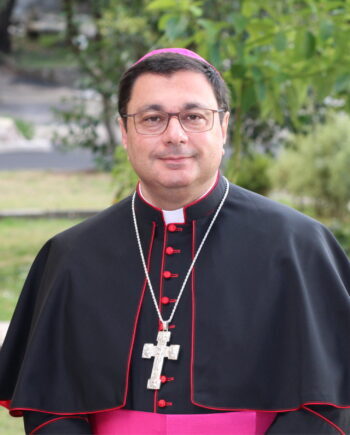
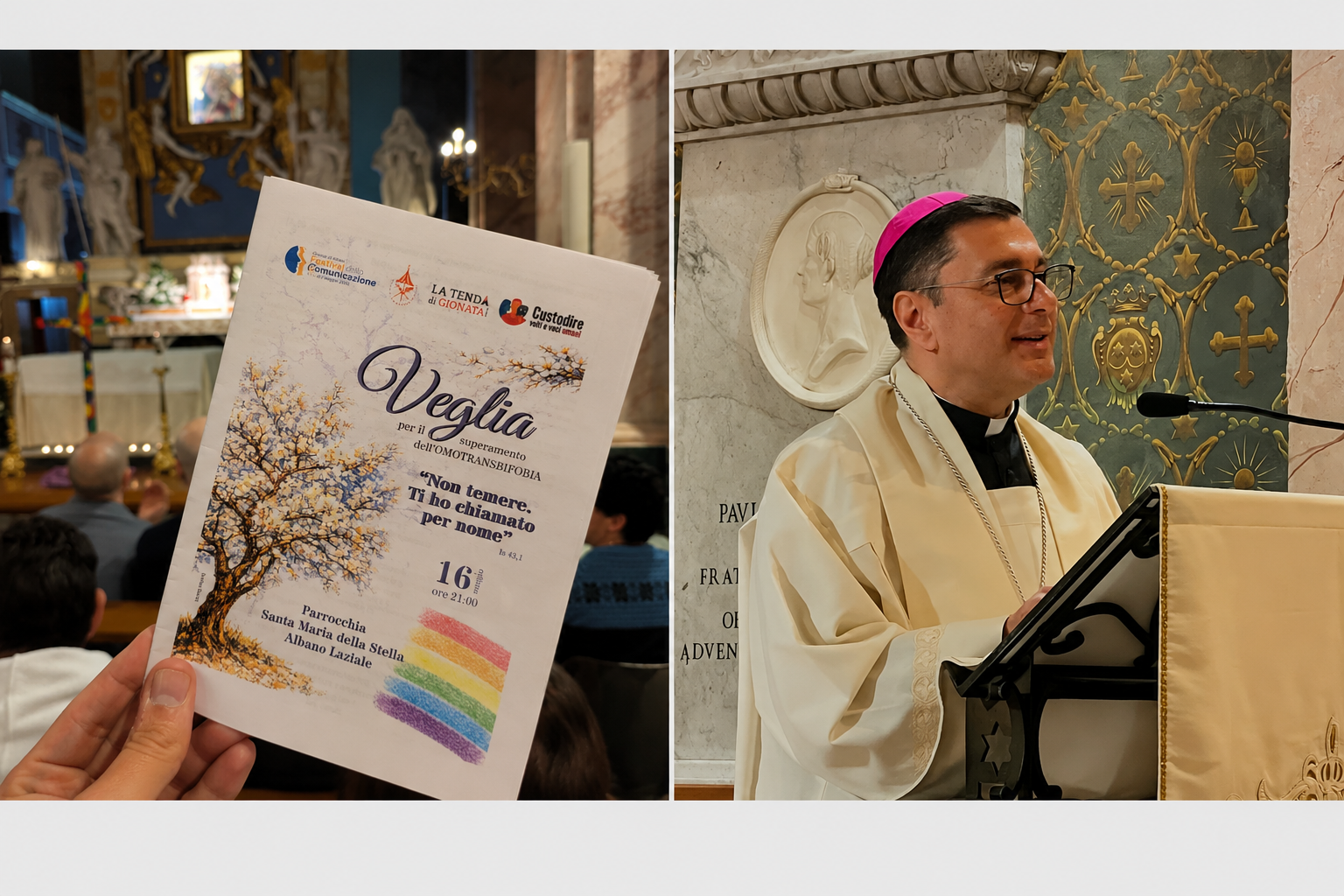
Editor’s note: On May 16, 2026 at the Parish of Santa Maria Stella in Albano Laziale, Italy, a diocesan prayer service was held with the LGBTQ community for the intention of overcoming homophobia and transphobia, organized in conjunction with La Tenda di Gionata, a group for Italian LGBTQ Catholics. One of the main speakers was Vincenzo Viva, the bishop of Albano, who also knelt in the sanctuary before the vigil and prayed with the group. The original Italian is on the diocesan website here.
“Do not fear, for I have redeemed you; I have called you by name: you are mine” (Is 43:1). These are the words that resonate this evening in our Church here in the city of Albano, on the Via Appia Antica, specifically at the 15th mile of ancient Rome’s most famous and important consular road, the “Regina Viarum” (from the Latin, “Queen of Roads”), where we also find the Catacombs of San Senatore, a place particularly dear to this city, which take us back to the roots of our diocesan Church.
And these words, which we find in Deutero-Isaiah, remind us of a central truth that runs throughout Scripture: The people of the covenant are constantly enveloped in the love of their God, who “created” and “formed” them (cf. Is 43:1). These are the very same verbs that the author takes from the Book of Genesis (cf. Gen 1–2), where we are told that God expresses satisfaction with the work of his creation; indeed, he approves of it and takes pleasure in it: God loves His creation and loves every person created in His image.
And precisely when his people are depressed, disoriented and faced with entirely new situations—as in the time of exile—God instills courage and proclaims hope: “Do not fear, for I have redeemed you; I have called you by name: you are mine … Because you are precious in my eyes and honored, and I love you” (Is 43: 1-4). Note that this is not an isolated statement in the Bible: throughout salvation history, the Lord continually repeats this command “Do not fear.” He says this to different men and women, in different times, but always anew, even on Easter morning, through the words of the angel at Jesus’ tomb (cf. Mt 28:5–7). He says, “Do not fear.” The first word of the resurrection is, therefore, freedom from fear. Just as in the context of exile, the people of the covenant are encouraged to step out of their fears, because the Lord has redeemed these people and called them by name: “You are precious in my eyes; You are mine.”
We are here tonight because we see and experience that there are still many fears we must overcome with the help of prayer. Fear has many faces and many names, and it has the power to stifle joy, to hinder the work of the Holy Spirit and to impede our growing understanding of God’s Word.
You see, tonight is the first time that our Diocesan Church of Albano is holding a prayer vigil to overcome a fear that has caused so much suffering and continues to cause suffering among people living in our ecclesial and civil communities: homophobia, transphobia and all other forms of contempt for people caused by prejudice. It is therefore a step forward for us to be here tonight to pray for this intention: a thoughtful, not to be taken for granted, important step. A journey that this diocese wishes to undertake together with many others in Italy, with steps that are still uncertain at times, but concrete and encouraged also by the Synodal Path we have experienced, which has taught us to listen more attentively and to walk alongside the people of our time. And for this I wish to give thanks to God with you.
Tonight is the first time that our Church of Albano is holding a prayer vigil to overcome a fear that has caused so much suffering: homophobia, transphobia and all other forms of contempt for people caused by prejudice.
But I would also like—and I say this with all the desire in my heart—that, ideally, this should also be the last prayer vigil for overcoming “homotransphobia.” Not because it embarrasses anyone or causes misunderstanding in someone else, but because the day when it is no longer necessary to hold vigils like this will be the day when every person is recognized—and I use this word with full awareness and deliberation—“recognized” as a living, original, irreplaceable part of the Body of Christ, without needing to pretend to be something they are not or to hide themselves.
That is why I do not wish to speak this evening of “welcoming,” but of recognition and full integration. Welcoming presupposes that someone arrives from the outside and is allowed in out of the generosity of others. But as the baptized, no one is a guest in this church. God knows us by name, loves us and tells us again and again that we belong to him. There is, then, no door to cross, because by virtue of our baptism we are already inside, each of us, with our own identity, our own history, our own weaknesses and shortcomings, our own gifts and unique characteristics: we are all within the heart of God and within the ecclesial body, even when this body, with its human frailties, has struggled and still struggles to recognize and accept differences.
That is precisely why, unfortunately, this vigil is still necessary. Still, even now, right here. And it would be dishonest not to say so. It is necessary because we must help all of God’s people to mature and grow in their faith and to live an inclusive, non-sectarian faith that heals the wounds of hatred, prejudice, ignorance and superficiality with love, knowledge and brotherhood. Christ bore witness to a profound and radical brotherhood and gave us the commandment of love, care, and mutual acceptance.
That is why I do not wish to speak this evening of “welcoming,” but of recognition and full integration. Welcoming presupposes that someone arrives from the outside. But as the baptized, no one is a guest in this church.
We must ask God for forgiveness because we do not take his Word and the witness of the Son of God seriously enough. Because there are still so many people whose lives are wounded—if not sometimes totally destroyed—by the violence that begins intellectually, then becomes verbal, and finally even physical, which LGBTQ+ people experience in our society: there are too many stories of exclusion; too many victims of gender-based violence; too many gay boys, lesbian women and transgender people rejected by their families, ridiculed, bullied and kicked. There are still many parents who, perhaps precisely within the Church community, should receive help, care, and tools to overcome unjustified feelings of shame and prejudice. There are still far too many who do not see the person, but see a deviation, a “mistake of creation,” a threat, a problem.
The experience of the people of the covenant has been that of having a God who is both Creator and Redeemer: it is He who says to us this evening, “Take courage; do not fear.” And it is wonderful that we are also experiencing this vigil within the Festival of Communication, where we are called to bring to light the voices and faces of authentically human communication, in accordance with the inspiration drawn from the Holy Father’s message for the 60th World Communications Day.
Yes, we must say it: for too long, certain voices have been left without a microphone, and when they do resound—outside our own circles—they have often been accompanied only by so much anger and resentment. Certain faces have been kept in the shadows—within families, within parish communities, within society—forced not to speak out, not to breathe, to survive rather than to live.
Authentic human communication—and the Gospel is communication, the most radical kind—is that which calls people by name.
Silence, at times, has seemed like prudence. But the silence that covers up pain and suffocates wounds is not prudence: it is complicity. Authentic human communication—and the Gospel is communication, the most radical kind—is that which calls people by name, which makes room for their stories, which reduces no one to a label.
Let us ask the Lord again this evening: help us, Lord, with your Spirit, so that our parishes may be places where no one feels on trial, where no one bears the burden of having to prove they deserve their place. Places where families and individuals find understanding, not judgment. Where everyone can live their spiritual life without hiding it. Where diversity is not experienced as embarrassment or shame.
Certainly, all of this requires conversion. It requires listening and pastoral care. It requires, at times, the courage to take the first step toward those who have drifted away because they felt hurt. This evening, our diocesan Church, too, has taken a small step to bear witness to fraternity and to learn, quite simply, to see brothers and sisters where others see threats, dangers, problems, ideological claims, or, worse, enemies to be fought.
May the Lord help us in this as well, through the intercession of the Virgin Mary, invoked in this church as Our Lady of the Star. Amen.