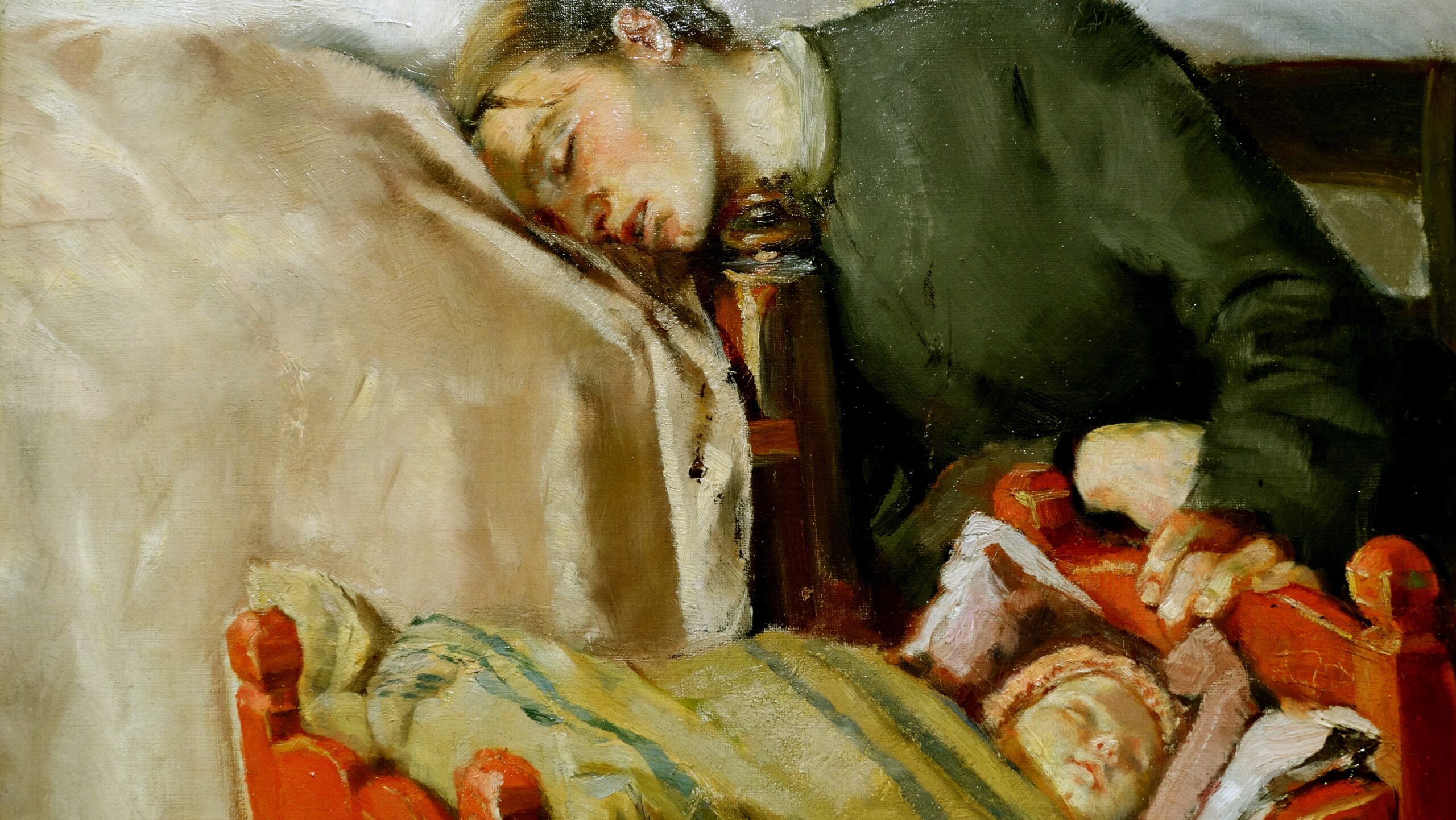
The doctor carved a seven-layered wound into my body, then drew him out of the depths. She held him up for us to see through the clear drape dappled with specks of my blood: our son. My wife, noticing that I had burst into tears, gently asked if I was okay. I nodded. She took out her phone, smiling, to note the time: 8:50 p.m.
It was exactly one year to the day since we lost our first pregnancy, when I had miscarried at ten and a half weeks along. Soon after our baby was born, I wrote him a letter: on the day of your birth, I wrote, the veil between life and death broke open in one small seam, and what connected those estranged worlds for just an instant was the intensity of our love for you both, for our two children, living and dead.
The first night, I barely slept. This was equal parts anxiety—is he breathing?—and wonder. I just wanted to look at him: at his perfect Cupid’s bow mouth, his long lashes, his impossibly small, red-purple fingernails. I held him close to my chest as he made his first feeble, eager attempts at feeding, retethering himself to my body after nine months during which I had never known for sure whether what I felt inside myself was me or him.
He was here, safe. Safe: the only thing I had thought about for the long months of pregnancy, yet something I could barely let myself imagine after burying the remains of his tiny almost-sibling the year before. Then, deliriously, I had sobbed while reading a poem aloud over a hole my wife had dug in the dirt of our backyard. A year later, I wept quietly, feeling the warmth of his soft breath against my bare skin as he slept.
The idea of motherhood can feel like a concrete wall between myself and my actual experience: the animal tenderness, the raw desire, the fierce delight of growing and nurturing a new life.
Almost nine months later, he is fully at home in the world of the living, brimming with curiosity, energy, delight. He babbles and bounces; he waves and wonders. And yet: I still feel a pull to close the gap. He makes joyful gurgling sounds in his stroller, endlessly entertained by attempts to pull off his own socks, while I push him on our walking route through the cemetery by our apartment.
I stop at one headstone, close to the entrance, engraved with the devastating words: “OUR BABIES, George Alban, 1876 – 1876; Harry Francis, 1879 – 1879.” In the weeks after my miscarriage, I found this monument to parental grief deeply consoling.
I sing to my son, and he coos along as we wander through the paths of the dead. Do they hear him? Can they? I imagine it, every time.
Motherhood’s wounds and wonders
It is not an original thought, of course, that birth is the mirror image of death. In one of my favorite scenes in all literature, in Tolstoy’s Anna Karenina, Konstantin Dmitrievich Levin, full of awe and anxiety as he waits for his wife, Kitty, to give birth to their first child, realizes suddenly that he is thinking about the year before, when he had cared for his brother, Nikolai, as he died of tuberculosis. “That grief and this joy were equally outside all the ordinary conditions of life; they were like holes in that ordinary life through which something supreme showed.”
The connection is more than abstract: even for those of us privileged to receive excellent medical care, to bring life into the world is still to expose one’s flesh and heart to danger. As soon as my wife and I began to try to have a child, we started hearing stories from friends, so many more than we would have anticipated: stories of traumatic births, in which either the child or the birthgiving parent had almost died; stories of miscarriages and stillbirths; stories of physical and psychological complications from pregnancy or childbirth that persisted years afterwards.
“That grief and this joy were equally outside all the ordinary conditions of life; they were like holes in that ordinary life through which something supreme showed.”
Why don’t we talk about this? I asked myself, through both of my pregnancies and through the postpartum period. Why does no one talk about this—about what it takes for human life to continue to exist? I have a piece of my own answer in the fact that even now, as I write this reflection, there is part of me wondering why I am being so morbid. Why am I not just writing about my (very real) joy?
The idea of motherhood can feel like a concrete wall between myself and my actual experience: the animal tenderness, the raw desire, the fierce delight of growing and nurturing a new life. Part of this, I know, is that as a queer woman, I have never felt invited to the motherhood party. Another part is that so much thinking about what motherhood is has been either done by men or, when done by women, trivialized and relegated to the sphere of the sentimental.
In an interview discussing her book, The Obligated Self: Maternal Subjectivity and Jewish Thought (2018), the queer Jewish scholar Mara Benjamin lamented how infrequently parenthood, and motherhood specifically, has been taken seriously as a source for critical thought. “People all over the world at every moment of the day are thinking about these really existential, profound questions, ethical questions [about parenthood], and why don’t we have a way to talk about that, besides, you know, mommy blogs?”
At two o’clock in the morning, during middle-of-the-night nursing sessions, I hold my son to my chest and ask myself the same thing. More often than not, I end up thinking about Blessed Julian of Norwich.
Meeting Julian of Norwich
I first met Julian — medieval visionary, recluse and theologian—in my sophomore year of college, only months after I had come out of the closet and, as a result, had been rendered spiritually homeless. I picked up her book, the first known to be written by a woman in the English language, somewhat at random from the shelf of the Jesuit retreat center where I was participating in a five-day silent retreat.
I fell in love. When I taught the same passages, later, to college students, I would always have to encourage them to see past the wounds, the torture, the suffering, to the love that pulsates through her text. For me, in that moment, no one had to teach me that. She spoke clearly and directly to my tender, broken heart.
It is this total offering of his body to give us life, writes Julian, that makes God our true mother.
In her tenth vision, Julian is visited by Jesus Christ, who proceeds to show her the wound in his side, the one he received from a Roman soldier’s spear at his crucifixion, out of which, so the Gospel of John relates, “blood and water” had poured (Jn 19:34). In her vision, Julian wrote, she could see into the wound all the way to his heart, cloven in two by the weapon of empire.
Julian and Jesus, in a delightful example of late medieval weirdness, admire his mangled heart by staring at it together. Then he blissfully sighs: lo, how I have lovid the! Look at how I have loved you. It is a joy, a blis, an endles lekyng to me that ever suffrid I passion for the, and if I myht suffre more, I wold suffre more. It is a joy, a bliss, and an endless delight to me that I suffered my passion for you, and if I could suffer more, I would suffer more.
It is this total offering of his body to give us life, writes Julian, that makes God our true mother. The moder may leyn the child tenderly to her brest, but our tender Moder Jesus, He may homely leden us into His blissid brest be His swete open syde. The mother may lay her child tenderly on her breast, but our tender Mother Jesus leads us into his blessed breast by his sweet open side.
Julian’s strange vision made immediate sense to me. Yes, I thought, God was found here, precisely here, in this torn and sundered flesh, in this freely offered blood. It was horrible and repugnant. It was astoundingly beautiful. It was incredibly queer. Lo, how I have lovid the!
Now, I read it with an ache. I think of the thick layer of blood and the bulbous mound of skin I poured out from a plastic container into the earth, that first child we loved into being. I think of my wife covering the makeshift grave with a tiny stone. I think of my friends’ losses, their enduring scars, their dashed hopes, their searing regrets.
This is what it takes, I think. This is the cost: what we pay to bring life into the world.
In one of her final visions, God brings to Julian’s mind all of the suffering of the world — the pains and passions, spiritual and bodily, of all creatures—and tells her: al shal be wele, and al shall be wele, and all manner thing shal be wele. All shall be well, and all shall be well, and all manner of thing shall be well.
How? she wonders. She does not know.
“All Shall Be Well”
As I finish writing this reflection, my wife is holding up a brochure of New England bookstores to show our son, who is desperately trying to grab it and crinkle the glossy paper in his tiny hands. He looks over at me, across the room, and smiles a toothless smile.
On this Mother’s Day, our first as mothers of this miraculous new human being, it’s the words of Julian that I hear in my mind when I look at him: it is a joy, a bliss, and an endless delight to me that I suffered for you, and if I could suffer more, I would suffer more.
And all shall be well? I think of the babies buried in the earth.
I hope, and hope, and hope: as if hope were a song the dead could hear.