
You can find the readings for the Third Sunday of Lent here.
This Sunday’s readings at Mass invite us to confront a challenging question: What hardened parts of my heart is God striking at this Lent to bring forth new life?
Perhaps you immediately reacted to that question by responding with another, “Why do my neighbors continue to have such a hard heart toward LGBTQ Catholics, their allies and other marginalized individuals who are beloved by God?” This is a deeply prayerful question, and our readings today remind us that we are not alone in asking it, for the human heart always wavers in its openness to and resistance against God’s grace.
In the readings immediately preceding the Gospel, there is a timely invitation to ponder how God is striking at our hearts, especially at this point in Lent where we might feel agitated like the Israelites in the reading from Exodus, who grumbled against Moses and tested God in their desperation for water. In the second reading, the Apostle Paul insists to the Romans that Jesus, as the Christ, addresses our heart’s perennial problem by offering humanity his sacrificial love through his life, passion, death and resurrection.
The beauty of Lent is that our prayer, fasting and almsgiving draw us nearer to Jesus who continuously opens his heart to us.
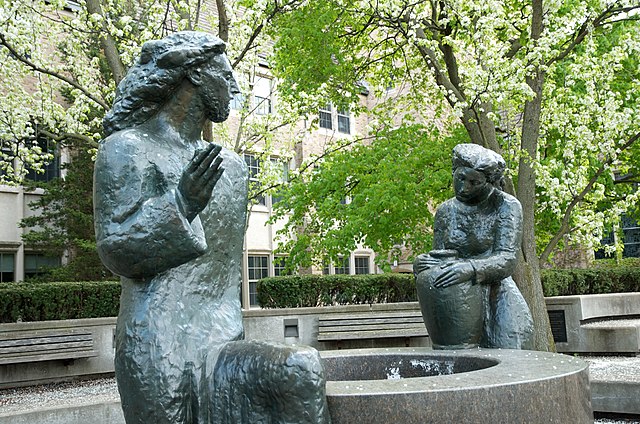
The beauty of Lent is that our prayer, fasting and almsgiving draw us nearer to Jesus who continuously opens his heart to us. And like most relationships, when someone opens their heart to you, you usually feel safe enough to open your heart to them. This is what ultimately unfolds in the Gospel story of the Samaritan woman at the well.
It’s important to note that Jesus revealing his Messianic identity to the Samaritan woman illustrates his preference to turn first to those on the margins. This is important for LGBTQ people who are still often portrayed as God’s belittled rather than God’s beloved. Even so, we must also remember the reverence the disciples themselves show to the Samaritan woman.
Halfway through the Gospel passage, the disciples arrive at the well surprised to see Jesus conversing with her. Despite this surprise, they do not dare to interrupt Jesus with trivial questions (Jn 4:27). Instead, their hearts remained postured in reverence. Adele Reinhartz, PhD, Professor of Classics and Religious Studies at the University of Ottawa, states in her exegesis of the Gospel of John that Jesus’ revelation to the Samaritan woman, “I am he” (Jn 4:26), alludes to God’s self-revelation as the great “I AM” to Moses in the burning bush. Because of this, the disciples did not need to know what Jesus had told her to recognize that something sacred had occurred, they could sense that she knew she was standing on holy ground.
This is important for LGBTQ people who are still portrayed as God’s belittled rather than God’s beloved.
Jesus strikes the Samaritan woman’s hardened heart and in doing so pours out God’s love to her. She responds to God’s love by becoming a wellspring of faith. John’s Gospel depicts her as an apostle to the Samaritans, telling them to “come see a man…Could he possibly be the Christ?” (Jn 4:29). Because of her courageous witness, many more Samaritans were led to a personal encounter with Jesus and came to know him as the Messiah. How many would have missed the opportunity to know Christ had the disciples failed to revere the Samaritan woman’s encounter with Jesus at the well?
LGBTQ Catholics’ and their allies’ testimonies are likewise a wellspring of faith for the universal Church. This Lenten Gospel passage invites those who struggle to recognize their LGBTQ neighbors as God’s beloved to consider how God’s self‑revelation to LGBTQ people confronts and softens the hardened places within their own hearts. It also invites LGBTQ people and allies to consider the places in our own hearts that God longs to entrust to us the living waters of God’s divine care. May we remain receptive to God’s grace, listening for God’s voice in the wilderness of our lives, that we might recognize the holy ground on which God and Christ draw near to us this Lent.