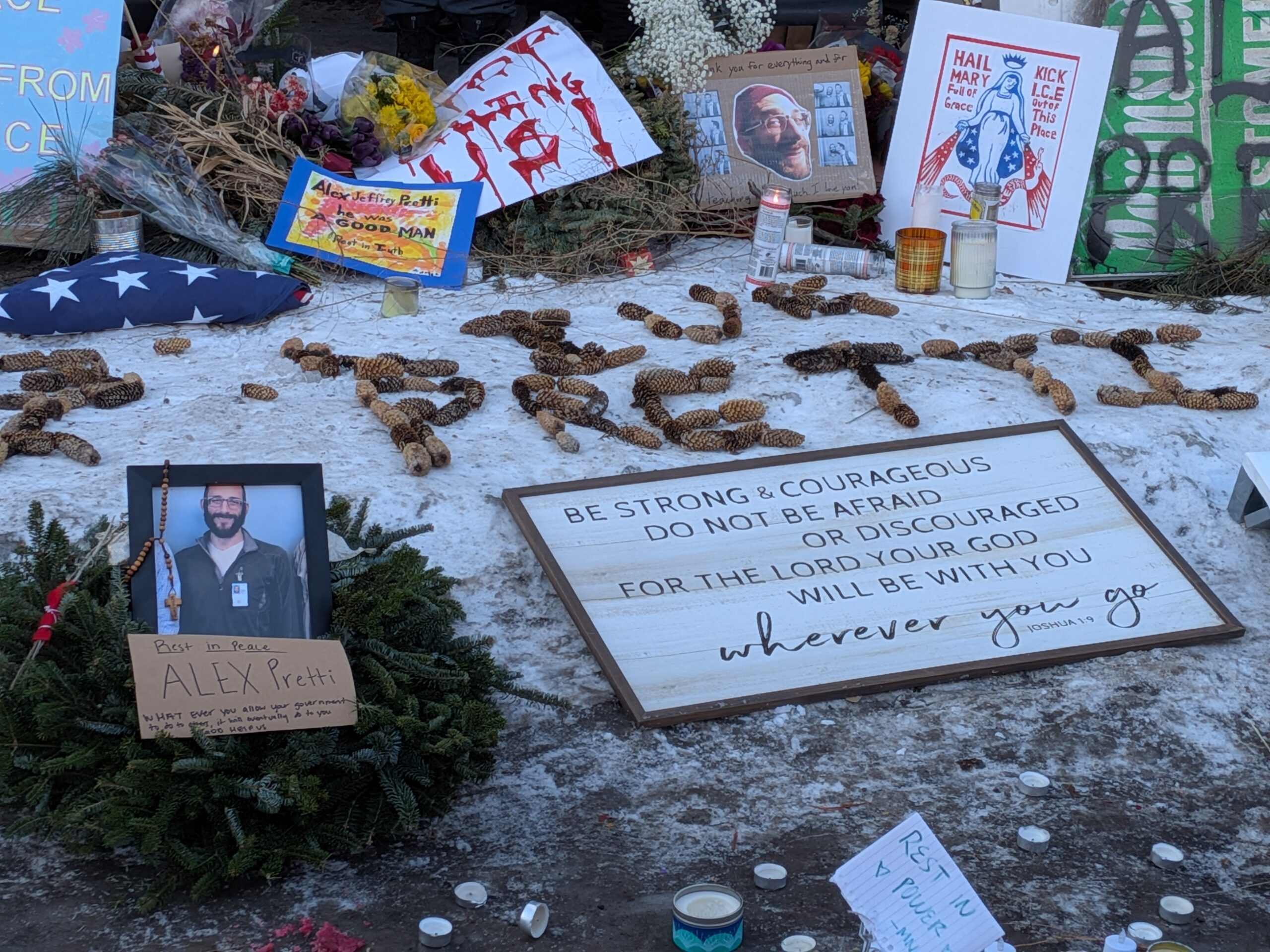
The morning Alex Pretti was killed in Minneapolis, he was trying to help a woman who had been shoved to the ground by federal agents during an immigration enforcement operation. At 37, Pretti was an ICU nurse known for caring deeply for others; video footage and eyewitness accounts also contradict federal officials’ claims that he posed a violent threat. Instead the videos appear to show him holding only a phone, being shoved and pepper-sprayed by agents, tackled to the ground and, even after being restrained and disarmed, struck by at least ten shots as he lay face down on the cold ground.
There are moments when someone’s life confronts us because it mirrors our own, reflecting back the world as we have learned to see it. Alex Pretti, Renee Good, and I are all millennials, all 37 this year. We were ten years old when the shootings at Columbine High School cracked the illusion of safe schools and thirteen when 9/11 reordered our sense of fear and nationality. We learned to protest in the streets during the Iraq War, having been warned about weapons of mass destruction that never appeared. We became adults as the economy collapsed along with the collapse of Lehman Brothers.
Those shared experiences matter. They shape how we see the world, what we notice and how we respond when those who are suffering are forcibly pushed to the margins.
Earlier this month for Outreach, Kevin Clarke wrote about Renee Good with clarity and care. Her story, and now Alex’s, poses an urgent question to all of us: What does it mean to live with an awakened conscience in a world that punishes those who stand in solidarity with the marginalized?
For LGBTQ Catholics, our awakened conscience probably developed at an early age. Most of us learned quickly that the world was not built with us in mind. Our institutions failed to account for our lived experience. That realization is painful, but it molds us into the people we are meant to become.
Once you know what it feels like to be unseen or misunderstood–by your community, by your friends or family, by your Church– it becomes much harder not to notice when others are treated the same way.
Thus, empathy is born.
Our LGBTQ identity can help open us to a deeper understanding of those, like us, who have been pushed to the margins. By exercising our emphatic imagination, we can try to better understand the myriad ways that systems fail to address the needs of immigrants, people of color, women, the differently abled, those experiencing homelessness, the violence of mass incarceration or the devastating effects of climate catastrophe.
Alex Pretti appears to have lived with that empathetic imagination already fully developed. By all accounts, his life reflected a deep sensitivity to suffering beyond himself. That kind of attentiveness is not accidental. It is cultivated and learned. And it is deeply consistent with what Catholic social teaching asks of us.
Our tradition insists that human dignity is indivisible. We do not get to defend it selectively. Solidarity is not a feeling; it is a physical commitment. The preferential option for the poor and vulnerable is not a slogan; it is a demand that reshapes how we live our everyday lives.
James Baldwin articulated this truth with searing clarity when he wrote:“The violence was being perpetrated mainly against black men … and so it didn’t count. But, if a society permits one portion of its citizenry to be menaced or destroyed, then, very soon, no one in that society is safe.”
Baldwin was naming a pattern we still see today: when suffering is confined to “those people,” it becomes easier to ignore — until it isn’t confined anymore.
None of us arrives at justice on our own. We are taught how to love our neighbor through both encounter and proximity.
And sometimes, we are awakened by stories that refuse to let us remain comfortable. Alex Pretti’s death, like Renee Good’s, calls us back to this truth: our faith is not proven by how eloquently we speak about justice, but by how faithfully we respond to those pushed to the margins. And as LGBTQ Catholics, we know the pain of that marginalization.
So how do we best move from that pain, to a place of action, one in which we stand in solidarity, day in and day out, with those like us? Alex Pretti and Renee Good should call us to action, so we more deeply encounter our neighbor, and live in proximity with those whom Jesus has always called us to walk alongside.