The gravitas of Christmas Eve Mass has always struck me. Though the liturgy is obviously different from that of the Easter Vigil, the church is still dark, with dim lighting and candles aglow. People shuffle into the pews with smiles on their faces and hushed conversations echo in the sanctuary.
Then, the organ sounds and the choir begins with the classic “O Come, All Ye Faithful.” It always seems that no matter if someone is a regular churchgoer or it’s someone’s first time to church in ages, the words to this hymn are written on everyone’s hearts. As the servers and clergy conclude their procession to the altar, the people roar out the climax and crescendo: “Yea, Lord we greet thee, born this happy morning! Jesus, to thee be glory given.”
Then, with extra gusto and every ounce of air in their lungs, the congregation proclaims “Word of the Father, now in flesh appearing. O Come, let us adore him. O come, let us adore him. O come, let us adore him, Christ the Lord!”
Every time I hear that line, I can’t help but feel moved because of all that it means for us as God’s children, but especially as LGBTQ Catholics.
It’s an echo from the passage from John’s Gospel that we read on Christmas Day: “And the Word became flesh and made his dwelling among us, and we saw his glory, the glory as of the Father’s only son, full of grace and truth.” At initial glance, it’s an odd reading for Christmas. Those who attend Mass on Christmas Eve hear the genealogy of Jesus from Matthew’s Gospel or bits and pieces of the Christmas story itself from Luke’s Gospel.
Yet for the Mass of Christmas Day, we hear the “prologue” of John’s Gospel, and in it one of the core teachings of Christianity: God became one of us and thus knows us, intimately. Because God became flesh in the person of Jesus Christ, God knows what it means to be sorrowful, and knows what it means to come among his own people and then to realize “his own people did not accept him.”
Jesus was born in and lived among the margins, rejected even by those whom he loved, an all-too-real reality for too many LGBTQ Catholics.
But we know that this story does not end in rejection and despair. John’s prologue tells us that the gift of Christmas is that, because of Christ’s birth, we too can be called children of God, and therefore join with him “at the Father’s side,” as today’s Gospel concludes. And as God’s children, Jesus not only took flesh in the manger that first Christmas, but is born in you and me, in our hearts, each and every day.
Jesus’s birth means that we too “bear Christ” to the world, in our own flesh. It is within us that God continues to make God’s “dwelling among us,” out of God’s abundance of grace and mercy, with Mary, the first “God-bearer” as our model.
Commissioned by our baptism and nourished with the Eucharist, we bear Christ to the world by living like him: walking with the poor, providing a voice for the voiceless and serving the less fortunate. As LGBTQ Catholics, we also bear Christ to the world when we are sorrowful or turned away from family and friends because of how God has made us. It is in those moments most especially that God reminds us today that Christ is still “Emmanuel,” “God-with-us,” even when others might say otherwise.
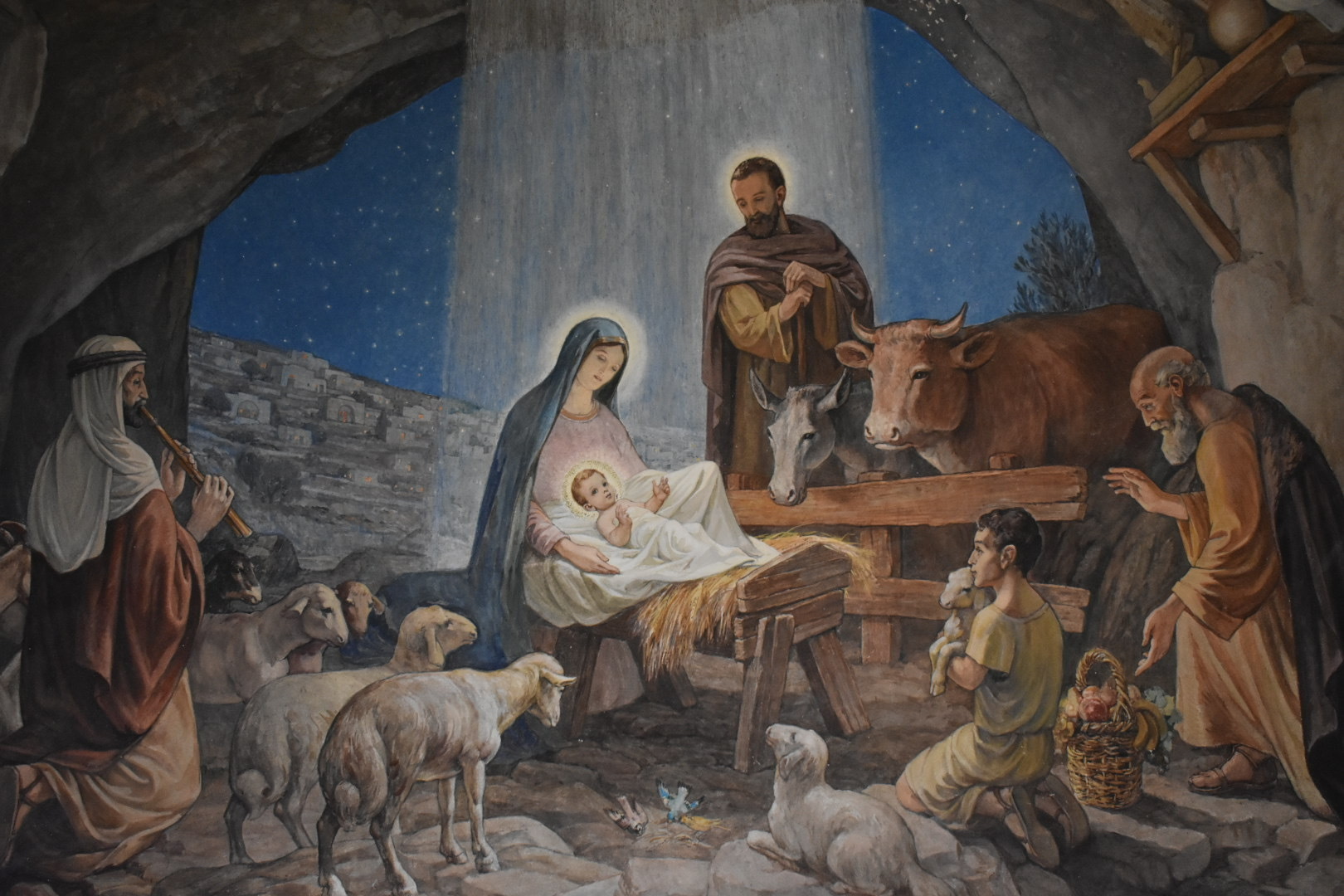
So as we officially begin the Christmas season today (and over these next eight joyful days celebrate the Octave of Christmas), let us remember that the same Christ who was born in the manger from the womb of our Blessed Mother is born today in you and me. Whether in the celebration of Mass today, with family or friends, at your local soup kitchen and homeless shelter, or even within your own heart, let us be joyful with all creation because the Word of the Father appears and will continue to do so forever.
O come, let us adore him.