
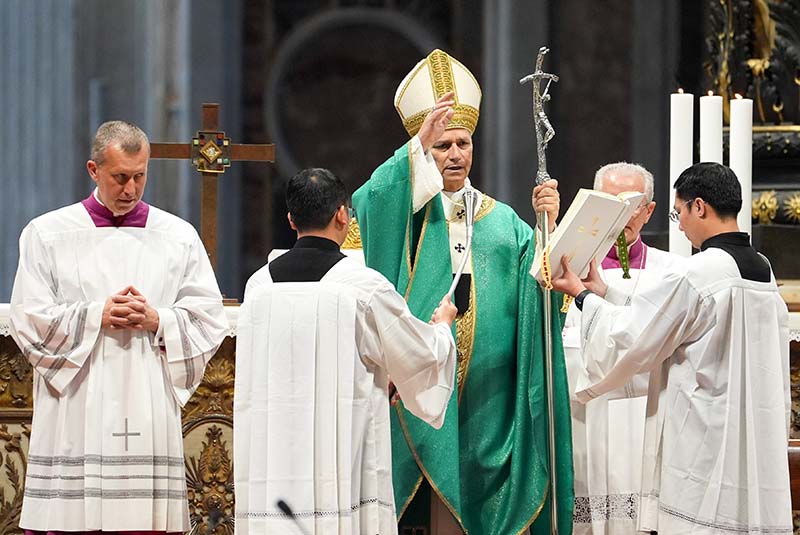
U.S. Catholic bishops gathered in Baltimore this November, where they elected new leadership, responded to Pope Leo XIV’s call to speak on immigration and issued updated directives on transgender care in Catholic hospitals. On Nov. 12, they released a pastoral message addressing the fear and dehumanization affecting immigrants in the U.S. Their words were strong, clear, and deeply rooted in church teaching: every family deserves safety, dignity and protection of their rights. For many people, this message was a welcome affirmation of the church’s commitment to justice and human dignity.
At the same meeting, the bishops approved revisions to the Ethical and Religious Directives (E.R.D.s) regarding gender-affirming care in Catholic hospitals and clinics. These changes set clear parameters for care according to the bishops’ understanding of Catholic teaching. As teachers of the faith, bishops have a unique role in guiding the church, and Catholics are called to listen to them even when we wrestle with how their guidance is lived out pastorally. In the current climate, when access to gender-affirming care is increasingly restricted in many states, these directives illustrate the tension between institutional policy and the pastoral imperative to walk with gender-diverse Catholics.
Because Catholic hospitals are often the only accessible or affordable providers—particularly in rural areas—these new rules will have the greatest impact on those with the fewest options. As Marianne Duddy-Burke of DignityUSA observed, “the people least able to have a choice in where they get treatment will be those most harmed.” The directives prohibit interventions “aiming to transform the sexual characteristics of a human body into those of the opposite sex” and limit the ability of clinicians to refer patients elsewhere. In practical terms, this may make it more difficult for some patients to access well-established, evidence-based care, including care that cisgender patients rely on for other conditions. Gender-affirming care (which, broadly speaking also can include psychological counseling) is also associated with significant psychological benefits, including improvements in depression, anxiety, and overall well-being—documented across numerous peer-reviewed studies. Our focus, now more than ever, must be on walking alongside and supporting those most in need.
These directives illustrate the tension between institutional policy and the pastoral imperative to walk with gender-diverse Catholics.
I write this as someone who has had relatively easy access to gender-affirming care—a privilege not everyone shares. My weekly hormone injection is a small, yet life-changing act: it relieves dysphoria, allows joy to flourish in my life, and has deepened my connection with God by allowing me to meet Him as myself.
For me, gender-affirming care has brought concrete spiritual graces that I could not access before transition. Living in a body that reflects my authentic self has allowed me to stand honestly before God in prayer rather than hiding behind fear or self-denial. It has also given me clearer discernment—the ability to hear and trust God’s call in my life without the constant fog of dysphoria. And as my body and soul have come into harmony, I’ve experienced a renewed compassion for others and a sense of resurrected life that I can only describe as grace.My heart goes out to those who will now face barriers, delays or outright denial of care—those whose access is far less secure than mine. Walking with them, even in thought and prayer, is a responsibility we all share.
Amid these discussions in Baltimore, the church in Rome offered a quiet reminder of the pastoral heart at its center. On Sunday Nov. 16, 48 transgender women attended the Vatican’s annual lunch for the poor—a tradition begun under Pope Francis and continued under Leo XIV. While none were seated at the pope’s head table, they were welcomed as honored guests, seated near the pope, and greeted warmly. As one attendee told The Washington Post, their presence sent the message that “the church is not going to close the door that it opened.”
The gathering was not a sweeping doctrinal change or a major public statement. Yet it was a quiet, consistent pastoral signal: transgender people are part of the church’s life and belong to the community of God’s people. Pope Leo, like Francis before him, welcomed them as children of God. Cardinal Konrad Krajewski emphasized that they attended not because of special outreach, but because they are inherently part of the church.
When I told Pope Francis in Spanish that I am transgender, he received me with warmth and dignity, the same welcome that he offered to every pilgrim.
I have experienced such encounters firsthand.
When I told Pope Francis in Spanish that I am transgender, he received me with warmth and dignity, the same welcome that he offered to every pilgrim. Moments like these transform hearts—they transform the church. They remind us that the Gospel is most fully lived when we are present with one another, especially with those who are most vulnerable. This is the essence of accompaniment: walking with gender-diverse Catholics in tangible, human ways, even when policy creates obstacles.
Looking at both events together, the contrast invites reflection: directives provide structure and guidance for an institution, but true accompaniment and the imitation of Christ calls for presence, compassion and human proximity. Jesus walked alongside those on the margins and healed them. Catholic social teaching calls us to extend care to all who are vulnerable the way Jesus did—without judgement or restriction.
Gender-affirming care also has wider benefits beyond transgender patients. Restrictions may affect intersex and cisgender patients relying on similar hormonal treatments, families seeking accurate guidance and healthcare workers striving to act ethically. The new E.R.D.s state that interventions “to alter the fundamental order of the human body in its form or function” are not permitted, citing Amoris Laetitia’s teaching on respecting the gift of creation. They distinguish between medical interventions that restore versus those that transform the body, shaping how clinicians may approach care within Catholic systems.
It’s especially important for us to walk with our transgender friends and family members these days, when they are experiencing so much pushback.
It’s important to state that recognizing and respecting the dignity of transgender people does not conflict with human dignity—it invites the church to expand its moral imagination to embrace the lived, evidence-based realities of trans and intersex Catholics. Walking with gender-diverse people is itself an affirmation of God’s gift of human diversity. Simply remember Pope Francis’s moving encounters with transgender people, which happened on a regular basis at the end of his pontificate.
It’s especially important for us to walk with our transgender friends and family members these days, when they are experiencing so much pushback in so many areas, for example, the virulent comments against them in the public square and the cancellation of passport identifications for trans people.
Jesus never divided the vulnerable into categories of worthiness. He healed without hesitation, restored those on the margins, and welcomed all who were suffering. His example calls the church to respond in the same spirit: with presence, compassion, and a commitment to inclusion.
The church is invited to walk a path of closeness with gender-diverse Catholics, seeking ways to be present to those on the margins while navigating the challenges of institutional life. The Vatican lunch, small as it may seem, gestures gently in that direction—reminding us that simple acts of welcome, recognition, and shared humanity can ripple outward in ways that transform hearts, lives, and the church itself.