
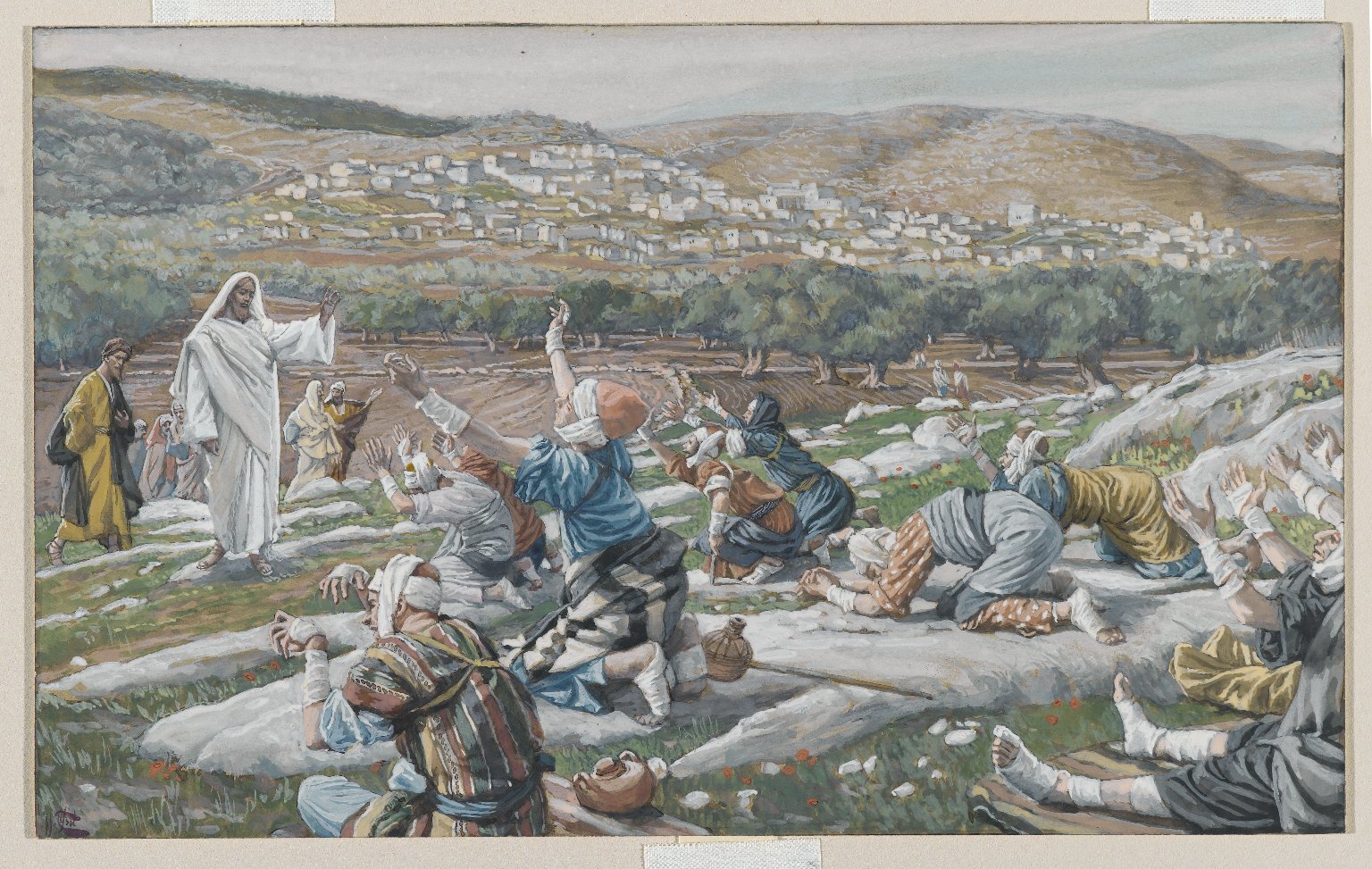
This essay first appeared in our weekly Scripture reflection newsletter on October 11, 2025.
2 Kgs 5:14-17; 2 Tim 2:8-13; Lk 17:11-19
You can find the readings for the 28th Sunday of Ordinary Time here.
Earlier this week, we read the Parable of the Good Samaritan, which is often reduced to some commonplace morals: Be nice. Help people. Be charitable (Lk 10: 30-37). All those things are wonderful. But there is much more to that parable, which is, in its own way, timelier than ever. And this Sunday’s Gospel, which focuses on the gratitude of another Samaritan (a man healed of leprosy) is another instance of someone from a despised group turning out to be not only the good guy, but a model of behavior.
So let’s look at these two Samaritan stories, which are only a few chapters apart in Luke, together. Taken together, they can tell us a lot about hatred, division and polarization today.
To understand something about this Sunday’s Gospel, which has been called “The Grateful Leper,” as well as the Parable of the Good Samaritan, we need to understand something about Samaritans.
Taken together, these Samaritan stories can tell us a lot about hatred, division and polarization today.
As most Christians know, there was a tremendous amount of enmity between Jews and Samaritans in the first century, not only for historic religious reasons about where one should worship God (the Temple in Jerusalem versus Mt. Gerizim) but for more contemporary reasons. In his book The Forty Parables of Jesus, Gerhard Lohfink notes that during Jesus’ time, a group of Samaritans scattered human bones in the Temple to render it unclean. It’s hard to imagine something more offensive to the Jewish people.
So, without stereotyping or assuming everyone felt the same, we need to understand at least some in these opposing groups felt a great deal of enmity. That’s the reason the Parable of the Good Samaritan is not simply about two people passing by someone in need but passing by an “enemy.” It’s why the story of the Samaritan woman in John’s Gospel is not simply about Jesus speaking at length to a woman with a checkered past, but spending time with a person on the “other side” (Jn 4). It’s also why the healed Samaritan is not just an example of gratitude, but the “wrong person” showing gratitude.
I’m sure that each of us could come up with contemporary examples to help “actualize” both of those stories today. Just imagine someone from a group you don’t like.
Interestingly, Jesus not only specifies the two main actors in the Good Samaritan story but also locates it in a specific place: the road from Jerusalem to Jericho, which is still there and winds through some punishing landscape. One of the key phrases in the parable is that both the priest and the Levite, who are presumably coming down from the Temple after returning from their service, “see” the man and pass him by. But do they really “see” a person in distress, or do they just see a problem?
Both the priest and the Levite, who are presumably coming down from the Temple after returning from their service, “see” the man and pass him by. But do they really “see” a person in distress, or do they just see an enemy?
Then the Samaritan approaches the man. Jesus doesn’t say that the Samaritan simply sees the man. The Greek is kai idon esplanchnisthe—“And having seen him, he was moved with pity.” The Greek is more visceral, reflecting where the seat of emotions was in the Hellenistic world: He felt compassion for him in his guts. Any factional hatred was overcome by his compassion for the man.
So the Good Samaritan sees someone who should be an enemy but, moved with compassion, he helps him anyway. Thus, it’s not simply about helping someone; it’s about helping a man that some Samaritans might say he’s not supposed to help.
And what about the beaten man? We need to focus on him as well. Imagine him lying by the side of the road and seeing the priest and Levite approaching him, assuming they would help and then being bitterly disappointed. Now imagine him seeing the Samaritan and being torn. Thinking both, “Please let him help me” and “Him?”
But the salvation of the beaten men depends upon the one whom he considers to be a stranger, different, foreign, other, even hated. Which raises the question: Upon whom does your salvation depend? How can opening yourself up to someone “on the other side” heal you?
We can learn a great deal even from people whom we think we hate. Maybe especially from them.
In this Sunday’s story, the Samaritan is not simply the only one of the ten healed to give thanks to Jesus, but he is the only non-Jew. Jesus specifically makes that point, in case we miss it: “Has none but this foreigner returned to give thanks to God?” Like the story of the Roman centurion, in which Jesus praises the faith of a pagan soldier (Mt 8:5-13), we are meant to see that the person who is seen as “other” is actually living a holier life, a more faithful life, a more authentic life.
In all these Samaritan stories, we are invited to see the “other” in a completely different light. Jesus is giving his disciples and us a way out of demonization and polarization.
Today there is a great deal of demonization in both society and in the church. Attacks on social media, dismissals of people as “bad Catholics” and heated arguments—even in person—are increasing. The Parable of the Good Samaritan reminds us of the need not only to be moved with compassion for those on the “other side” but also to understand that we cannot be fully healed without their help. And this week’s story of the Grateful Leper reminds us that we can learn a great deal even from people whom we think we hate. Maybe especially from them. So upon whom does your salvation rest? And from whom will you learn? Who are the Samaritans in your life?