
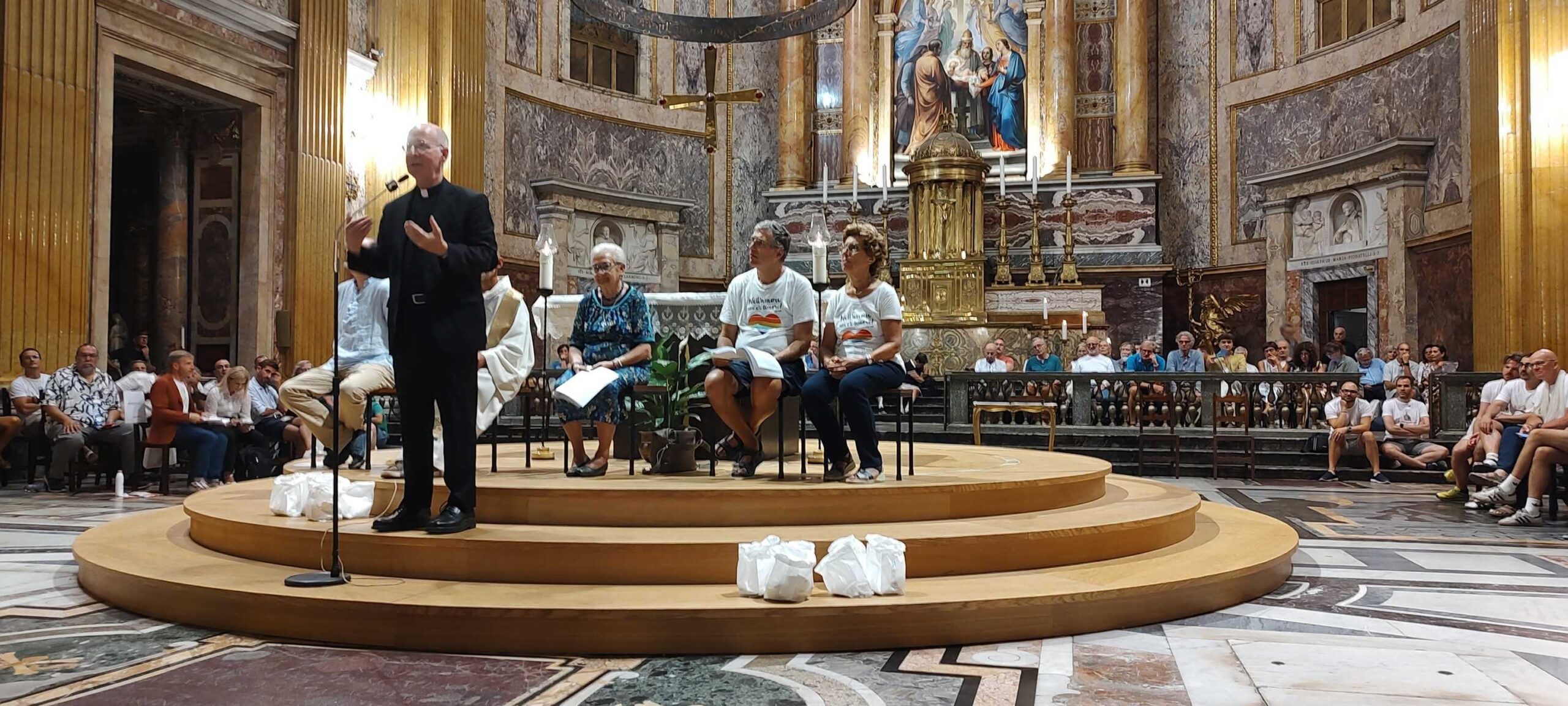
Editor’s note: Below is the transcript of a reflection given at a prayer service for LGBTQ Catholics at the Church of the Gesù in Rome, organized by La Tenda di Gionata, on the evening of Sept. 5, 2025.
Buona sera!
Why do we work and minister with LGBTQ Catholics? Let us think about some reasons.
First is what you might call the “secular reason.” As we have heard tonight, LGBTQ Catholics are often the victims of violence, beating and harassment. So any person of goodwill would want to help these people, our brothers and sisters.
The second is the reason that comes from Catholic social teachings. One of the pillars of Catholic social teaching is being in “solidarity” with people on the margins, people on the “peripheries,” as Pope Francis said.
Third, if you are a member of a religious order, as I am, you might have “religious charisms.” We sit tonight between the body of St. Ignatius Loyola, who asked us to find God in all things and in all people; and the arm of St. Francis Xavier, who baptized tens of thousands of people who were considered at the time to be “less than human.”
Today, we Jesuits are called to “walk with the excluded.” And there is no one more excluded in our church than LGBTQ people.
And so, we have a secular reason, we have a Catholic social teaching reason and we have a reason from a religious order.
All these are good reasons. But the more important reason is that this is what Jesus asks us to do. Because this is what Jesus did in the Gospels.
And I want to look very briefly at three Gospel stories that show us this.
The first is the Jesus’s encounter with the Roman centurion in Capernaum (Matt 8.5-13). Capernaum is a fishing village on the Sea of Galilee. A Roman centurion comes up to Jesus. He is a member of an occupying army; he is a colonizer. He asks Jesus for healing for his servant.
This is what all LGBTQ Catholics want: they want to see and know Jesus.
What does Jesus say? Does he say, “Go away from me, you are a member of a colonizing force”? Does he say, “Go away from me, you are not Jewish”? This man is as far outside the Jewish milieu as possible. He is the ultimate outsider.
But no. Jesus listens to him, heals his servant and does a great favor for him and thus blesses him.
He treats him as the Catechism asks us to treat LGBTQ people: with “respect, compassion and sensitivity.” And he praises his faith. He says, “Never in Israel have I seen faith like this.” And when I look at my LGBTQ brother and sisters, who have been through so much pain, I sometimes think: Never have I seen faith like this
The second story is that of “Woman at the Well” in John’s Gospel, the Samaritan woman, whom you know (Jn 4:1-42).
Jesus is going through Samaria. And the Jews and the Samaritans at the time were at odds with one another.
We are told that it’s 12 noon. What a strange thing to hear! Why do we care what time it is? Well, because this woman is at the well at the hottest time of the day. Even hotter than it is in Rome today and in this church!
She is there because she has been excluded. Why is she excluded? Why can she not go with the other women in the town? We find out later: she has been married five times and is living with a man who is not her husband. She has an “irregular” sexual past and an “irregular” sexual present.
Now, how does Jesus treat this woman who, by rights, he should not be talking to, because she’s a Samaritan, she is a woman, and she has this strange past?
Does he say, “Go away from me”? Does he say, “I’m not talking to you”? No, he engages with her in one of the longest conversations in the Gospels and reveals herself to her as a “Living Water.”
We can stand with Jesus and Zacchaeus or we can stand with the grumblers and the complainers. For me, I choose Jesus.
Then she leaves her water jug behind and goes out and proclaims the Gospel to the Samaritans. She becomes an “apostle,” one who is sent. It’s the second sign of how Jesus treats people on the margins. And there is not a word of condemnation to the Samaritan woman, this person on the margins whom Jesus loves.
The third and final story is my favorite: it is the story of Zacchaeus (Lk 19:1-10).
Zacchaeus is the chief tax collector in Jericho. Now, he was seen as “on the outs.” I bring this up not because LGBTQ Catholics are more sinful than anyone else, but because he is excluded, because he is a tax collector.
I want you to think about LGBTQ Catholics like Zacchaeus.
Zacchaeus is described as “short in stature.” He is physically short. But how much little “stature” do LGBTQ Catholics have in the church? They have little “stature,” little “standing.”
We are told that Zacchaeus cannot see Jesus “because of the crowd.” The crowd gets in the way. How often is the church “the crowd” that gets in the way of the person with little stature, who cannot see Jesus?
And why does he want to see him? He just wants to know Jesus. This is what all LGBTQ Catholics want: they want to see and know Jesus.
So what does Zacchaeus do? He climbs a tree. He does something difficult. He does something that other people don’t have to do.
Jesus is passing through Jericho and he says, “I must dine at your house tonight.” Zacchaeus comes down the tree “with joy.” Because we know how joyful it is to be welcome finally.
And then the line that is so meaningful to me, which I want to share with you: Luke’s Gospel says, “All who saw this began to grumble” (19:7).
You will have faced protests and grumbling and complaining. Tomorrow when we process through the Holy Door there might be protests. People grumbled in Jesus’s time and people grumble in our time. Because showing mercy to people on the margins always makes some people furious.
So, we have to be ready for the grumbling and the complaining.
Zacchaeus comes down and he says that he will give half of his money to the poor and repay anyone he has defrauded. He has a conversion.
But some New Testament scholars say that the Gospels are using the present tense: Zacchaeus is already giving half of his money to the poor; he is already a generous person.
And finally, Jesus says, “Today salvation has entered this house.”
So how does Jesus treat Zacchaeus? “Get away from me”? No! He says, “I want to dine with you.”
So it seems to me there are two places for us to stand in the church. We can stand with Jesus and Zacchaeus or we can stand with the grumblers and the complainers. For me, I choose Jesus. And I also invite you, my brothers and sisters, to do the same thing.
God bless you.