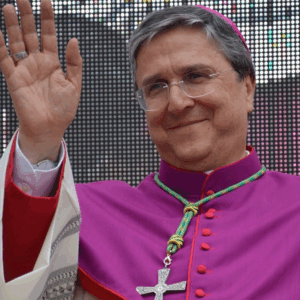
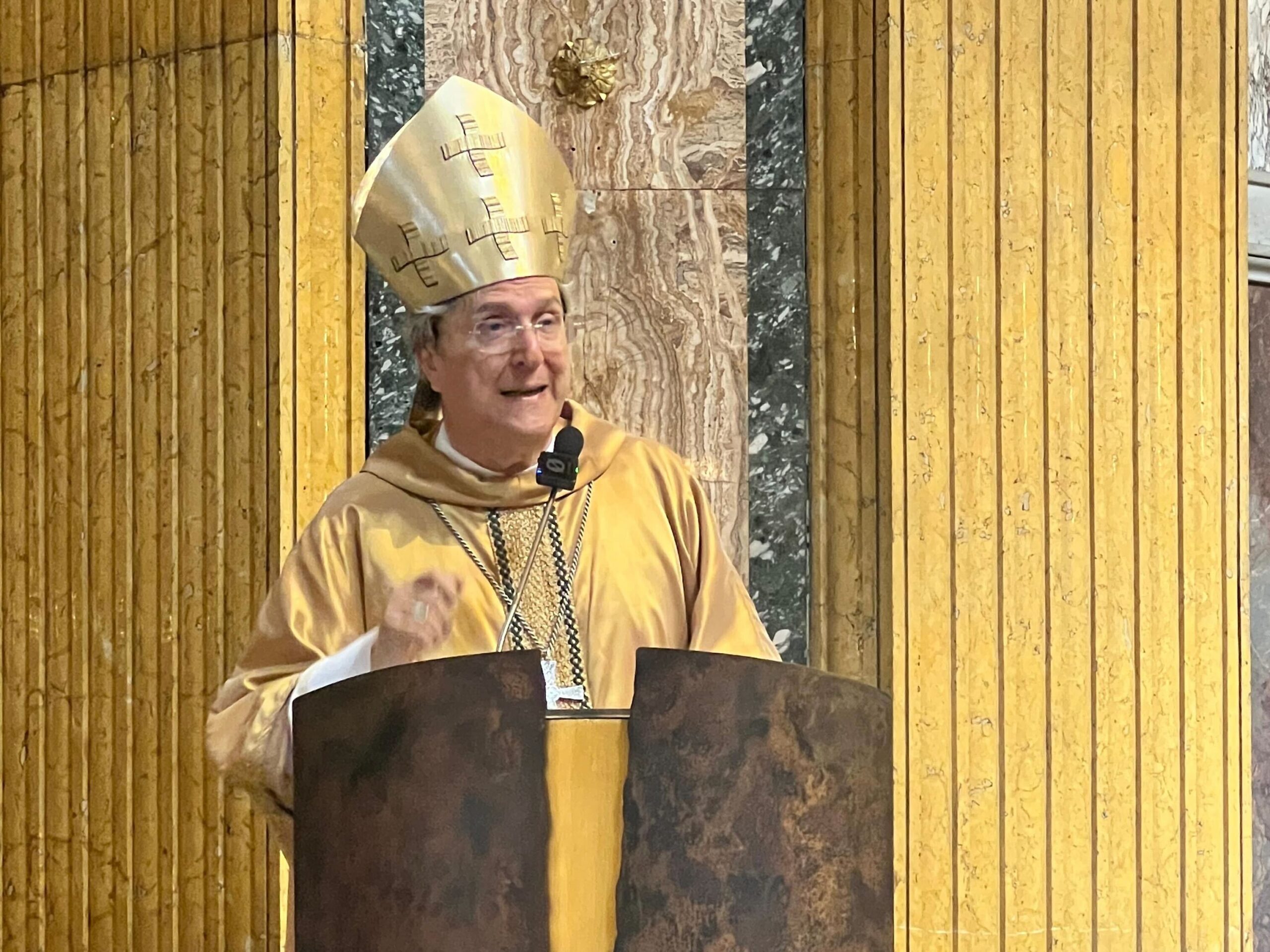
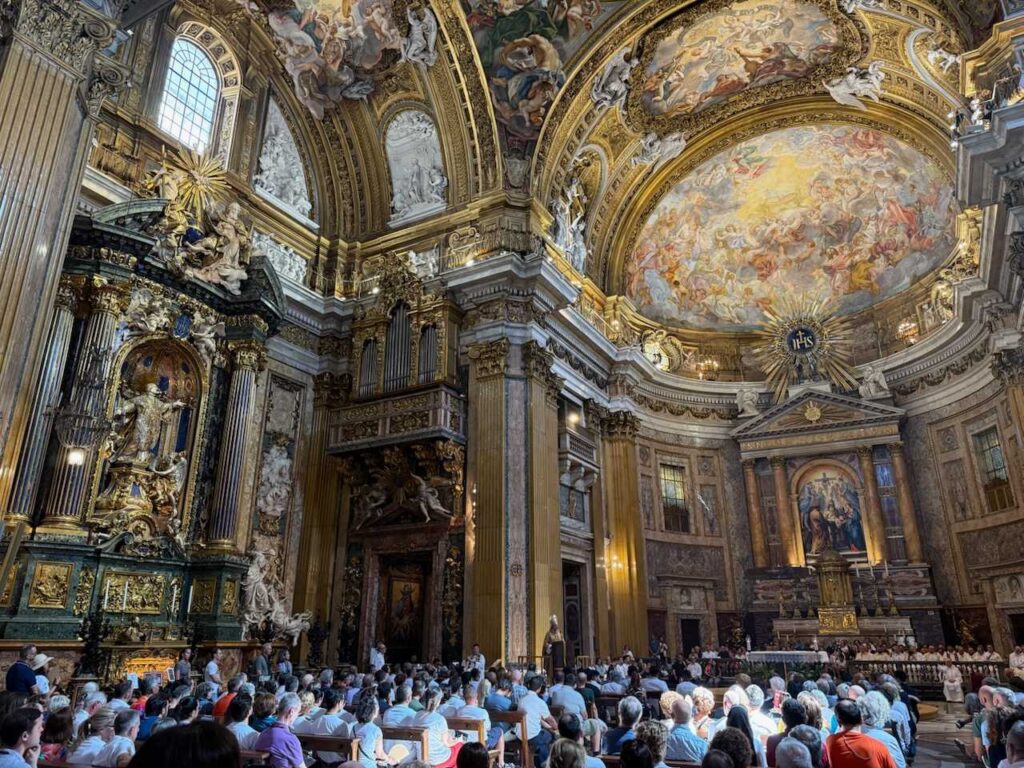
Editor’s note: The Most Rev. Francesco Savino, bishop of the Diocese of Cassano all’Jonio in southern Italy and a vice president of the Italian bishops conference, preached during a Mass at the Church of the Gesù in Rome for a gathering of international LGBTQ Catholic pilgrims, their friends and families on Sept. 6, 2025. The Mass was part of a Jubilee Year celebration hosted by the Italian organization La Tenda di Gionata. A transcript of the full homily as preached, translated from Italian into English by Harry Rose, is below.
Before sharing what the Word of God generated in me and what the Spirit generated in me, I’d like to obediently listen to its action and invite you all to look at each other. Look at each other! Look at each other! We are a group of faces facing. We are a group of real stories. We are a group of people that ask with dignity and authenticity and truth to be recognized. Each one with their own story. Each one with their own wounds. But each with their own beauty, with the beauty that lives within each of us, regardless of our fragilities. And we want to leave this celebration more joyful and more hopeful than ever. We want to leave convinced that God loves us, of a singular and unique love, of an asymmetrical love, of a love without conditions.
For me, the true foundation of hope takes root in this knowledge: not an illusory love that becomes an anesthetic to the conscience, but that which pours from a singular and unique love and founds itself on that.
We must make hope walk in a world of despair, make it walk braving the dawn, braving the dusk, regardless of the night.
Brothers and sisters, let’s make hope walk on our legs, each of us by their own accord, but all of us together nurturing and carrying forward this hope that the world—and myself first and foremost—so vitally needs. The great church father Isidore of Seville said so when he said that in the word “Spes”—“hope”—there’s the word for “feet”—“pes.” Hope always has something to do with our legs, with our feet. We must make hope walk in a world of despair, make it walk braving the dawn, braving the dusk, regardless of the night. I invite myself and all of us to attest that we are all beggars of hope.
But for those who believe, hope is a story. Hope is a name. Hope is Jesus of Nazareth, our Messiah, the Son of God. And it was beautiful, brothers and sisters, that the sprinkling of the baptismal waters that signaled the beginning of our Eucharist let our eyes glimpse what truly unifies us.
What unifies us?
The love of Christ that reigns amongst us, giving us an indelible dignity. I emphasize: an indelible dignity like the apostle Paul said in the letter to the Galatians (Gal 3, 26-28): “A small step, in the midst of great human limitations, can be more pleasing to God than a life which appears outwardly in order but moves through the day without confronting great difficulties.”
Pope Francis wrote these words in Evangelii Gaudium no. 44 and these words remind us of what God can realize in our lives and that which he realizes comes before any human ideas. God, only God, the God of Jesus Christ, works by way of his church. He shapes that for all as an invitation and sign rooted in our common humanity.
We can resist or accept the work of God, which in Christ is completed but not concluded. This is important: in Christ the work of God is completed but it is not concluded. God still works. Just look at each other’s faces. How I like to look at all your faces. Someone is crying, someone is smiling, someone is sad, someone is hopeful. But our faces are like that. They express the paths of our lives.
Now we realize where we are from and what we are living out this morning: to bear witness and to move ourselves. Yes, to move ourselves, meaning to let ourselves be moved by the action of God that Jesus called the ”Kingdom of God.” There is no other Gospel. There is no Gospel other than what Jesus announced. “The Kingdom of God is at hand.” It’s here, in our midst. From the start, obviously, this implies a question: “What should we do about this Kingdom of God in our midst?” The answer is always the same: “Convert!” I must convert myself first. We all must convert, meaning turn, look in the opposite direction from before.
Now we realize where we are from and what we are living out this morning: to bear witness and to move ourselves.
The Acts of the Apostles document this experience as defining and definitive. The church of Jesus doesn’t flow from the initiative of the Apostles, but from the work of God that Peter and the Apostles accept. The only ‘doctrine’ the Apostles must obey regards Jesus the Crucified, now raised, the stone pushed aside by religious, cultural and political power, but which God placed as a cornerstone. It happens like this in history that all those pushed aside, like Jesus, become cornerstones.
In the reading selected for this Eucharist we heard the expression of Peter (Acts 10:25-30, 33-35, 44-48). I invite you all to reflect deeply on this expression that better expresses the relationship between church and Revelation, between church and Jesus resurrected, between church and doctrine.
Peter says: “In truth I am realizing that.”
Each of us—you all here, your families, your brothers and sisters, us pastors and disciples of God—each of us has had to accept or reject a living truth in our lives. We recall when Pope Francis said, “reality is greater than the idea,” (Evangelii Gaudium) preferring reality over prejudice. I emphasize: in preferring reality over prejudice, God can enter. In making ideas the opponents of reality, the ideas themselves corrupt and kill. How many ideas have killed in the history of men and women?
It’s the difference between a living truth and a dead truth: the living truth enlivens, the dead truth kills.
It’s the difference between a living truth and a dead truth: the living truth enlivens, the dead truth kills.
Together, all together now, we can pray: Jesus, you are the way, the truth and the life. Because you come before your church, you come before all of us, asking Peter and the Apostles to place the living truth above the dead truth. The holy word of Peter still inspires each of us, to the extent that it is able: “In truth I am realizing that.”
Lord, lead us not—lead me not—into temptations of ideology or polemic, from a preconceived action based on prejudice, because we only want to follow and to serve you so your kingdom may come and nobody will feel excluded anymore. Nobody should feel excluded. I emphasize, nobody excluded. Nobody should fear it as a threat. May your kingdom be the life of life for everybody, everybody, everybody. Jesus—way, truth, life—make our church, of which we are a part, yours once again.
Dear brothers and sisters, the way in which the apostle Paul speaks about ancient law, which he studied for years with great intensity, can help us. There is no gift from God that is given without a reason. Even that which can feel confining with time, even that about which we have to say or to yell “Stop!,” because we have grown and it has hurt us, has its pedagogical place, and not only God’s gifts. I’d add our sins. We must confess them and discover that they can become a “felix culpa,” a happy fault, when God transforms places of death into jumping off points.
This logic, which is not to be used to justify evil or unjustifiable slowness, takes us to the heart of the Jubilee in the Hebrew tradition. Just read the first covenant, the Old Testament, and just read that which Jesus—which we heard in the Gospel a moment ago—proclaimed in the synagogue, that beautiful passage from the fourth chapter of the Gospel of Luke (Luke 4:16-21).
Brothers and sisters, I say with emotion: it is time to restore dignity to all, especially those to whom it has been denied.
The Jubilee—what was it? What was the Jubilee? It was the year of the restitution of lands to those from whom they had been taken. The Jubilee was the forgiveness of debts and the freeing of the slaves and prisoners. The Jubilee was the time to liberate the oppressed and restore dignity to whom it has been denied. Brothers and sisters, I say with emotion: it is time to restore dignity to all, especially those to whom it has been denied.
[Long applause]
I need to breathe for a moment…
I was pleased by what the Cardinal Archbishop of Madrid José Cobo wrote and said:
The human person and their dignity must be the point of reference for all Christians. Christian communities, even those walking with and concerned about avoiding every form of unjust discrimination and process that dehumanize, cannot merely stop at acceptance. Christian communities are called to promote a culture of dialogue, of accompaniment and of concrete conclusion of those who desire to walk into the Church. We are opening new doors towards this, new pastoral outlooks that favor understanding and help us to all feel filled with hope.
Brothers and sisters, it is clear that we cannot cancel out the past, we cannot rip out the painful chapters from our lives, we cannot hide our own stigmata, but God saves through transformation.
The risen Jesus, recognizable by his wounds, is the name of God. We are here in Rome, at the tombs of the Apostles, in communion with Pope Leo XIV, to cross through that one holy door that is Christ. He repeats to me, repeats to you, repeats to us, repeats to all of you: “I am the door.”
Through him, one enters into the life and concretely—we hope, we desire—into the life of the church, which in its human dimension and corresponding attention wants to and must be the anticipation of eternal life. This is how Peter taught us to re-believe, the apostle Paul, to overcome ourselves. From before Christ to after Christ, this is the conscience of Paul, this is the New Testament, this is the Jubilee of Hope.
“In Jesus we see, and from Jesus we hear, how everything changes because God is king, God is close to us.” These are the words of Pope Leo at the Vigil of Pentecost.
[Pope Leo] said…“Go and celebrate the Jubilee organized by Tenda di Gionata and the other groups that work with brothers and sisters,” who are all of you.
Allow me a worthy parenthesis: on August 7, I had a private audience with our pope, Pope Leo, a meeting from which I went home calm, joyful, filled with hope, filled with beauty. Because—and I say this with much sincerity—Pope Leo is the pope of listening. When you meet with him you will see it: he is a pope of listening, a pope of beautiful Augustinian spirituality. He is a son of St. Augustine. And when I shared with him that I was coming here to celebrate the Eucharist, he said with great tenderness—I’m not just saying this, believe me—with a great tenderness, with a sweetness, he said, “Go and celebrate the Jubilee organized by Tenda di Gionata and the other groups that work with brothers and sisters,” who are all of you.
This made me feel, believe me, a joy characteristic of the fruit that is faith in Christ, fruit of the encounter with Christ, fruit of a maternal and a paternal church. And these words of Pope Leo help us to better enter—I’m coming to the end—into the liberating mission of Christ: “He has anointed me to announce the good news to the poor […] To proclaim deliverance to the prisoners and sight to the blind, to set free the oppressed, to proclaim the year of God’s grace” (Luke 4:18-19).
Pope Leo continued at the Vigil of Pentecost: “Here tonight, we sense the fragrance of the chrism with which our foreheads have been anointed. Dear brothers and sisters, baptism and confirmation united us to Jesus’ mission of making all things new, to the Kingdom of God. Just as love enables us to sense the presence of a loved one,”—when you love, you sense the fragrance of the beloved, right?—“so tonight we sense in one another the fragrance of Christ. This is a mystery; it amazes us and leads us to reflect.”
Dear Pope Leo, it’s true, it’s so. And here, too, today, this morning, in this beautiful Church of the Gesù, we breathe in this fragrance, we breathe in this amazement and we feel—and here I conclude—authorized to hope because we are able to love selflessly. Amen.
May it be so. A good trip to all of you.