Throughout the six weeks of Lent I will share some of my own artwork and stories inspired by many of my most beloved saints. These people rose above the limitations put upon them by a cruel and unjust world that pushed them to the margins in order to exemplify the principles of Catholic Social Teaching. These holy people can inspire us to remain prayerful, calm and hope-filled in the midst of anxiety, anger and fear.
Welcome these beloved holy figures into your Lenten prayer routine. They are ideal spiritual companions and guides for the LGBTQ community as well as immigrants living in fear, unhoused people living in poverty, the mentally and physically challenged, the lonely and abandoned and anyone seeking awareness of God’s loving presence in their daily lives. They will remind you that you are not alone in these troubled and troubling times.
Holy Mary, Mother of God


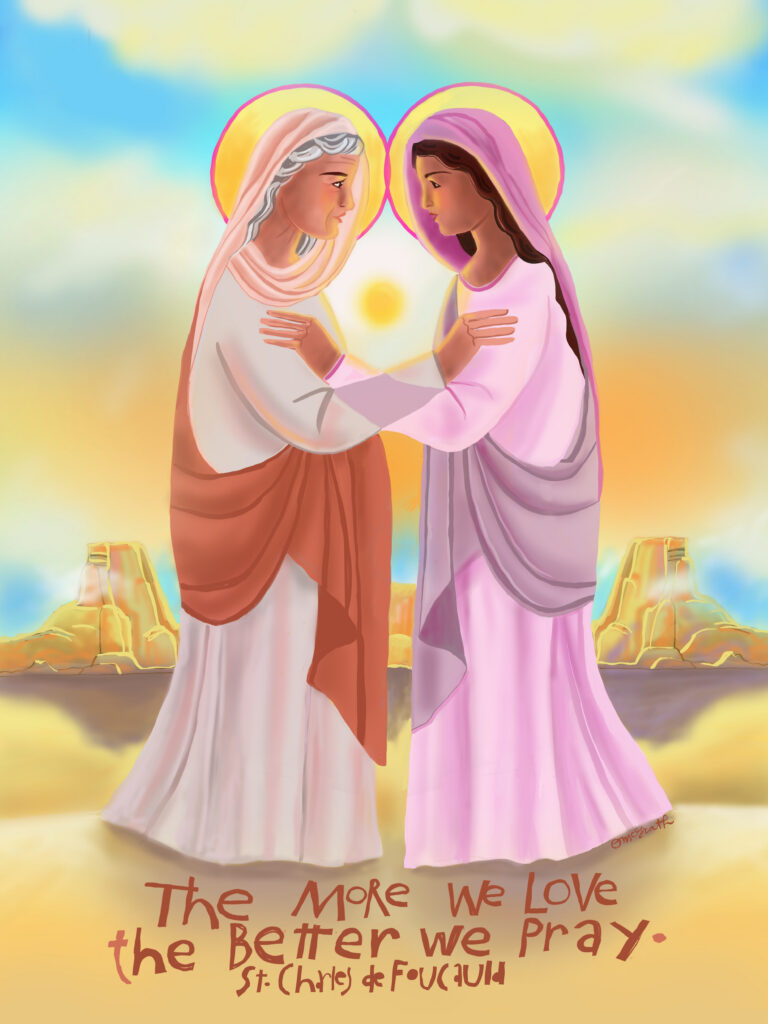
Our Lenten series on the saints concludes in Holy Week with Mary. Over the years I have painted more images of her than any other saint, publishing two books of art and reflections on our mother. For me, Mary represents the eternally life-giving face of God’s divine presence always in our midst.
Each of the five saints from this series remind us of the timeless relevance of Mary’s bold Magnificat, as well as the basic principle of Catholic Social Teaching: respect for all people regardless of who they are, what they look like or whom they love.
For many years, Minneapolis has been a city near and dear to my heart. George Floyd’s murder on May 25, 2020 filled me with tremendous grief and sadness. The Annunciation school shooting on August 27, 2025, sickened my heart with grief. Each of these tragedies sent a forceful reminder that our human family is in crisis. We are living in a house divided by fear, anger, hatred and greed. As an artist, I respond to these horrific events by creating images of hope and beauty. There are my visual prayers for peace. Very often, Mary is the source and subject matter that emerges. She is the icon of gentle strength.
For me, Mary represents the feminine, eternally life-giving face of God’s divine presence always in our midst.
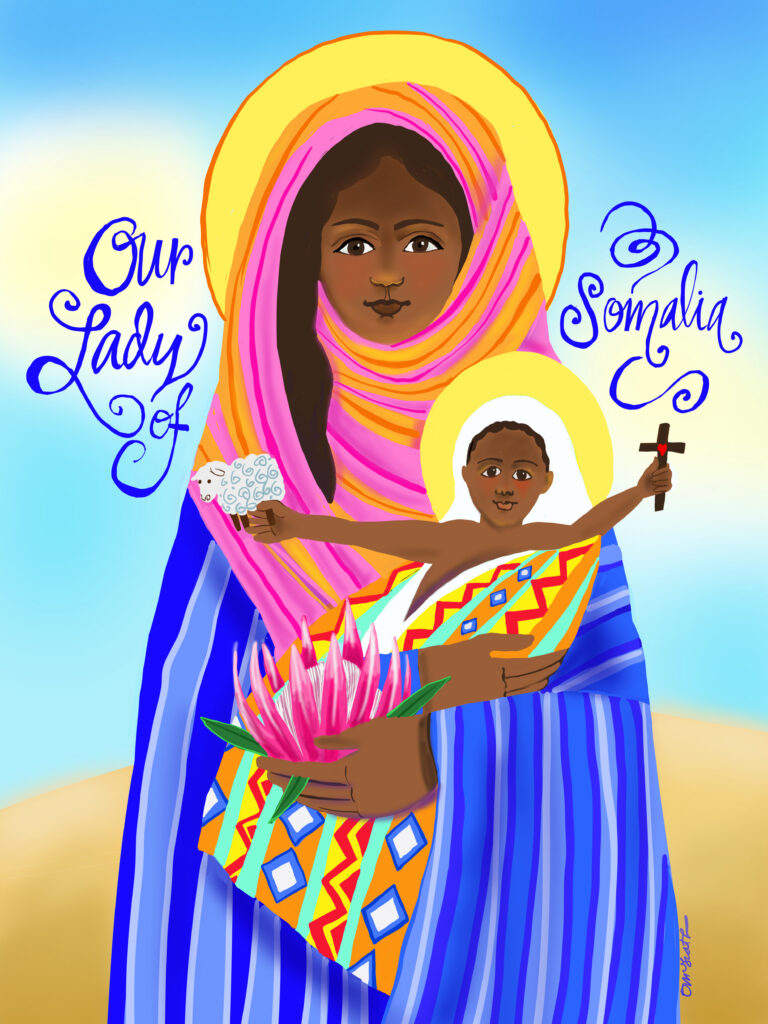
Minnesota is home to the largest population of Somalian refugees and immigrants in the country. When the president referred to them as garbage, I immediately began praying and got to work. I researched traditional Somalian fabric patterns and styles. In the first image above, I chose to wrap Mary and Jesus in their bold, vivid colors. Jesus, his arms outstretched like a cross, holds a toy sheep in one hand and a crucifix in the other. Mary, who has various flowers in her repertoire of symbols, holds the national flower of Somalia in her hand: the king protea. Crown-shaped, this flower symbolizes change, transformation and hope. How appropriate, I thought, as I savored the opportunity to create beauty in the midst of such ugliness.
When ICE agents took Liam Conejo Ramos and his handcuffed father off the streets of Minneapolis, it was time once again to draw on divine inspiration. In the second image above, Jesus wears the same blue hat as that little boy seen in photos that went viral across the world.
Mary holds the Christ child in her lap while children of immigrants come to meet them and seek their comforting, heavenly peace. Jesus extends a sunflower as a sign of hope, waiting for us at the end of all of our storms. Snow and ice remind us that thousands of people came out in sub-zero weather to protest the injustice and cruelty perpetrated against the children of God.
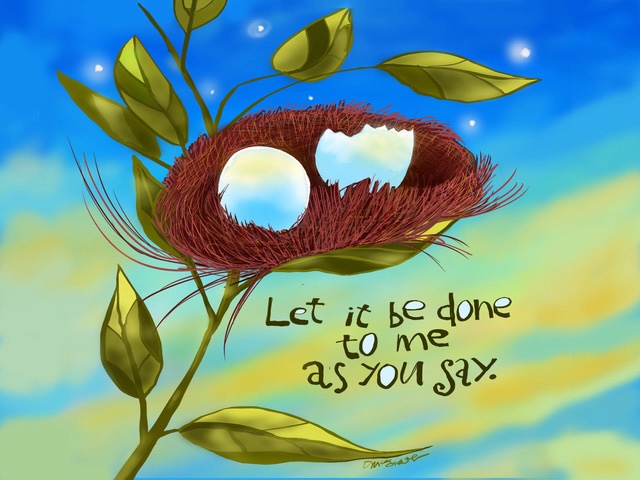
Our series began with Alfred Delp, the Jesuit priest imprisoned, tortured and executed by the Nazis. He was in his jail cell throughout the Advent and Christmas seasons and secretly wrote that Mary was his biggest source of inner peace while waiting for his death. He wrote that Mary was for him a symbolic figure of courage. “These times through which we are living carry the blessing and mystery of God”, seen in our third image, are words as relevant today as they were in Alfred Delp’s time.
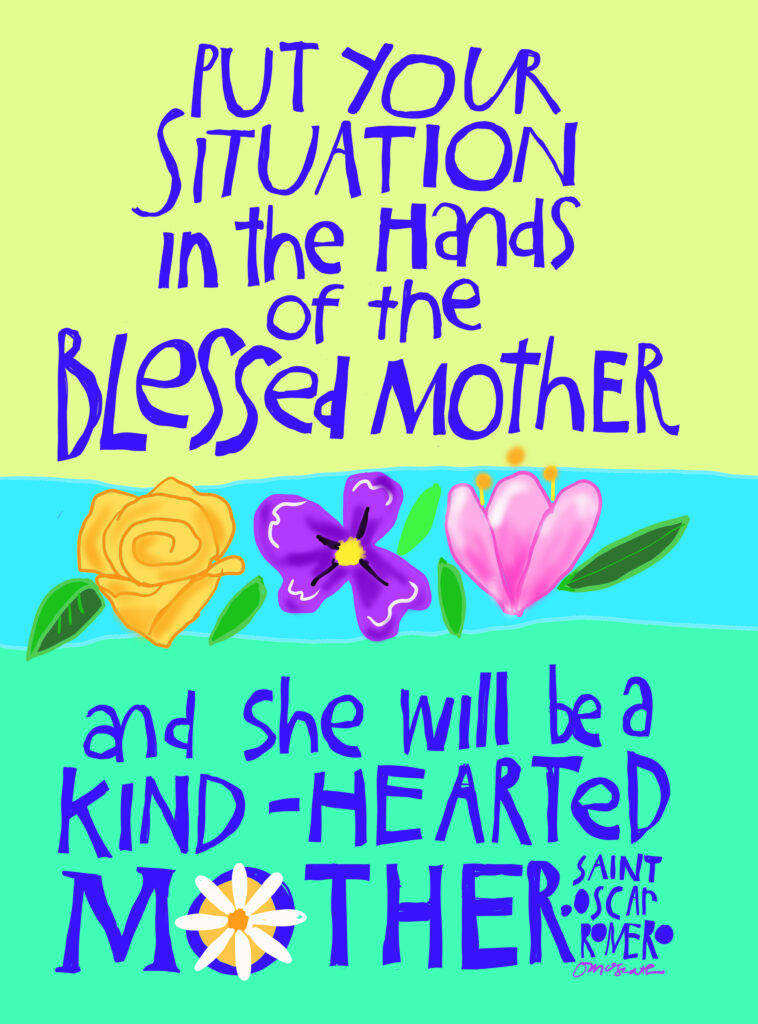
During St. Óscar Romero’s time as archbishop in El Salvador, he was constantly surrounded by violence, torture, abuse, fear and turmoil. Yet he never lost hope in the eternal presence of God’s love and justice. He once said, “A bishop will die, but the church of God, which is the people, will never perish.” He put life and concerns into the hands of Mary, who shared with him the undying kindness of her motherly heart.
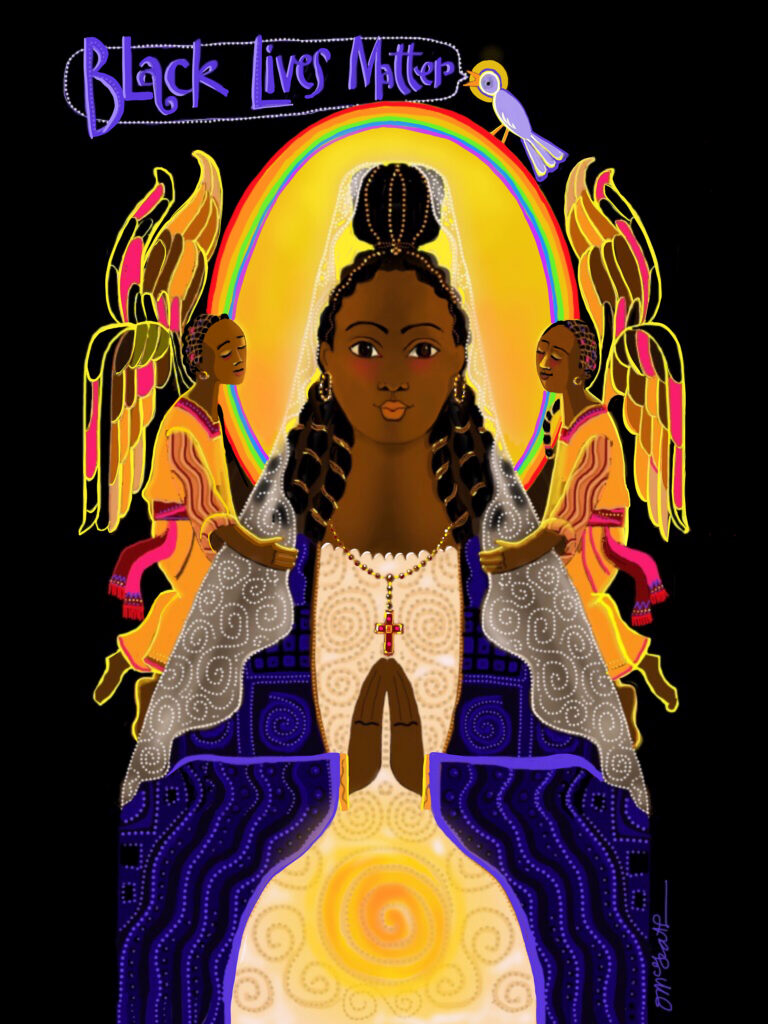
The Black Lives Matter movement came about long after Servant of God Thea Bowman’s death, but it is definitely reflective of all that she worked for, especially during the heights of the Civil Rights movement. The message of the Gospel is clear: we must not fear diversity, but rather love diversity because each human being is made in the image and likeness of God.
For LGBTQ people and for all who long to belong, Mary gathers us as beloved children.
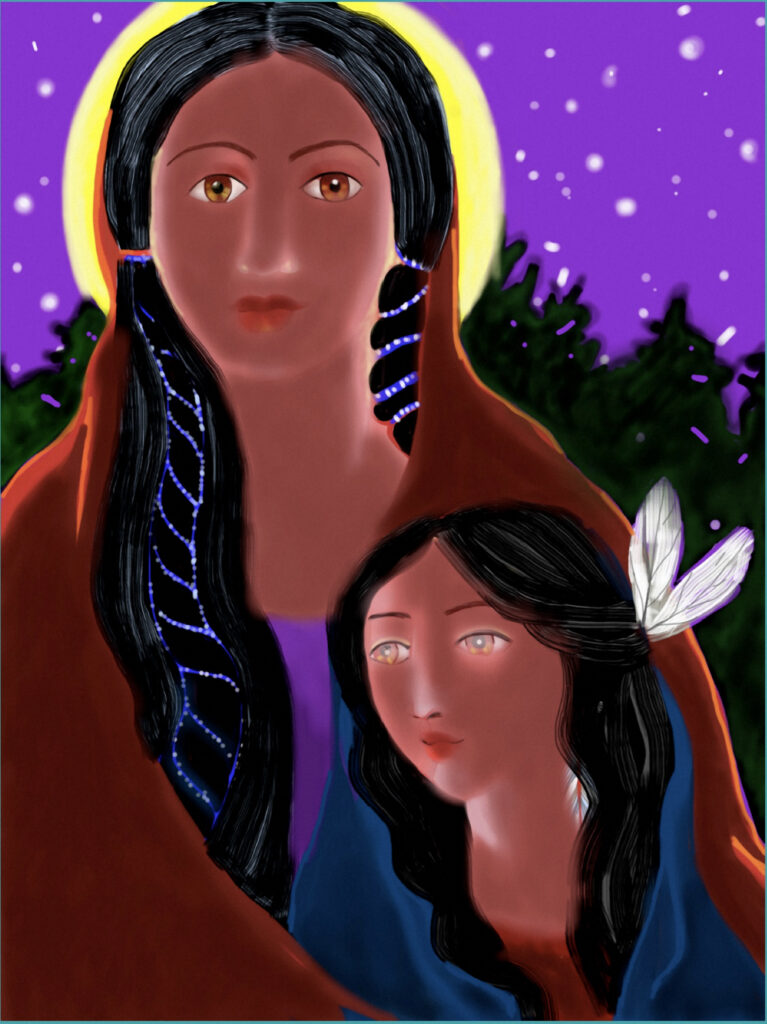
St. Kateri Tekakwitha was orphaned at the age of four when her parents died from the hideous effects of smallpox. Her mother was an Algonquin woman taken prisoner by the Mohawks during one of the many wars fought between the two indigenous nations. When the Jesuits brought the Gospel to her village, Kateri learned of Jesus and his mother. Mary was known as “Wari” in the Mohawk language, and she became for Kateri the mother she never knew, as well as the beloved proof of God’s maternal love for us.
Lastly, St. Charles de Foucauld chose the story of the Visitation of Mary and Elizabeth as one of his chief inspirations to live in the Sahara Desert. Just as Mary carried Christ in her womb, he wanted to carry Christ in his heart to all the people he encountered, regardless of faith or religion. And just like Elizabeth, he wanted to feel the deep presence of Christ within himself, as she did when John the Baptist leapt for joy inside her womb. As St. Charles and all the saints have taught us: “The more we love, the better we pray.”
This Lenten journey now brings us back to where it has always been leading: to Mary, and through her, to the quiet but unshakable promise of God’s presence among us. In a world so often marked by division and wounded by injustice, she stands as a living reminder that love is still stronger and hope is never in vain. For LGBTQ people and for all who long to belong, Mary gathers us as beloved children. And with her, and with all the saints who have walked before us, we are invited to become what we behold: bearers of Christ’s love in a broken world.
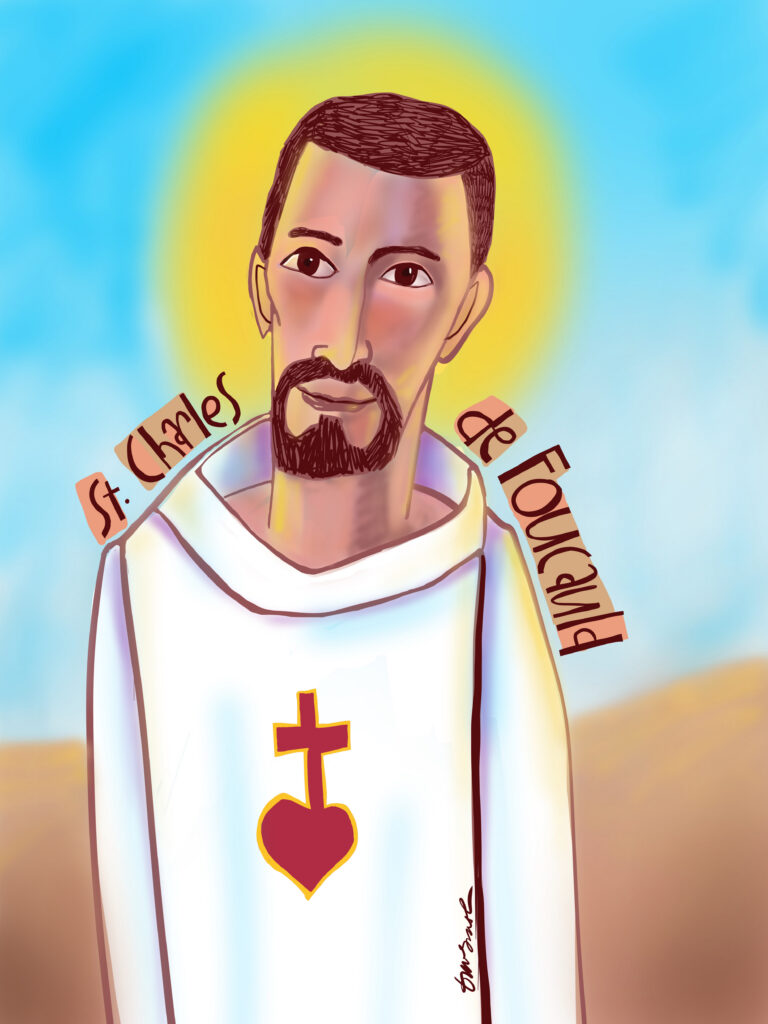
St. Charles de Foucauld (1858- 1916)

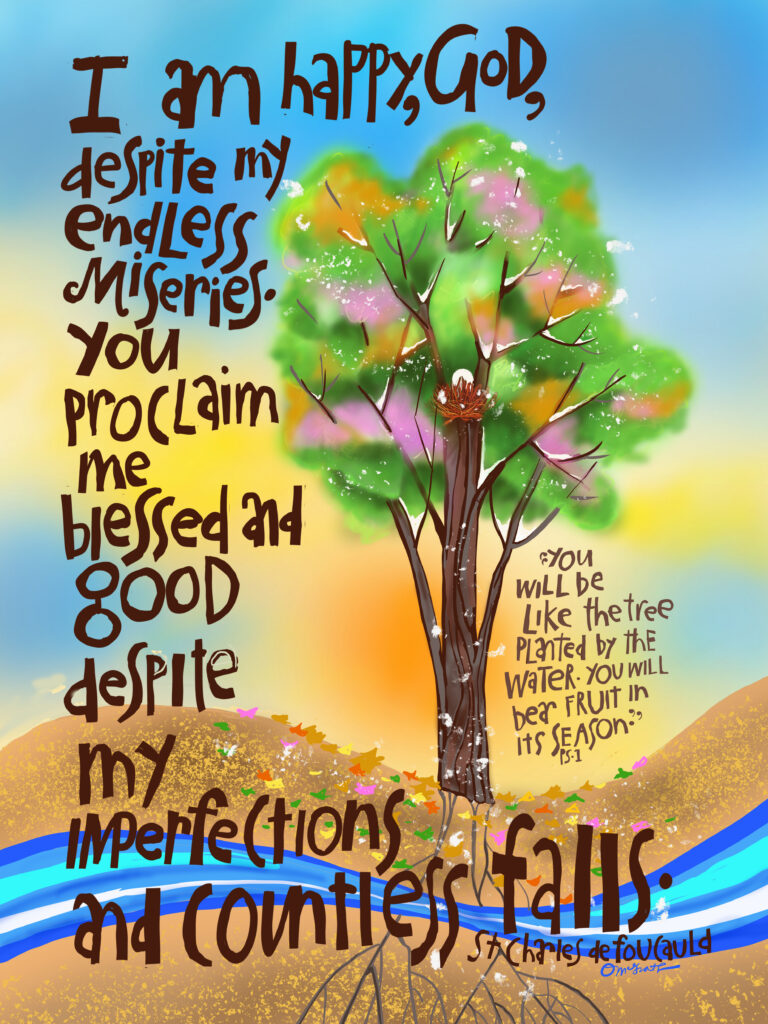

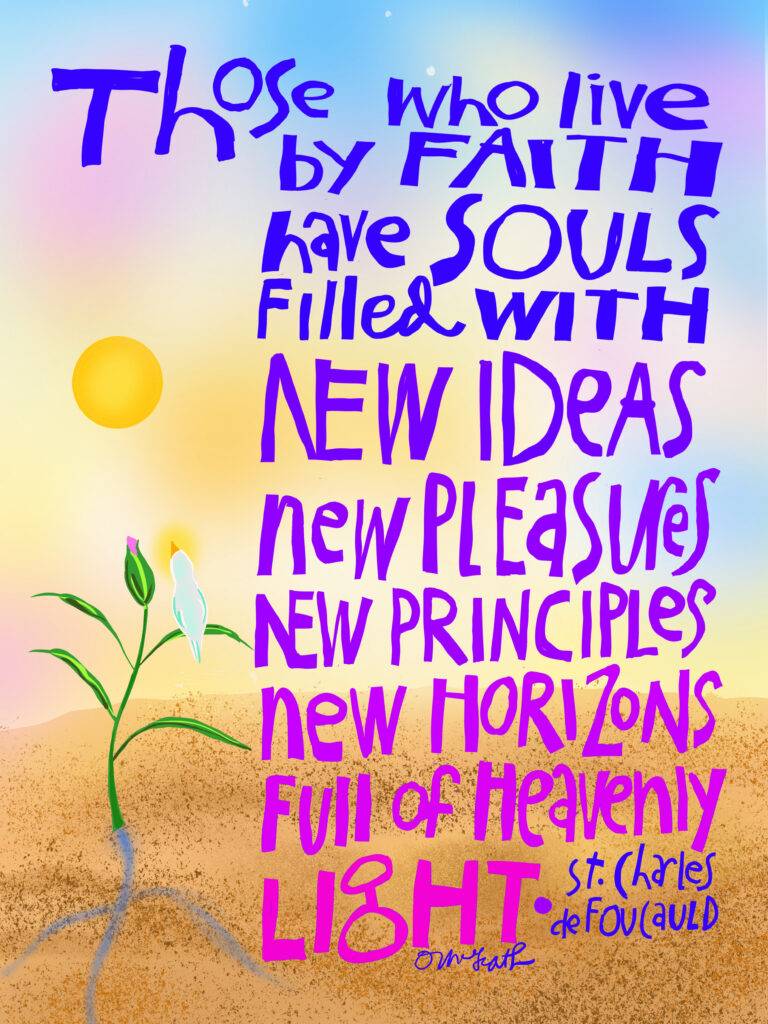
I am sure that each one of us knows what it is like to live in a desert at different times in our lives. Maybe not in a literal desert like St. Charles de Foucauld did in the Sahara, but in a spiritual or emotional desert in which we are weighed down by fear, loneliness and uncertainty. It is both a part of being human and a part of being a Christian—especially in Lent. During these 40 days, we enter the desert within us, leaving behind abandonment and weariness to rediscover the comfort and companionship of Christ.
St. Charles de Foucauld first captured my attention when he was canonized by Pope Francis in 2022. Like most of the saintly people who fascinate me, his life was characterized by restless searching in his early years and contemplative peacefulness in his later years. He was orphaned at seven; raised by his wealthy grandfather who left him a sizeable inheritance when he was twenty; expelled from a boarding school as a misbehaving teenager; lost his faith; joined the French cavalry and stationed in Algeria, where his love for the Sahara was born. He eventually exchanged that military desert life for the Parisian nightlife, where he lived as a rich and privileged playboy, flaunting his mistresses and money.
Charles wanted to be with the people who were “the furthest removed, the most abandoned” by the world.
Yet his restless yearning was never satisfied. He loved the Sahara ever since his military days and was always impressed by the devout lives of the Muslims he met there. So, Charles ventured back there to explore it more fully. At the time, Europeans were denied entry into Morocco, so he disguised himself as a Jewish rabbi and wandered the desert for a year, begging for food and shelter. Charles grew to love the mendicant lifestyle and soon joined the Trappists.
While he was happy in the Trappist world, it didn’t satisfy his need for desert life. Ordained a priest at the age of forty three, Charles moved into a hermitage of his own and devoted the rest of his life to working with the Tuareg people of southern Algeria. He wanted to be with the people who were “furthest removed, the most abandoned” by the world. In 1916, while World War I was raging across Europe, Charles was shot and killed by a 15 year-old boy and his companions, who mistakenly believed Charles was hiding ammunition for the French army.
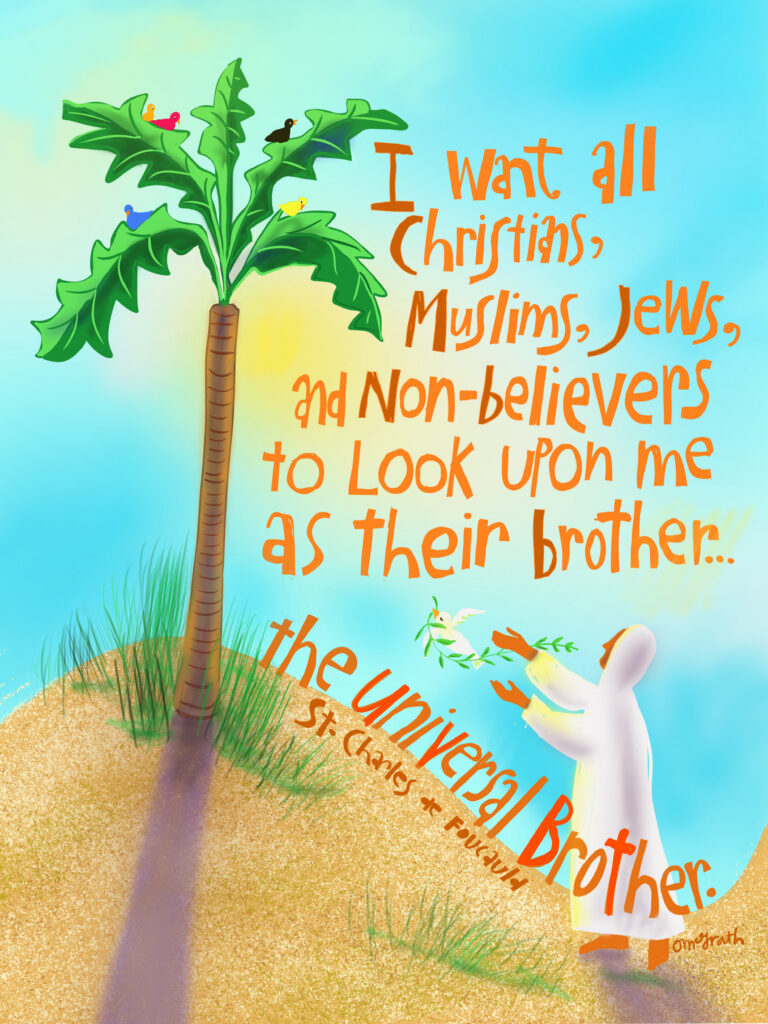
St. Charles chose to live his life in service to the Muslims he came to know and love in the Sahara region. His aim was never to convert them to Christianity, but to be a brother to them and a witness to the Gospel. Calling himself “the universal brother”, Charles shared everything he owned with his neighbors, no matter their faith. He was loved and admired by all who knew him and he even occasionally attended worship in a mosque with his Muslim friends. But he never lost his love and devotion for the Eucharist, a love which only increased with time.
Charles desired to emulate the so-called “hidden years” of Christ’s life, when he worked as a carpenter and lived with Mary and Joseph in Nazareth. The humility and simplicity of those years formed Jesus into the public man he would become. This inspired Charles more than anything else. Although he was ordained a priest, he never sought the accolades and privilege that came with that role. To Charles, manual labor and kindness to his desert neighbors was the key to imitating Christ. He learned the language of the Tuareg people, even creating a dictionary compiled of Tuareg words and phrases. He lived out the works of mercy as Jesus had instructed him to do.
To Charles, manual labor and kindness to his desert neighbors was the key to imitating Christ.
Charles chose the mystery of the Visitation of Mary and Elizabeth as the patronal image of the congregation of Little Brothers of Jesus, a community which didn’t form until twenty years after his death, when the Little Sisters of Jesus also became a reality. He said that just as Mary carried Jesus in her womb, we must each carry Him in our hearts so others can meet him—just like Elizabeth whose son, John the Baptist, leapt in her womb for joy.
One of the things I love most about St. Charles is the fact that he was a gifted painter who created an image of the Visitation which inspired my own version seen here. Charles had a special devotion to the Visitation, stating that just as Mary carried Jesus in her womb, we must each carry Jesus in our hearts so others can meet him within us—and hopefully leap for joy like John the Baptist within Elizabeth.
During his lifetime, Charles believed his mission had failed. He died in the Sahara with no followers and no religious community to carry forward his vision. Yet after his death, his writings and witness quietly took root. In 1933, nearly two decades later, the Little Brothers of Jesus were founded in France, drawing directly from his spirituality and desire to live humbly among the poor.
St. Charles de Foucauld never abandoned his talents and intellectual gifts but rather used them on his journey to wisdom, hope and joy. Reading about Charles and creating art inspired by his life and words has been a great blessing on my own spiritual journey. In the words of Sr. Thea Bowman, whom we looked at two weeks ago, I say to St. Charles, “Lead Me, Guide Me” through my own desert times and places.
St. Kateri Tekakwitha (1656-1680)
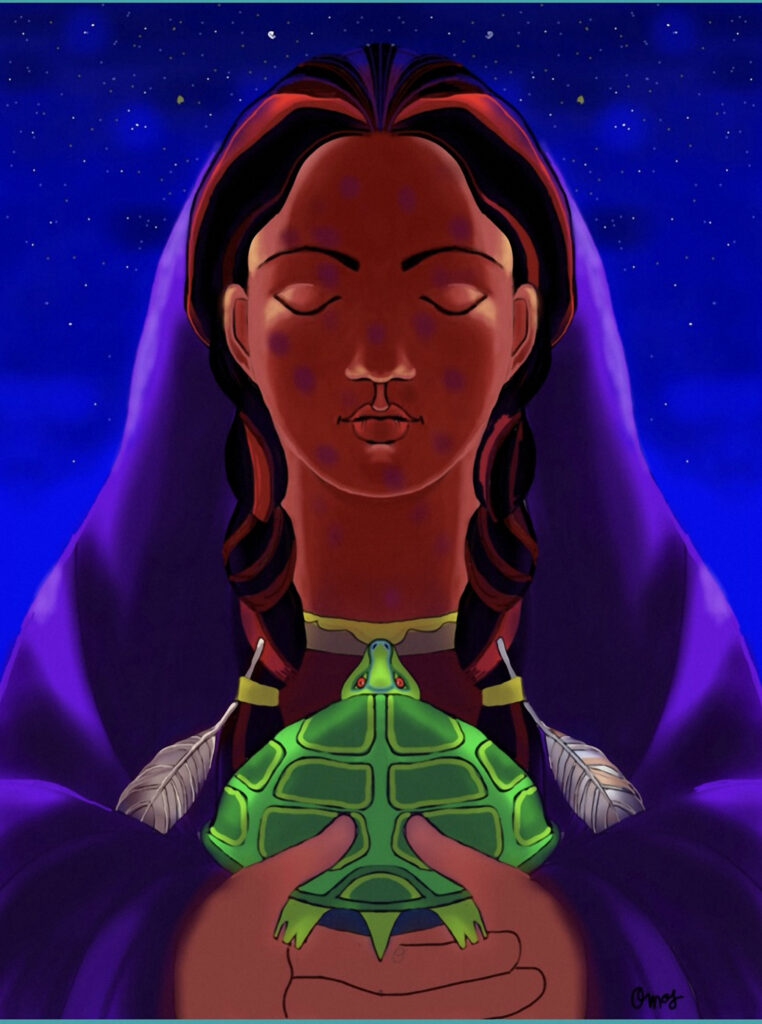

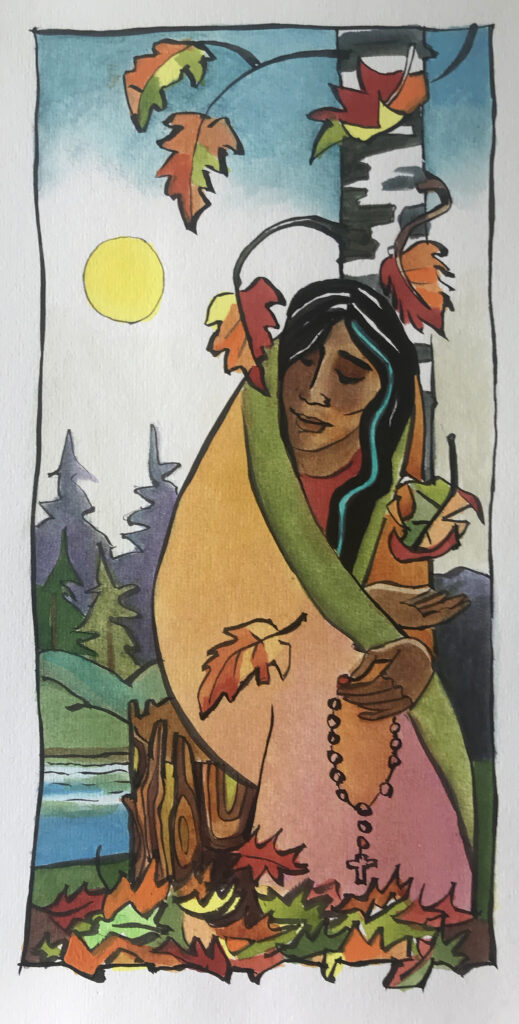

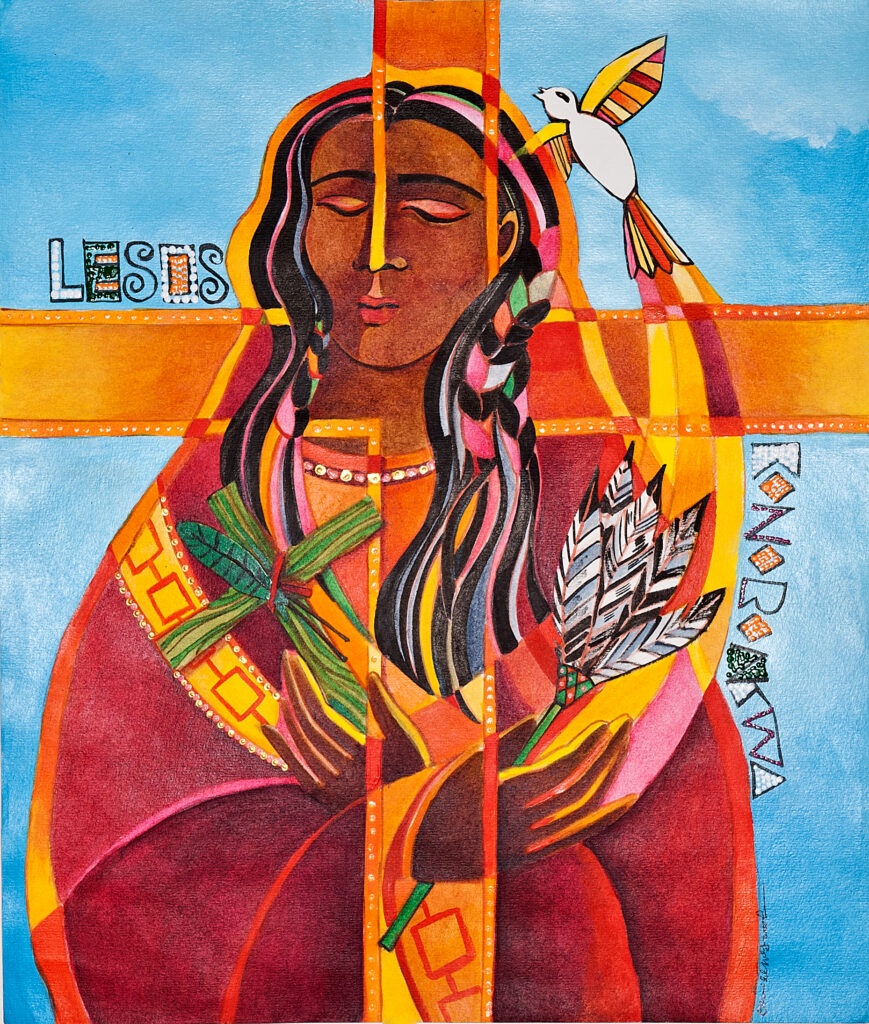
I have loved St. Kateri since I was a little boy, long before she was canonized by Pope Benedict in 2012. My devotion for her has only increased as I have grown older. It has evolved and deepened over the years since I faced the challenges and uneasy feelings of my young adulthood. As I come to the end of my sixth decade, I love her all the more for the wisdom and insight she has brought me in the span of time since my youth.
She has shared with me the wisdom of indigenous spirituality and the loving care for all of creation. Kateri has been designated a patron saint of the environment and as such she can teach us so much about our need to stay connected to the healing power of nature.
Kateri has shared with me the wisdom of indigenous spirituality and the loving care for all of creation.
During the era of colonization, historians estimate 90% of the indigenous populations of North America were wiped out by European borne diseases—such as smallpox, influenza and measles. Kateri’s parents and infant brother died during a smallpox epidemic when the French invaded present-day New York. Four-year-old Kateri survived smallpox, but as a result her face was scarred and her eyesight severely damaged.
Afterwards, she was called “Tekakwitha”, due to her need to walk with hands extended so she wouldn’t bump into things. In her Mohawk culture, disfigurements and disabilities were causes for marginalization and abuse, so from the time she was a little girl, Kateri knew firsthand the pain of being cast aside as the “other”.
As if that weren’t enough, to add to her inferior status, Kateri’s mother was Algonquin. She had been taken prisoner in a tribal war, and wasn’t Mohawk like Kateri’s father. Therefore Kateri was not accepted as a true blood member of the Turtle Clan of the Mohawks. She was considered “half breed” – to use modern, un-Christian terms.
In Native American spirituality, the turtle is a symbol of the sacred feminine aspects of life. The strong outer shell and soft interior represents wisdom, gentleness and patient endurance. The turtle is equally comfortable on land (physical) and in water (spiritual). They are gentle protectors of the environment. Kateri possessed these sacred qualities, explaining why today she is the patron saint of the environment and ecology.
When Kateri was eleven, she encountered some of the first French Jesuit missionaries in the new world—likely the first white people she ever met. Their sharing and preaching of the Gospel turned Kateri’s world upside down. She was baptized at the age of eleven, further alienating her from her people.
But—and this is why I love Kateri—she believed in herself and the very real presence of Christ in her heart and soul. In their annals, the Jesuits wrote that Kateri, who always had her face hidden by a shawl to hide her scars and protect her eyesight in the sunshine, was unlike any other young Mohawk woman of her time. Kateri responded to abuse and ridicule with gentleness and kindness—not revenge—reaching out to those in need with loving attention. She also withdrew into the woods every day to meditate and be renewed by nature.
When the abuse leveled at her grew more life threatening, Kateri followed the advice of her Jesuit spiritual directors and left present-day New York. She journeyed by foot and canoe, practically blind and with two guides and companions, to Kahnawake—near modern day Montreal. The St. Francis Xavier Mission was her home for the last four years of her life. She died in 1680 at age 24 due to complications from tuberculosis.
Her Jesuit companions prayed and sang at her deathbed, recording in their journals that the small pox scars vanished from her face fifteen minutes after her death. Kateri’s last words were “Jesos konoronkwa” which means “Jesus, I love you” in Mohawk.
Kateri’s last words were “Jesos konoronkwa” which means “Jesus, I love you” in Mohawk.
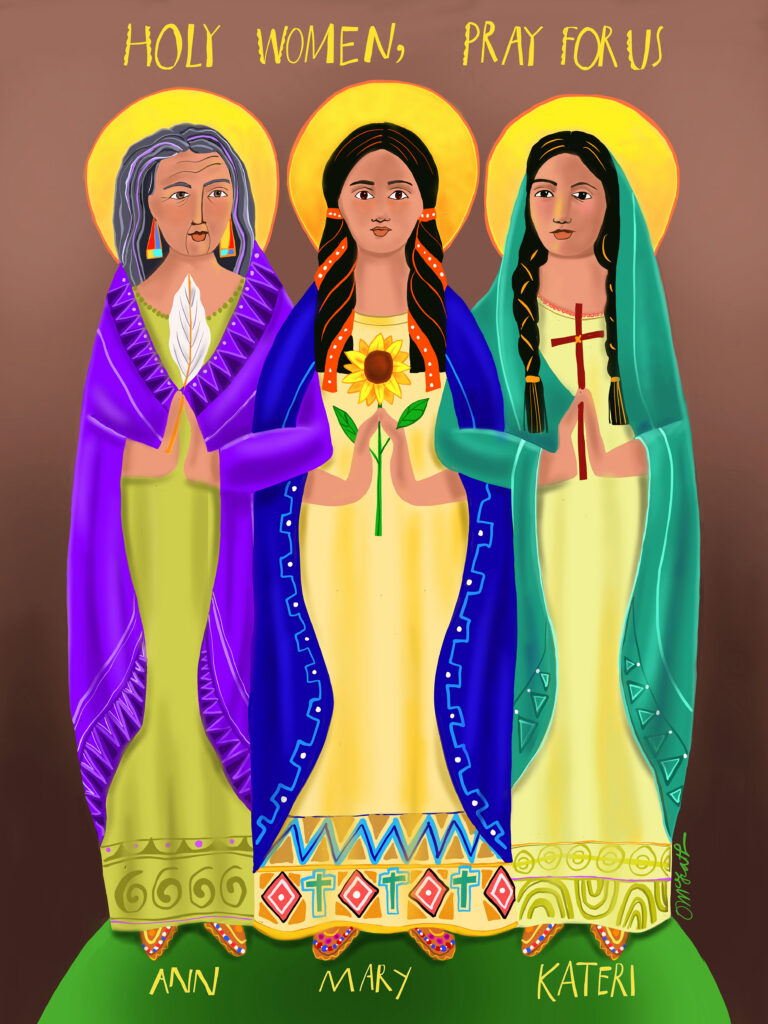
Over the next several centuries, Native Americans faced increasing hardship due to the extreme racism and social injustice perpetrated by the American government and by Christian institutions, including on Jesuits missions. On one of the last major trips of his papacy, Pope Francis visited Canada on a peace and reconciliation mission. Pope Francis asked all Canadians to pray every day to three women: St. Anne, the grandmother of Jesus; Mary, his mother; and Kateri Tekakwitha, whose final resting place is near Montreal. The healing journey is a long and winding road.
Because of her gentle and loving response to constant abuse and criticism, her love of creation and the way she found deep faith and hope in the midst of grief and despair, I find in St. Kateri Tekakwitha a powerful model of love and charity. She remained true to herself and offers inspiration to all who feel marginalized, neglected or abused, especially in the face of corporate and institutional evil. We need those virtues now more than ever in this troubled and troubling world.
Servant of God Sr. Thea Bowman (1937-1990)




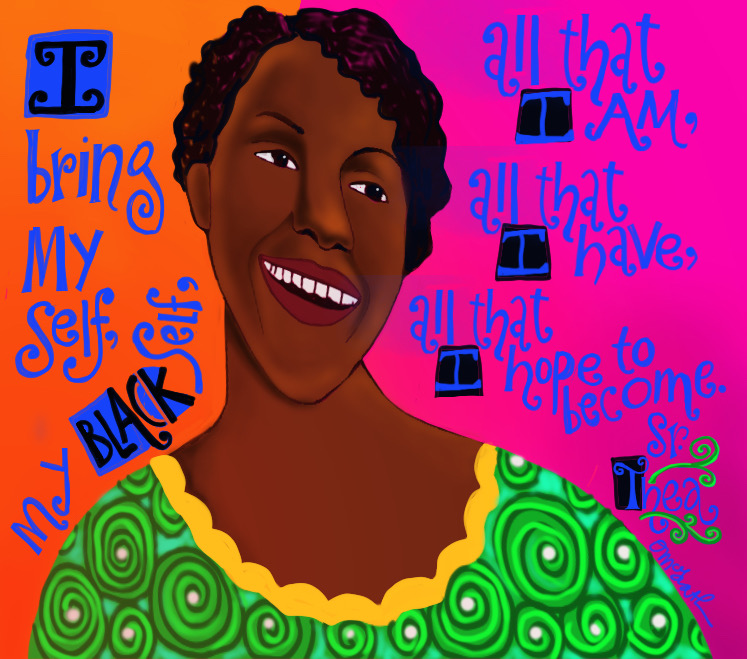
Sr. Thea is not officially a saint yet, but in my mind and heart I have already canonized her. Of the six amazing African-Americans in line for canonization, she is not only the most contemporary, she is the only one not born into slavery. She is a shining light of the civil rights and Vatican II era whose lovely voice rang out in song to unite hearts and bring people together in praise. Ever bold and confident, Sr. Thea was not afraid to simply be herself, no matter her audience nor the setting in which she preached the good news.
It was as if Thea spoke directly to me and said, “Listen and learn, I have just what you are looking for.”
I never heard of Sr. Thea until after she died when I read her final interview in US Catholic magazine in 1990. My father was dying at the time and my mother had died several years before. The unsettling thoughts of being a 35-year-old orphan who no longer felt called to the teaching ministry were very challenging. My self-identity was in a state of deep flux and Sr. Thea Bowman came to the rescue. As is the case with all of my favorite saints and heavenly BFF’s, it was as if Thea spoke directly to me and said, “Listen and learn, I have just what you are looking for.” And she has been doing just that for my spirit ever since.
Over the years, I have continued to deepen my relationship with Thea. I have visited her childhood home in Mississippi and her motherhouse in Wisconsin. I have met her childhood friends and fellow Franciscan sisters, all of whom happily shared with me their personal memories and stories of Thea. Stories like how she rose high above and beyond the narrow limitations put upon her for being both black and Catholic in the Jim Crow south—a double dip into hell—as well as being the only woman of color in her all white community. I have listened and loved Thea’s music and eloquent speech, her greatest gifts that fed her deep faith and abiding love for Christ.
Great saints and mystics across the ages have taught us that one of the secrets of being in good relationship with God is simply being our true selves and even better, loving our true selves. That is challenging for most people of any color in the best of circumstances, and even more so for this African-American girl who chose to become Catholic in the racist, hateful world of her childhood.
Thea was deeply inspired by the example of the Franciscan Sisters of Perpetual Adoration who journeyed to Canton, MS from La Crosse, WI in the 1940’s to open a Catholic school for the children of color forbidden by law from attending the public school for white kids. They not only opened her mind to great literature and writing (she eventually got her PhD in Literature from Catholic University), they also expanded the horizons of her heart and soul.
Servant of God Thea Bowman reminds each of us that love is the guiding force of God’s diverse universe.
As a gifted and soulful singer, music was Sr. Thea’s favorite way to communicate the messages of love, equality and social justice promulgated in the post-Vatican II church. She even enthusiastically sang from a wheelchair while stricken with cancer in her final years, getting her diverse audiences on their feet, swaying to the rhythm and singing “We Shall Overcome”. Her final speech was at the gathering of the United States Conference of Catholic Bishops with whom she shared a very prophetic vision of the synodal church as seen in her words illustrated above. Thea died on March 30, 1990.
Through her eloquent speech, soulful music and charismatic presence Servant of God Thea Bowman reminds each of us that love is the guiding force of God’s diverse universe; that each of us has a little light within and we must let it shine, let it shine, let it shine.
St. Óscar Romero, Archbishop of El Salvador(1917- 1980 )

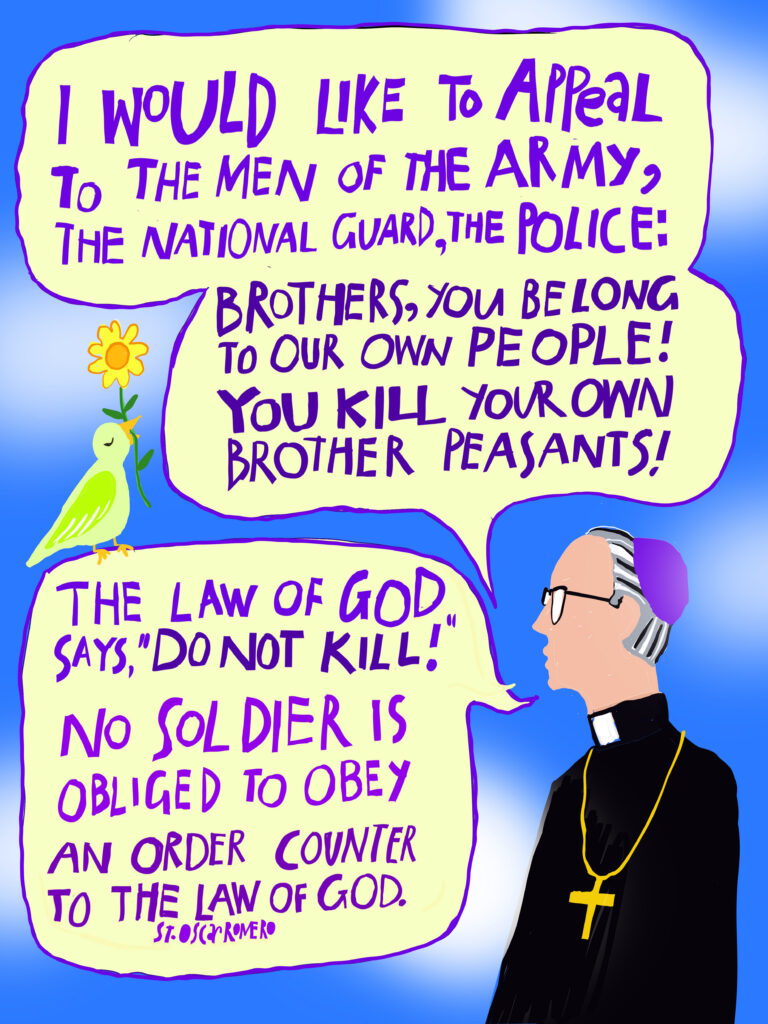
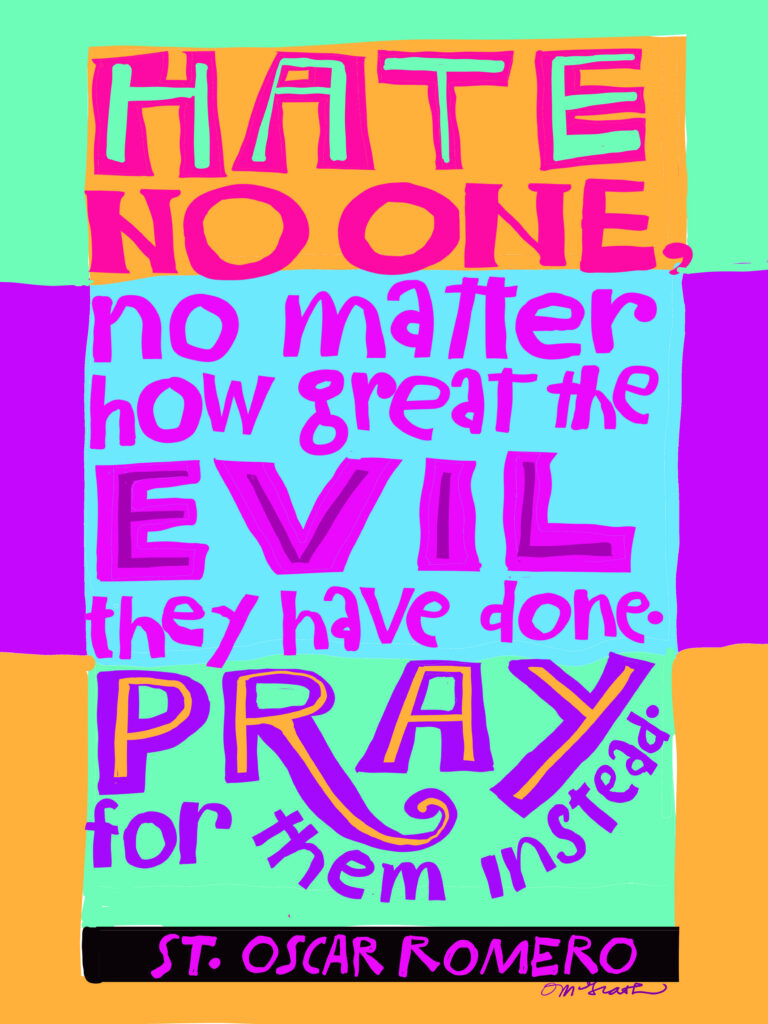
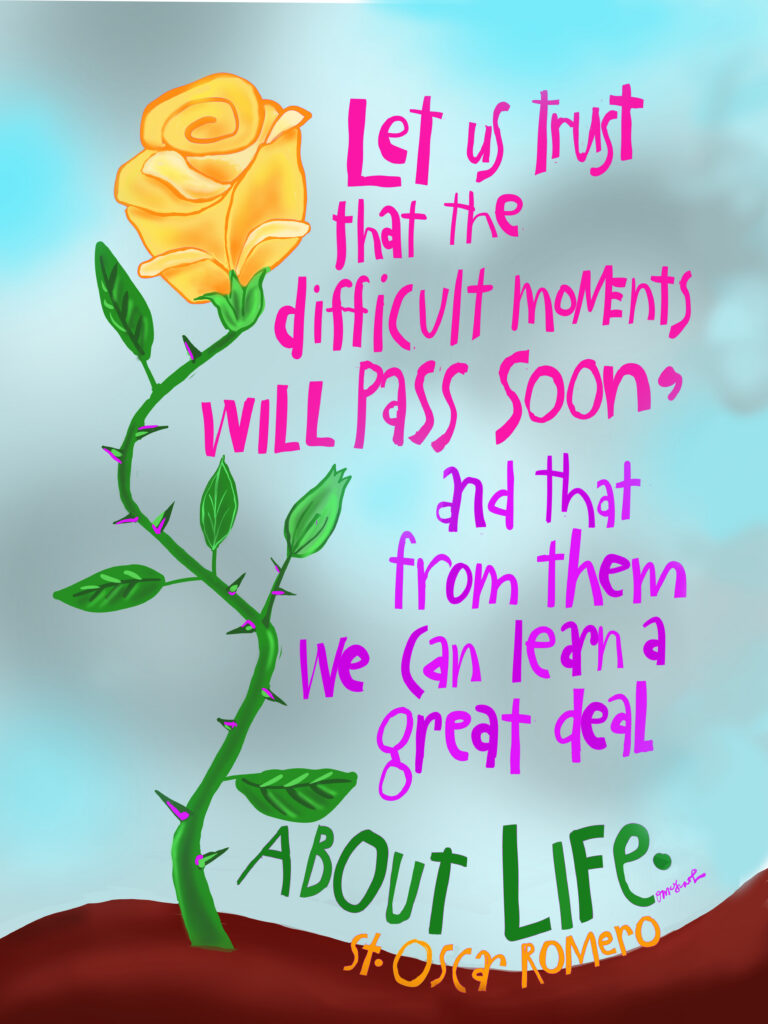
This March 24 will mark the forty-sixth anniversary of St. Óscar Romero’s death. His canonization by Pope Francis in 2018 made him the first designated martyr of the post-Vatican II era. One of the things I love best about St. Óscar was his ability and willingness to evolve with the flow of the Holy Spirit, even when it seemed impossible to do. Such challenging times of change introduce us to our true selves, the selves we were created to be in God’s image and likeness. Our true selves alone bring us joyful peace of mind in the face of fear, anger and resentment—emotions all too prevalent in our world today.
One of the things I love best about St. Óscar was his ability to evolve with the flow of the Holy Spirit, even when it seemed impossible to do.
Óscar was born into a very modest family in rural El Salvador. There, he was apprenticed to a carpenter and learned to make doors and tables as a young boy. After time in a minor seminary, he studied theology in Rome during World War II where hunger, fear and air raid sirens were a daily reality until his ordination in 1942 at 24 years old. Returning to El Salvador to serve as a parish priest, Fr. Óscar developed a love for the poor of his parish as well as a love for Ignatian spirituality. While he wasn’t entirely comfortable with the changes in clerical life Vatican II brought, he was even more disturbed by the tenets of liberation theology that emerged after the Medellin Conference. These new principles emphasized the modern priest’s primary role as a promoter of social justice and change.
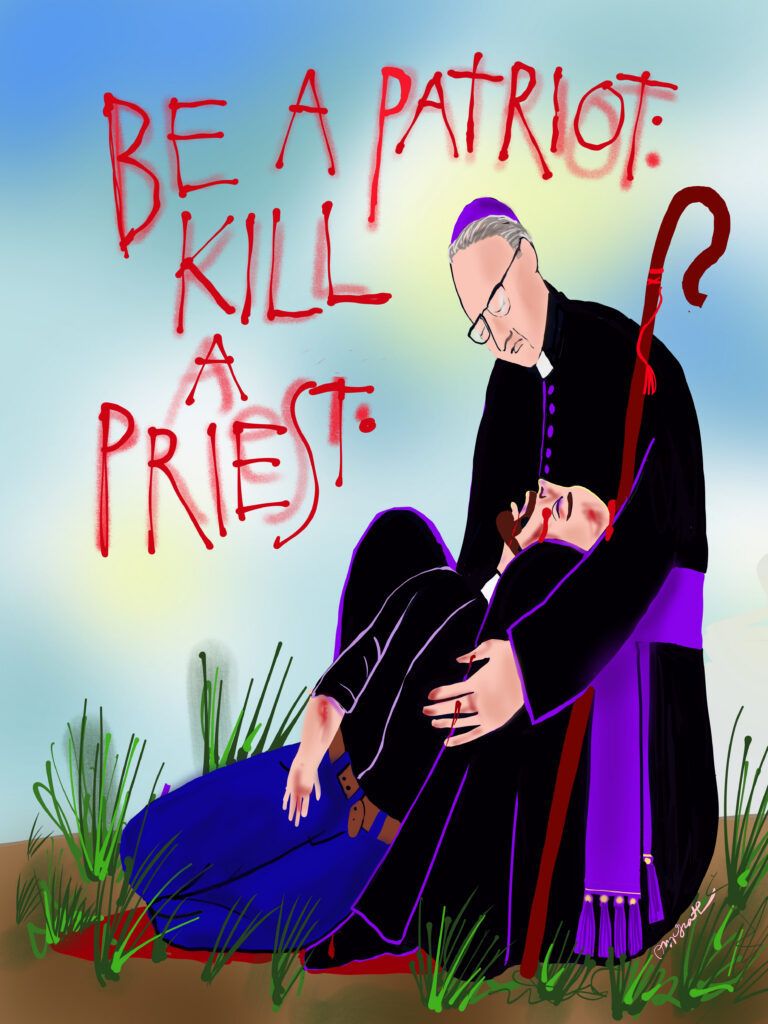
However, Óscar’s attitude changed as growing numbers of innocent peasants and pastors were tortured and killed by the National Guard under orders of the military dictatorship which ruled the country. Right wing death squads even circulated flyers with the words, “Be a patriot, kill a priest!” He could no longer hide behind the role of silent pastor when his dear friend Rutilio Grande, a Jesuit priest, was brutally assassinated while driving with several passengers down a country road. Rutilio had been targeted by the army because of his social justice work with the persecuted peasants of his parish.
Anyone who feels abused or threatened in our increasingly anxious world can find in St. Óscar Romero the calming voice of God’s presence.
Bishop Óscar’s unspeakable grief and sorrow led him to newer, deeper awareness of God’s loving presence and Christ’s passion. He was more determined than ever to be the loving shepherd his people needed. Through national radio broadcasts he delivered hope-filled homilies to the suffering people and refugees around El Salvador about Catholic social teaching; and about living with love in the midst of widespread violence and hatred. He celebrated funeral liturgies for murdered priests, sometimes with over one hundred concelebrants.
Because of the constant threats he received everywhere, St. Óscar was certain that his own assassination was inevitable. He prepared himself for it spiritually and mentally throughout the Lenten season of 1980, and preached about the ways in which our crucifixion experiences inevitably lead us to resurrection. He once said, “I wish to affirm that my preaching is not political. It naturally touches on the political and touches people’s real lives.” St. Óscar Romero was shot and killed at the altar while celebrating Mass, making the Body and Blood of Christ come alive in a disturbingly relevant and holy way. St. Óscar was canonized by Pope Francis in 2018.
Anyone who feels abused, shamed, threatened or riddled with anxiety for any reason whatsoever in our increasingly anxious world can find in St. Óscar Romero the calming voice of God’s presence within. As he once said, “There are many things that can only be seen through eyes that have cried.” With that in mind, we can become gifts for one another. St. Óscar Romero, pray for us.
Alfred Delp, S.J. (1907-1945)
Apparently, Alfred Delp was not the easiest guy to get along with in community. He could be an arrogant, self-important, loud-mouthed know-it-all who laughed too loudly and smoked way too many cigars. His request for final vows was turned down twice by his Jesuit provincial, but eventually, he tearfully professed them in a Nazi prison cell in the days leading up to his execution. An ironic location for such a blessed event. Hitler, of all the religious communities and orders he suppressed, had a most special loathing for the Jesuits. That same experience of imprisonment and torture by Nazis that helped him discover within himself the gentle, loving presence of God.
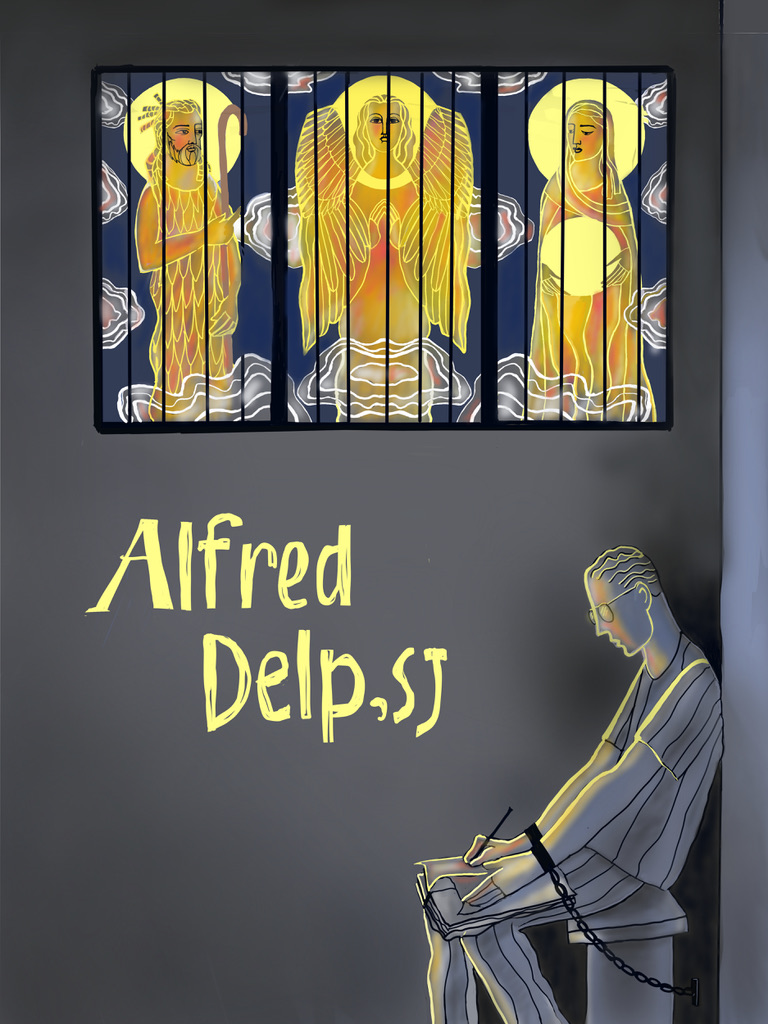
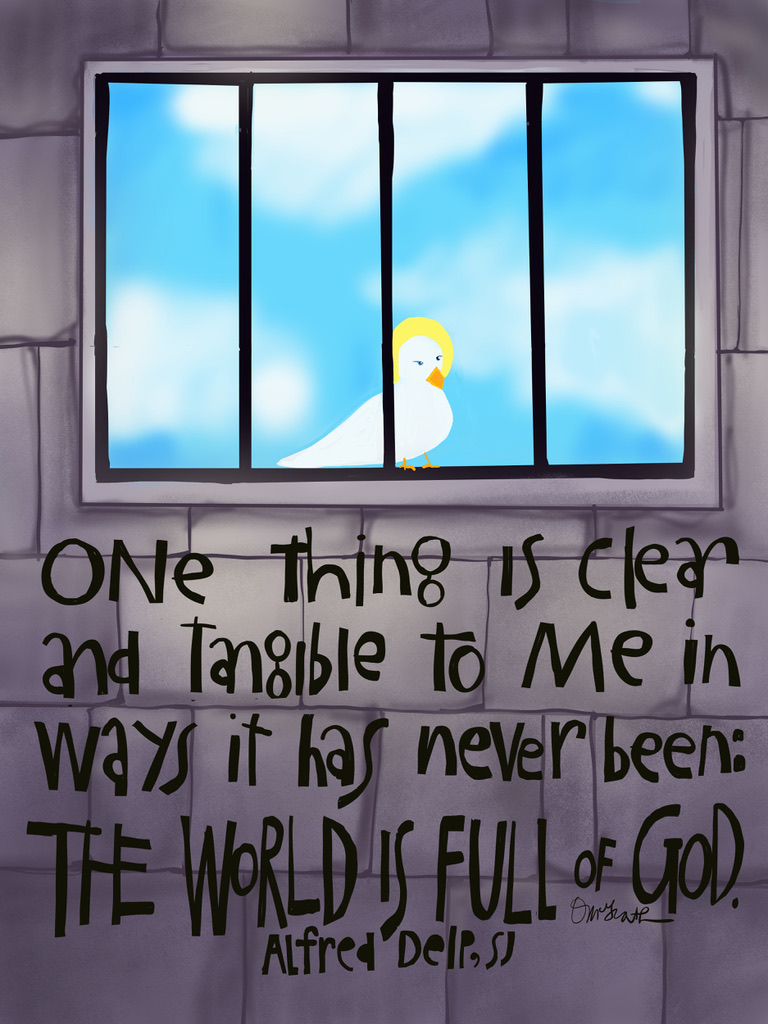
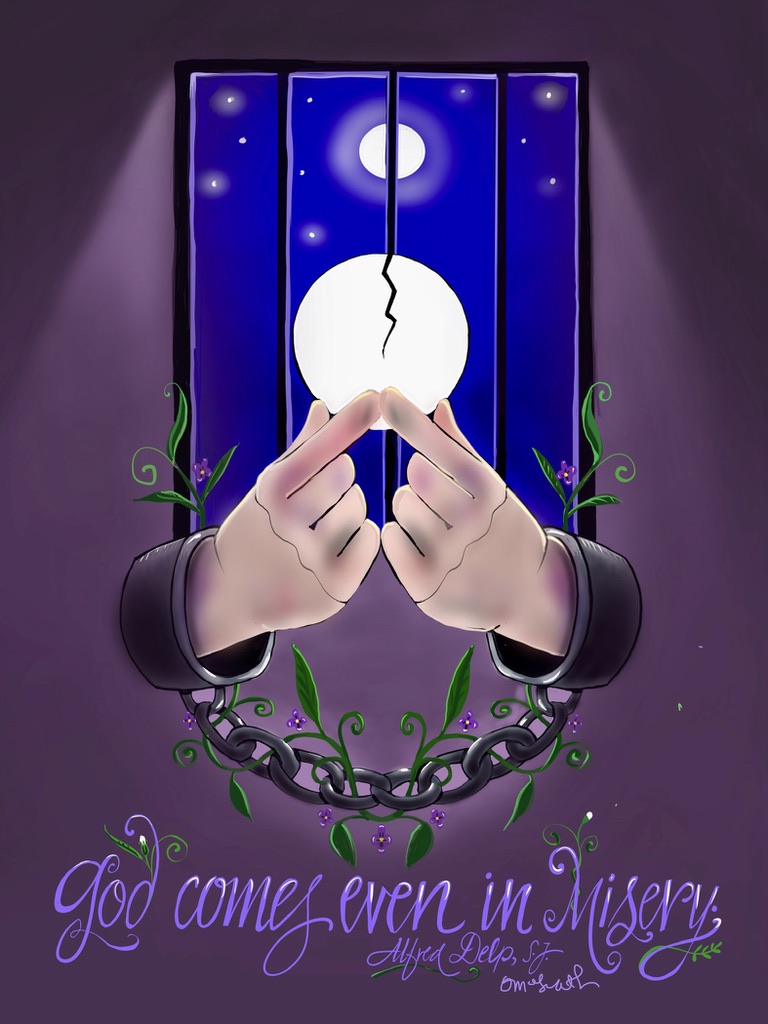
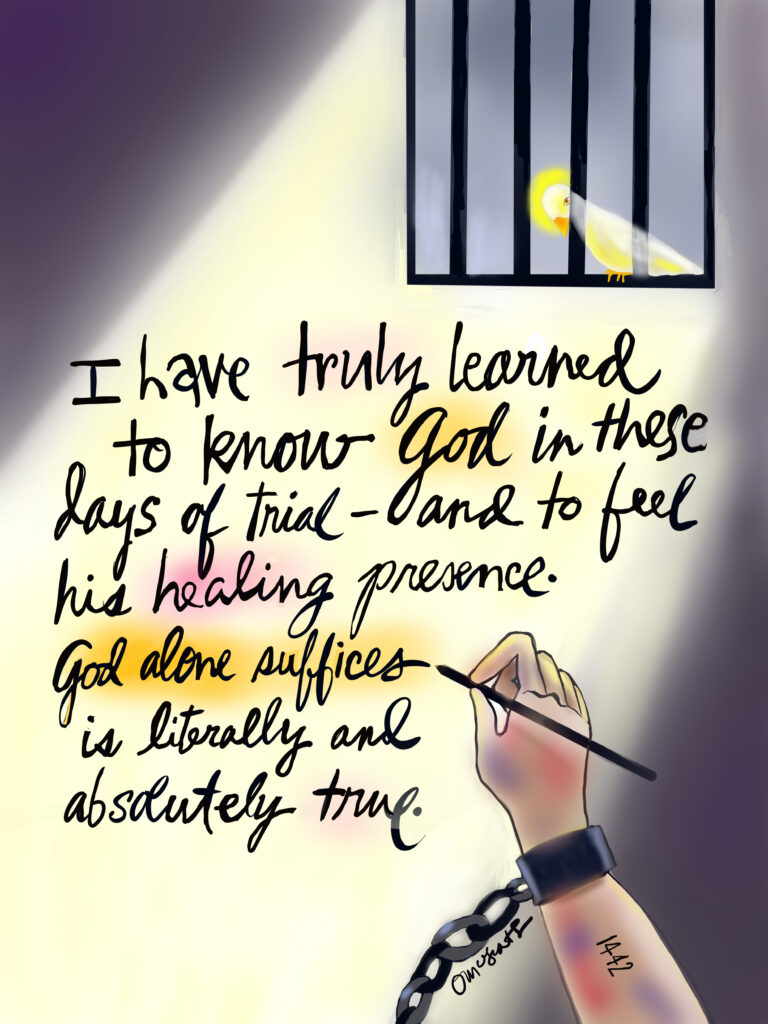
Alfred was convinced that the Nazis were an evil force that had to be reckoned with—one that caused lots of trouble for the Jesuits and their ministries. Alfred did not hide his disdain for the Nazis in his sermons at Mass. He helped Jews escape from Germany into Switzerland. Alfred even joined the Kreisau Circle, the same underground resistance group of which the martyred Lutheran pastor Dietrich Bonhoeffer was a member. When the Circle’s well planned assassination attempt on Hitler failed, all the known members of the Circle were imprisoned, subjected to mock trials and sentenced to death. Even though he was not part of the assassination plot, Alfred was jailed in Tegel Prison in Berlin where he was ultimately hanged.
Alfred’s short term in prison is most inspiring, as he was there throughout the Advent and Christmas seasons. While enduring torture and abuse, with hands handcuffed and chained to the wall, Alfred secretly wrote essays and homilies on the coming birth of Christ.
In his powerlessness and pain, he discovered inner peace and hope in the Incarnation.
He shared these reflections using paper and pens smuggled in by his two friends (both named Mary Anne) who were allowed to pick up and return his laundry. These secret allies also brought him unconsecrated hosts so he could secretly celebrate Mass alone in his cell. Alfred Delp was hanged on February 2nd,1945—the feast of the Presentation which marked the official end of the Christmas season.
In these days of ever-increasing anxiety, tension and fear—especially for the continuously marginalized groups of immigrants, people of color, gay and trans people, people experiencing homelessness and uninsured or underinsured people, victims of violence and victims of hatred—may the Jesuit priest Alfred Delp remind us that the Gospel and Catholic Social Teaching exist beyond politics. They serve as our only true source of peace in the midst of our storms. Amen.